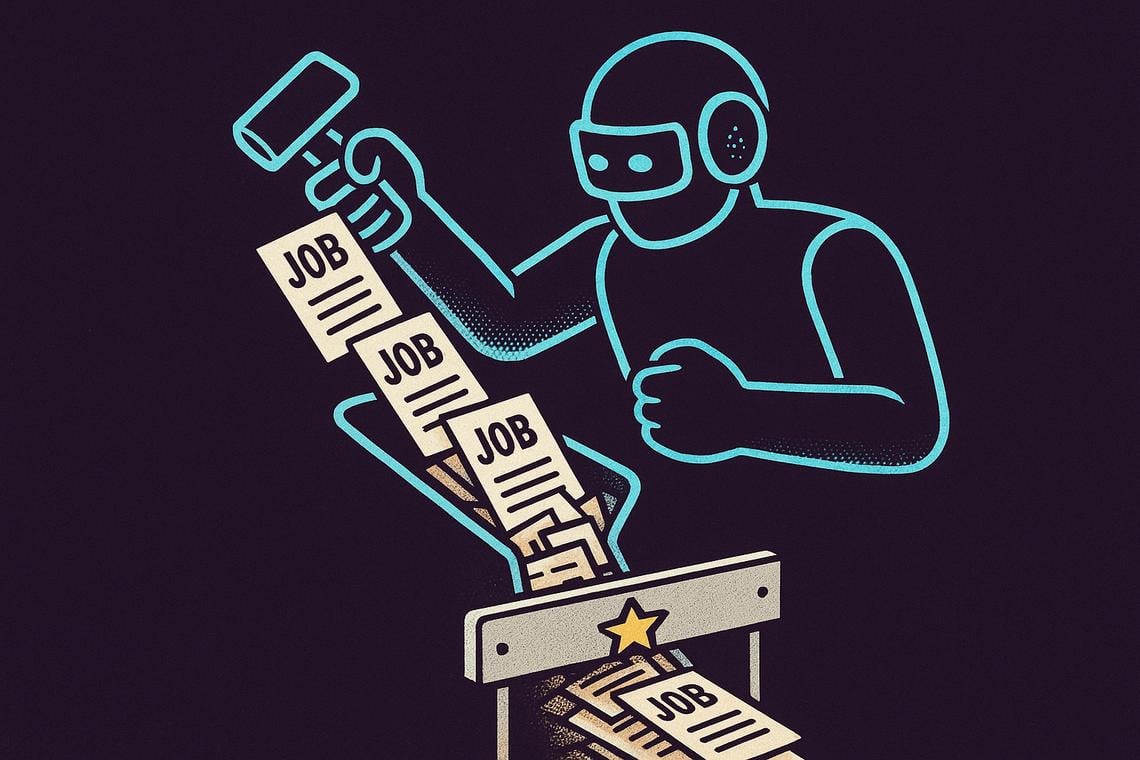
For a few dollars and a few clicks, job seekers have found a way to apply to every open role on Greenhouse simultaneously. The catch? Everyone else is doing the same thing — and it’s turning the hiring process into something barely functional for anyone involved. The man who runs Greenhouse, CEO Daniel Chait, has a name for what’s happening: the AI doom loop.
Summary
Key takeaways
- AI-powered mass application tools cost as little as $20 and can auto-submit to every job on Greenhouse’s platform.
- Greenhouse currently hosts 175,000 live jobs, with an average of 254 applications per job — pushing recruiter workloads up by 412%.
- The AI doom loop describes a self-reinforcing cycle: applicants spam more jobs, employers deploy AI filters, applicants spam even harder.
- Greenhouse’s new “My Dream Job” feature caps applicants at one priority flag per month and delivers roughly five times higher hire rates than standard applications.
- The company acquired Ezra AI Labs to introduce AI voice interviews for every applicant, aiming to make mass spamming impractical.
AI job applications are flooding the hiring pipeline
The numbers make the problem concrete. Greenhouse’s platform currently lists 175,000 live jobs, and each one receives around 254 applications on average. That volume has pushed the number of applications a single recruiter must process up by 412%, according to data shared by Chait with Fortune. Recruiters are now receiving hundreds or thousands of submissions within 24 to 48 hours of posting a role — far faster than any human team can meaningfully review them.
The root cause isn’t just more people job hunting. It’s that the friction of applying has nearly vanished. Chait described the mechanics plainly: “You can go search on Google, and there are tools that advertise, use AI to automatically apply to every Greenhouse job.” The price of entry for this kind of automated carpet-bombing? About $20. For that, a job seeker can send their profile to every open role on the platform without opening a single application form themselves.
When every application looks identical
Volume alone would be manageable with enough staffing. The deeper problem is what those applications actually look like. Because so many are AI-generated, Chait says, “they all start to look the same.” Cover letters blend together. Skills summaries echo each other. The signals that recruiters traditionally used to identify genuinely motivated candidates — specificity, tailoring, tone — evaporate when an algorithm is doing the writing.
For employers, this creates an almost impossible screening task. Distinguishing someone who spent an evening crafting a thoughtful application from someone who auto-applied overnight to a thousand jobs becomes, in practice, nearly impossible from the application alone.
The AI doom loop: how both sides made it worse
The AI doom loop is what happens when two rational responses to a broken system combine to break it further. Job seekers, exhausted by submitting applications into what Chait describes as a “black hole” with no response, turn to AI tools to increase their volume. Employers, overwhelmed by that flood of indistinguishable applications, turn to AI to filter and rank candidates automatically. Job seekers, now filtered out more aggressively, respond by sending even more applications. And so it spirals.
“Everyone’s using their own AI to solve their own problem,” Chait told Fortune, “but it’s making the whole system worse.”
What makes this dynamic analytically significant is that it isn’t irrational behavior from either side — it’s individually logical and collectively destructive. No single job seeker is wrong to use a $20 tool when hundreds of competitors are already using one. No single recruiter is wrong to deploy AI filters when the alternative is drowning in applications. The doom loop is a systemic failure, not a personal one, and that’s precisely what makes it hard to escape without a structural intervention.
The data beyond Greenhouse reinforces how severe the broader job market breakdown has become. In the U.K. alone, more than 1.2 million applications were submitted last year for fewer than 17,000 graduate roles, according to Fortune’s earlier reporting. Goodwill CEO Steve Preston has warned that the job center is bracing for a surge of jobless young people as AI begins displacing entry-level positions entirely.
Greenhouse’s two-part plan to break the cycle
Chait is clear that rolling back AI adoption isn’t the answer — the window for that closed long ago. Instead, Greenhouse has introduced two structural fixes designed to change the incentives on both sides of the hiring equation.
The “My Dream Job” feature and what it signals to employers
The first is a feature called “My Dream Job,” which allows a job seeker to flag a single role per month — across the entire Greenhouse platform — as their top priority. The scarcity is deliberate. By limiting each user to one flag, the feature forces a genuine choice and converts that choice into a credible signal for employers. Nearly half a million dream job applications have been submitted since the feature launched, and Chait says candidates who use it are hired at roughly five times the rate of standard applicants.
That multiplier matters. It suggests employers are actively responding to the intent signal, not just receiving it. In a world where most applications arrive with no meaningful differentiation, a verified expression of genuine preference carries real weight.
Acquiring Ezra AI Labs to make spamming impractical
The second move is more structural. Greenhouse recently acquired Ezra AI Labs, an AI voice-interviewing company, with the goal of giving every applicant — not just a shortlisted few — access to a conversational interview at the top of the funnel. The strategic logic is direct: “Why would I send out automatic thousands of job applications if every single one of them I have to take an interview for?” Chait said.
If applying automatically means being automatically interviewed, the economics of mass-applying collapse. The acquisition also targets a step Chait describes as riddled with bias: résumé screening. Eliminating it in favor of a voice interview for all applicants could, in theory, remove roughly six days from the average hiring timeline while reducing the subjective snap judgments that a paper résumé invites.
Job seeker strategies to stand out right now
While Greenhouse works on platform-level solutions, individual job seekers aren’t entirely without options. Two approaches, low-tech by design, are getting renewed attention precisely because they’re rare in an AI-saturated environment.
- Handwritten thank-you notes after interviews have become so uncommon that a Gen Z hiring manager recently highlighted their absence as notable. The effort signals something an AI cannot replicate: deliberate human investment in a specific opportunity.
- Networking directly with people inside target companies bypasses the application funnel entirely. Netskope CEO Sanjay Beri told Fortune that some of the best jobs are “never published” at all, and advised job seekers to network at least two to three times a week. “Who you know, how you get to know them, and building your network will pay off over time,” he said.
The underlying logic from both suggestions is the same: in a market where AI-generated applications have commoditized the application itself, demonstrating authentic, specific human interest in a company or role has become a competitive differentiator again — almost by accident.
Whether platform fixes like “My Dream Job” and AI voice interviews scale fast enough to meaningfully shift the incentive structure before the doom loop entrenches itself further is the question Greenhouse hasn’t fully answered yet. The feature data is promising, but half a million dream job applications against 175,000 live roles represents early adoption, not market transformation. The real test is whether employers start treating the intent signal as reliably as Chait’s hire-rate data suggests they already are.
FAQ
What is the “AI doom loop” in job hiring?
It’s a self-reinforcing feedback cycle where AI tools enable job seekers to flood platforms with mass applications, overwhelming recruiters, who then deploy AI to filter the volume. Overlooked candidates respond by applying to even more jobs, deepening the problem for both sides. Greenhouse CEO Daniel Chait coined the term to describe this dynamic.
How does Greenhouse’s “My Dream Job” feature help job seekers?
It allows each applicant to flag exactly one role per month across the entire Greenhouse platform as their top priority. The scarcity makes the signal credible to employers. According to Chait, candidates who use the feature are hired at roughly five times the rate of those who submit standard applications.
Why are AI-generated applications a problem for employers?
Because they tend to look nearly identical, making it extremely difficult to distinguish genuinely motivated candidates from those who auto-applied to thousands of roles overnight using a $20 tool. The uniformity erodes the screening value of applications entirely.
What advice do experts give job seekers to improve their hiring chances beyond applying?
Networking directly with people inside target companies is strongly recommended — Netskope CEO Sanjay Beri told Fortune that some of the best roles are never publicly posted. Handwritten thank-you notes after interviews are also highlighted as an increasingly rare gesture that signals genuine human investment in a specific opportunity.
Article produced with the assistance of artificial intelligence and reviewed by the editorial team.