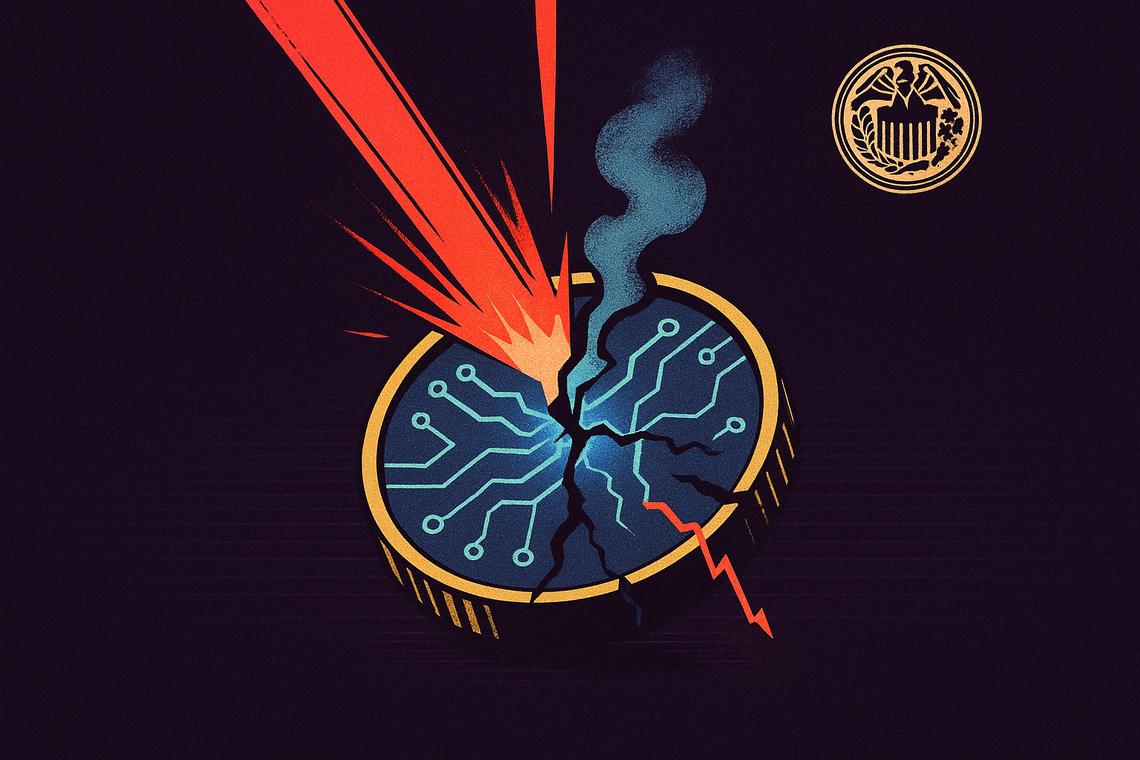
Something snapped in global markets on Tuesday, and AI fears were right at the center of it. Bitcoin dropped 2.7% to around $63,200 after the U.S. market close, dragged lower as a wave of selling swept through Asian tech stocks on concerns about whether the world’s massive bet on artificial intelligence infrastructure can actually hold up. The sell-off wasn’t just a crypto story — it hit semiconductors, futures, and chipmakers from Seoul to Amsterdam.
Summary
Key takeaways
- Bitcoin fell 2.7% to around $63,200 after the U.S. market close; Ether, XRP, and Solana also declined.
- South Korea’s Kospi plunged over 10%, with Samsung and SK Hynix each falling nearly 14%, triggered by China’s CXMT market debut and advances in domestic chip manufacturing.
- Nvidia shed about 5% after its AI-related financing commitments surpassed $750 billion, raising sustainability questions.
- The Federal Reserve begins a two-day meeting Tuesday with a rate decision Wednesday; traders price a 38% chance of a hike this week.
- The CLARITY Act was shelved in the Senate, pushing crypto regulatory clarity past the August 8 recess.
Cryptocurrency Prices Drop Amid Market Sell-Off
Bitcoin had been holding near $65,000 before Tuesday’s move lower. The drop to around $63,200 came as Asian markets opened to sharp selling, pulling crypto prices down alongside tech equities. Ether, XRP, and Solana all followed Bitcoin’s slide, underscoring how correlated digital assets have become to broader risk sentiment.
The speed of the move matters. When AI fears grip institutional investors, the sell-off doesn’t stay contained to one asset class. Crypto markets, now increasingly intertwined with the same macro forces driving tech stocks, absorbed the shock almost in lockstep with semiconductor names.
South Korean Tech Stocks Plunge on Chinese Competition
The single most dramatic market story of the session came out of Seoul. South Korea’s Kospi index plunged more than 10% — its steepest single-day fall in recent months, now down 25% from its mid-June peak. The index wasn’t just numbers moving on a screen; it represented a fundamental reassessment of who controls the next chapter of global chip manufacturing.
Samsung and SK Hynix Share Prices Drop Sharply
Samsung Electronics fell over 13% and SK Hynix plunged 14.65% at the close, according to CNBC. The broader damage extended further: Samsung SDI dropped 11.37%, LG Innotek fell 16.29%, Seoul Semiconductor shed 8.78%, and LG Chem lost 7.5%. Japan’s chip names weren’t spared either — Tokyo Electron dropped nearly 11%, Advantest slid over 10%, and Kioxia plunged more than 18%.
Samsung and SK Hynix are among the world’s largest suppliers of high-bandwidth memory chips used in AI servers, which makes their shares acutely sensitive to any shift in expectations for U.S. hyperscaler spending. When those expectations wobble, the stocks don’t just dip — they crater.
Impact of China’s CXMT Market Debut
The trigger was two-pronged. China’s CXMT made a blockbuster market debut, signaling growing confidence in domestic Chinese memory chip production. Separately, reports emerged that a Chinese company is manufacturing an immersion deep ultraviolet lithography machine — a space long dominated by ASML, which itself fell more than 8% on Monday and continued lower in European trade Tuesday.
The broader implication is hard to overstate. Investors who had positioned heavily in South Korean chipmakers were essentially betting that China’s semiconductor ambitions would remain constrained. That thesis just took a serious hit. As Acadian Asset Management’s senior vice president Owen Lamont told CNBC, “Right now we’re facing an incredible uncertainty. No one has any idea how this AI process is going to affect our economy, and so I think it’s going to be rocky no matter what.” He also flagged that leveraged ETFs in Korea, Hong Kong, and the United States may be magnifying market swings beyond what fundamentals alone would justify.
Standard Chartered’s chief investment officer for equities Sundeep Gantori offered a more measured view, noting that some broker reports pointing to a memory price peak in 2027 were also weighing on sentiment. But he added that “the market opportunity remains sufficiently large for multiple players to benefit and coexist,” and that at current valuations, the risk-reward picture for leading names has actually improved.
AI Spending Concerns Weigh on Nvidia and Tech Sector
Nvidia fell around 5% on Monday after its AI-related financing commitments surpassed $750 billion, raising fresh questions about the sustainability of the AI infrastructure buildout. The number is staggering, and markets are starting to ask whether the return on that investment can justify the scale of the bet.
Tesla and Alphabet had already flagged elevated AI costs in last week’s earnings reports. The spotlight now shifts to Microsoft, Meta, Apple, and Amazon, all reporting later in the week. Their guidance on AI spending will either calm nerves or confirm that the entire sector is heading into an overcapitalization cycle. Nasdaq 100 futures fell 1% in Asian trading Tuesday, while S&P 500 futures slipped 0.3%.
What makes this moment analytically significant is the feedback loop now visible between U.S. AI investment narratives and Asian hardware stocks. The weakness in Seoul and Tokyo isn’t disconnected from Nvidia’s slide — it reflects the same underlying anxiety. If U.S. hyperscalers pull back on data center spending, the demand for high-bandwidth memory chips collapses. That’s why Samsung and SK Hynix moved so violently on news that didn’t directly involve them.
Federal Reserve Meeting and Crypto Regulation Delay
The Federal Reserve began its two-day policy meeting on Tuesday, with a rate decision expected Wednesday. Markets mostly expect rates to stay on hold, but traders are currently pricing in a 38% chance of a hike this week and an 80% probability of a September increase. Core PCE and GDP data follow on Thursday, making this a uniquely compressed window of volatility for rate-sensitive assets.
For crypto markets specifically, the macro overhang combines with a regulatory setback. The CLARITY Act was pushed aside in the Senate to make room for a Russia sanctions bill. A vote is now unlikely before the August 8 recess, delaying the kind of regulatory framework that the industry had expected to open the door for institutional buying. The postponement doesn’t kill the bill, but it resets the timeline at a moment when crypto markets needed positive catalysts, not more uncertainty.
Elsewhere, oil prices declined after the U.S. and Iran paused hostilities, with President Trump stating that talks were ongoing and a deal was possible. Johnson & Johnson announced a proposed $5.5 billion settlement over ovarian talc litigation. The FAA proposed inspections on hundreds of Boeing 737 MAX aircraft over incorrectly installed seats.
The coming 48 hours will be defining. A Fed hold on Wednesday combined with cautious AI spending guidance from the major tech earners could either stabilize sentiment or confirm that the market’s faith in unlimited AI infrastructure growth has a real ceiling — one that no single rate decision can paper over.
FAQ
Why did Bitcoin and other cryptocurrencies fall recently?
Bitcoin dropped 2.7% to around $63,200 after the U.S. market close, with Ether, XRP, and Solana also falling. The move came amid a broader sharp sell-off in Asian markets driven by AI-related concerns, particularly fears about the sustainability of heavy AI infrastructure spending.
What caused the sharp decline in South Korea’s Kospi index and tech stocks?
South Korea’s Kospi plunged over 10%, with Samsung and SK Hynix each falling nearly 14%. The primary triggers were China’s CXMT blockbuster market debut and reports of advances in domestic Chinese chip manufacturing, which unsettled investors heavily positioned in South Korean chipmakers.
How is AI infrastructure spending affecting Nvidia and tech stocks?
Nvidia shares fell about 5% after its AI-related financing commitments surpassed $750 billion, raising concerns about whether such heavy AI infrastructure spending is sustainable. Tesla and Alphabet had also flagged elevated AI costs the prior week, with Microsoft, Meta, Apple, and Amazon reporting later in the week.
What is the status of the Federal Reserve’s upcoming rate decision and crypto regulation?
The Federal Reserve began a two-day meeting Tuesday with a rate decision expected Wednesday. Markets mostly expect rates to hold, but traders are pricing in a 38% chance of a hike this week. On the regulatory front, the CLARITY Act was shelved in the Senate, delaying crypto regulatory clarity until after the August 8 recess.
Article produced with the assistance of artificial intelligence and reviewed by the editorial team.