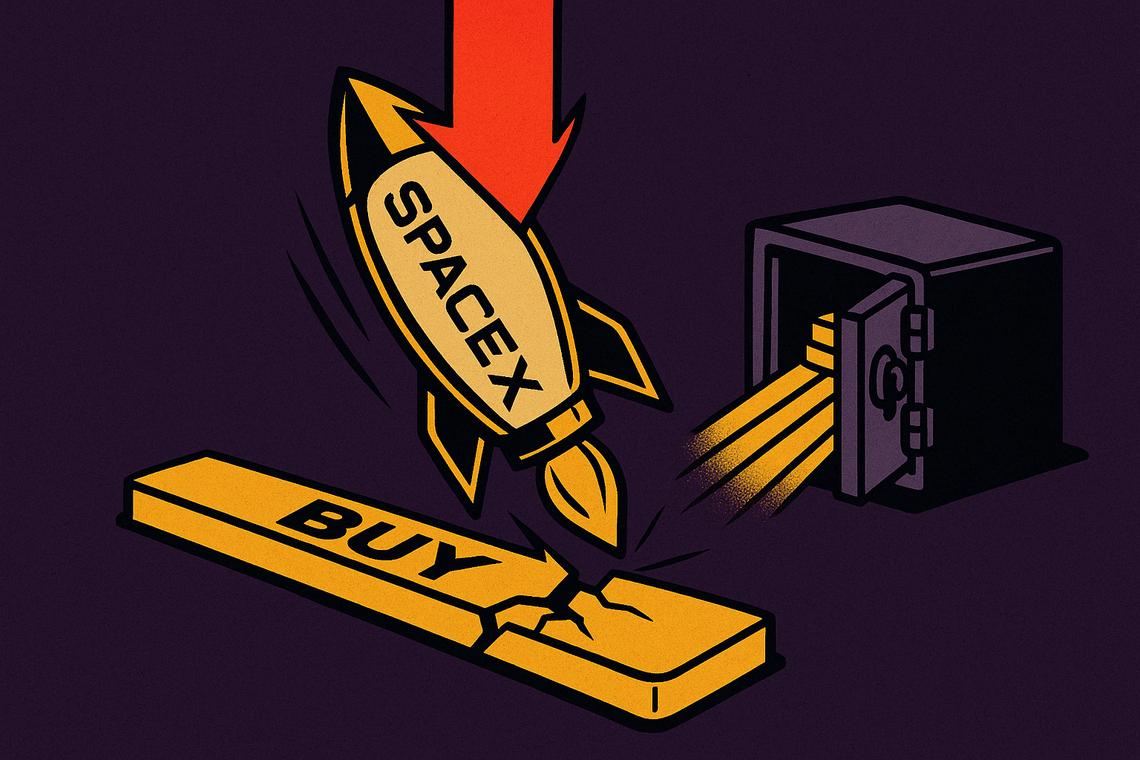
When a stock loses half its value in less than two months, most investors head for the exits. Cathie Wood does the opposite. As the SpaceX share decline deepened on Monday — with shares sliding another 1.4% to $113.50, now trading below the IPO price of $135 — Wood’s ARK Investment Management moved aggressively to accumulate more.
Summary
Key takeaways
- ARK Investment Management purchased 124,543 SpaceX shares worth $14.1 million across four ETFs as shares fell below their IPO price.
- SpaceX stock has dropped from a June peak of $225.64 to $113.50, erasing over $1.2 trillion in market value.
- SpaceX releases its first public earnings report on August 4, followed two days later by a potential lockup expiration that could release up to 911.5 million shares.
- Raymond James holds a Strong Buy rating with an $800 price target, implying more than 600% upside from current levels.
- The 13th Starship flight completed key objectives but the Super Heavy booster failed its landing burn, underscoring ongoing reusability challenges.
SpaceX’s Share Price Fall and Market Impact
The numbers are staggering. SpaceX went public at $135 per share, briefly soared past $225, then collapsed. The drop from the June high of $225.64 to the current $113.50 has wiped out more than $1.2 trillion in market value — a figure roughly equivalent to the entire market capitalization of Tesla at the time.
That kind of drawdown, at that speed, rattles even experienced investors. The stock has now declined in 13 of its last 16 trading sessions. Retail bearish sentiment is rising, and the pressure heading into two critical August events is palpable.
What makes this situation particularly unusual is that the sell-off is happening not against a backdrop of operational failure, but alongside continued technical achievements. The company’s fundamentals haven’t collapsed — the market’s patience has.
Cathie Wood’s ARK Investment Management Buys the Dip
Rather than reading the sell-off as a warning, Wood treated it as an entry point. ARK’s move represents a deliberate bet that the market is mispricing a generational asset.
Details of ARK’s Purchases
On Monday, ARK purchased 124,543 SpaceX shares worth approximately $14.1 million, spreading the position across four funds: the ARK Innovation ETF, the ARK Autonomous Technology and Robotics ETF, the ARK Next Generation Internet ETF, and the ARK Space and Defense Innovation ETF. According to The Motley Fool, ARK’s total SpaceX purchases recently reached $21.3 million when combined across multiple buying days.
SpaceX accounts for around 4.5% of the ARK Innovation ETF’s invested assets, making it one of the fund’s more meaningful holdings.
Context of ARK’s Portfolio Movements
The SpaceX purchases weren’t made in isolation. ARK also bought 27,864 Tesla shares worth roughly $8.6 million through two of its ETFs, effectively doubling down on two high-conviction growth names simultaneously. To fund part of the activity, ARK sold 9,407 shares of Deere and Co, valued at $5.9 million, and offloaded 72,497 shares in 10X Genomics, worth around $3.4 million.
The portfolio rotation tells a story: Wood is concentrating into what she sees as transformative long-term opportunities while trimming more conventional or speculative positions. Whether that proves wise depends heavily on what happens in the next two weeks.
Wood has been vocal about her conviction. After the latest Starship test flight, she posted on X: “Bull markets do not end in this way. They end when everyone believes the sky is the limit.” The implication was clear — she sees the current pessimism as a feature, not a bug.
Progress and Challenges in SpaceX’s Starship Program
The 13th Starship test flight delivered a mixed but broadly positive result. SpaceX successfully deployed operational Starlink V3 satellites, relit a Raptor engine in space, and achieved an intact splashdown while maintaining telemetry data throughout the flight. These are genuinely meaningful milestones.
The weak point was the Super Heavy booster, which failed to complete a successful landing burn — a setback for the full reusability goals that underpin the program’s long-term economics. Raymond James, which maintained its Strong Buy rating, called the overall flight an incremental step toward full reusability, suggesting the booster failure doesn’t change the long-term thesis but does indicate the program still has meaningful engineering hurdles ahead.
Wood described the splashdown as potentially “game-changing,” emphasizing that progress on Starship directly supports the broader commercial and AI infrastructure opportunities she sees as SpaceX’s core value driver. Morgan Stanley, which was an IPO underwriter, has projected SpaceX’s revenue could grow from $18.7 billion in 2025 to $319 billion by 2030, with nearly all of that growth driven by its AI division.
Upcoming SpaceX Events and Market Implications
The next ten days are arguably the most consequential in SpaceX’s short public market history. Two back-to-back events will test whether the current share price represents a floor or a starting point for further declines.
First Public Earnings Report on August 4
SpaceX will release its first earnings report as a public company on August 4. Given that the company remains unprofitable — and has never before disclosed financials at this level of public scrutiny — the report will shape expectations significantly. Nearly 30 analysts currently cover the stock, with a median 12-month price target of $243.81, roughly 111% above the current price, according to The Motley Fool. The range, however, is extreme: one analyst carries a $800 target while another rates it a sell with a $115 target.
IPO Lockup Expiration and Share Availability
Two days after the earnings release, on August 6, up to 911.5 million locked-up SpaceX shares could become eligible for sale in the first tranche of the post-IPO lockup expiry. That represents a massive potential increase in float. Elon Musk and certain other insiders remain subject to longer-term restrictions, but the sheer volume of shares that could enter the market creates a significant supply overhang — one that could amplify any negative reaction to the earnings report or suppress any positive momentum.
This combination of events creates a narrow but volatile window. Earnings could surprise to the upside; the lockup could produce less selling than feared. Or both events could compound the existing pressure on an already fragile stock.
Investor Sentiment and Market Analyst Perspectives
Raymond James Rating and Price Target
Raymond James maintains the most bullish published target, rating SpaceX a Strong Buy with an $800 price target — a figure that would represent more than 600% upside from current levels. The firm framed the 13th Starship flight as directionally positive for the reusability thesis, even with the booster failure.
Long-term and Contrasting Investor Views
Long-term investor Ron Baron sits at the far end of the conviction spectrum. His firm held $25 billion in SpaceX as of June, out of $70 billion in total assets. Baron Capital invested $2 billion across 27 transactions since 2017, then added another $1 billion at IPO. Baron himself has projected SpaceX could eventually reach a valuation of $20 trillion to $40 trillion over the next 10 to 15 years — a claim that requires extraordinary growth assumptions but reflects the breadth of SpaceX’s stated addressable markets. The company’s own IPO prospectus identified a total growth opportunity of $28.5 trillion, with more than 90% tied to AI infrastructure.
Not everyone is equally committed. Ross Gerber of Gerber Kawasaki said his firm avoided the IPO entirely but acknowledged the selloff could eventually make SpaceX “a bargain” sometime in the next year — a more cautious framing that suggests even skeptics are watching the price action closely.
The gap between ARK’s aggressive buying and Gerber’s wait-and-see posture illustrates the central tension surrounding SpaceX right now. The technology is progressing. The commercial opportunity is enormous. But with a potential wave of insider shares entering the market days after a debut earnings report, the stock’s near-term path runs directly through two events that neither bulls nor bears can fully control.
FAQ
Why is ARK Investment buying SpaceX shares despite the stock price decline?
ARK sees the current price dip as a buying opportunity, supported by Cathie Wood’s confidence in SpaceX’s long-term potential and ongoing Starship developments. Wood has publicly framed the sell-off as typical of bull market corrections rather than a fundamental deterioration.
What upcoming events might affect SpaceX’s stock performance?
SpaceX will release its first public earnings report on August 4, and up to 911.5 million locked-up shares could become available for sale after the lockup expiration on August 6. Both events carry the potential to move the stock significantly in either direction.
What was the outcome of SpaceX’s recent Starship test flight?
The 13th Starship flight completed most major objectives, including deploying Starlink V3 satellites, relighting a Raptor engine in space, and achieving an intact splashdown. However, the Super Heavy booster failed to complete a successful landing burn, leaving full reusability as a work in progress.
How do analysts view SpaceX’s stock price potential?
Raymond James rates SpaceX as a Strong Buy with a price target of $800, implying over 600% upside from current levels. The broader Wall Street consensus, based on nearly 30 analysts, carries a median 12-month price target of $243.81, roughly 111% above the current price, though individual estimates range from $115 to $800.
Article produced with the assistance of artificial intelligence and reviewed by the editorial team.