



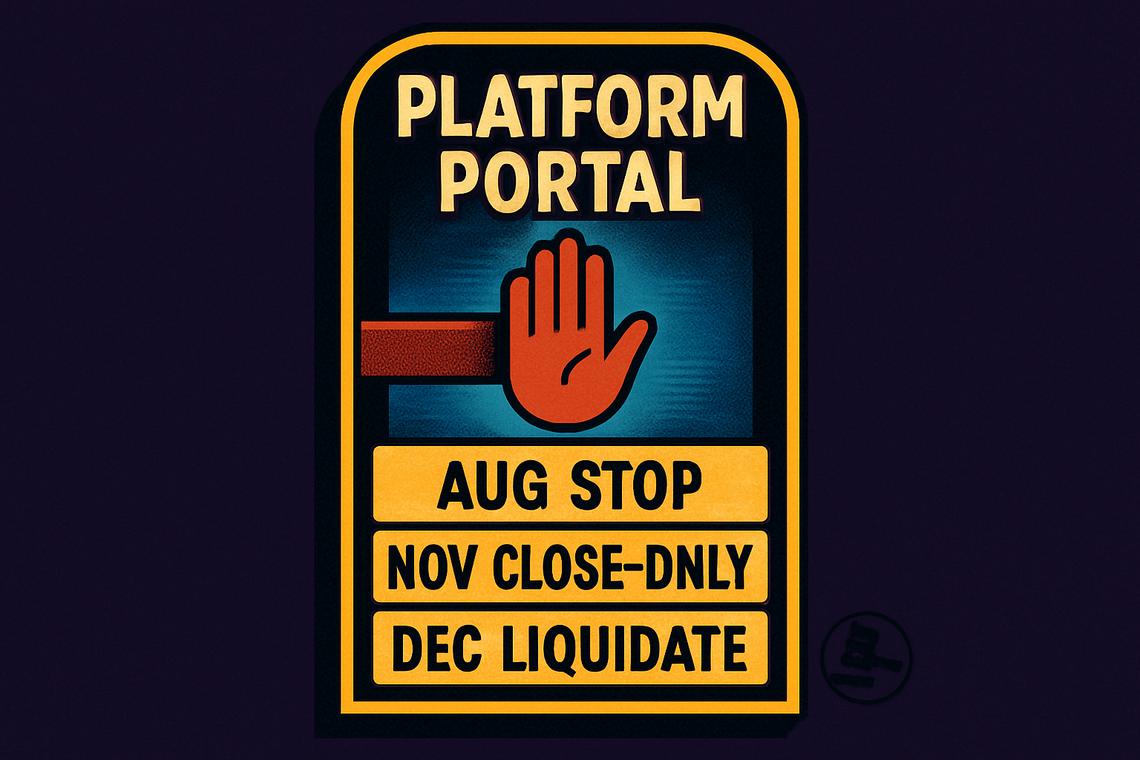
Bitget is shutting the door on Japan. The world’s fifth-largest crypto exchange by trading volume has begun a staged exit from the Japanese market, a move that traces directly back to a tightening web of regulation that made staying put far riskier than leaving. The Bitget Japan exit unfolds over several months, with new account sign-ups already frozen, trading restrictions arriving in November, and a hard deadline by year-end that will force the closure of any positions still open.
Summary
Key takeaways
- Bitget halted new registrations from Japanese residents on August 3, 2026, the first step in a phased withdrawal from the country.
- Starting November 1, 2026, at 11 a.m. JST, Japan-linked accounts will enter close-only mode, losing access to spot trading, futures, P2P, copy trading, and more.
- Any positions still open by December 31, 2026 will be forcibly liquidated at market prices, with card services suspended the same day.
- Japan’s parliament reclassified Bitcoin and 104 other cryptocurrencies as financial instruments on July 15, 2026, with the broader law taking effect in fiscal 2027.
- A related provision raising criminal penalties for unregistered exchange operators, effective around August 4-5, 2026, pushed maximum prison terms to ten years and fines to ¥10 million.
Bitget Ends Services for Japanese Residents
Bitget’s decision to pull out of Japan comes down to compliance math that stopped adding up. According to a company notice cited by CoinDesk, the exchange said it would stop providing crypto trading services to Japanese residents to comply with local regulations, without naming a specific regulatory trigger.
The wind-down follows a clear, dated sequence. New registrations from Japan stopped on August 3, 2026. From there, the exchange set two more checkpoints that Japanese users need to watch closely.
Close-Only Mode and Forced Liquidation Timeline
Beginning November 1, 2026, at 11 a.m. Japan Standard Time, any account identified as belonging to a Japan resident moves into close-only mode. That means no opening or adding to positions, and no access to spot trading, futures, P2P trading, convert, earn products, card services, copy trading, or trading bots. Deposits remain available with limits, and both crypto and fiat withdrawals stay open during this phase.
Then comes the final cutoff. On December 31, 2026, at the same time of day, Bitget will forcibly liquidate any remaining open positions and suspend card services. According to the company’s FAQ, crypto withdrawals will remain available even after that date, giving users a window to retrieve funds after the forced closures.
Regulatory Changes Driving Bitget’s Exit
The timing of the Bitget Japan exit lines up almost exactly with a legal shift that dramatically raised the cost of noncompliance. Japan’s National Diet passed sweeping digital asset legislation on July 15, 2026, reclassifying Bitcoin and 104 other cryptocurrencies as financial instruments under the Financial Instruments and Exchange Act. CoinDesk reported that the broader framework is expected to take effect in 2027 and includes fines around $62,800 alongside prison terms of up to ten years for operating without registration.
While the main law phases in over the next year, a narrower provision moved faster. It raised penalties for operating an unregistered exchange have been increased from a maximum of three years imprisonment and ¥3 million to ten years and ¥10 million, and it took effect roughly 20 days after promulgation, landing around August 4 to 5, 2026. Any exchange still serving Japanese residents without Financial Services Agency registration after that point faced a penalty regime roughly triple the previous severity.
That single detail helps explain why Japanese crypto regulation suddenly became an existential issue for an offshore platform like Bitget rather than a background compliance task.
A Pattern of FSA Warnings Since 2023
This wasn’t a surprise crackdown. Japan’s Financial Services Agency first warned Bitget in March 2023 for operating without registration under the Payment Services Act, and CoinDesk noted that Bitget, Bybit, BitForex, and MEXC all received similar 2023 warning letters over the same issue. A second round arrived in November 2024, when the FSA named Bitget alongside Bybit, MEXC Global, KuCoin, and Bitcastle in near-identical notices.
The agency escalated further in February 2025, asking Apple and Google to remove the apps of all five exchanges from Japanese app stores. In June 2025, Japan’s Kanto Local Finance Bureau separately warned BTG Technology Holdings Limited, the corporate entity behind the exchange, over unregistered solicitation of over-the-counter derivatives transactions. Bitget never secured FSA registration, and this exit is effectively the resolution of that three-year-long gap.
Implications and Guidance for Bitget’s Japanese Users
For anyone with a Japan-linked Bitget account, timing now matters more than anything else. The exchange said users who receive a specific notification on or after September 17, 2026 will be preliminarily treated as Japan residents, while those who don’t receive that notice around the same date won’t be classified that way by default.
Residency Verification Process
Users who believe they’ve been incorrectly flagged as Japan residents Users may fulfill Level 2 identity verification requirements by providing documentation of residence, including statements from financial institutions, energy bills, or official tax records, matching their existing KYC documents. Bitget clarified that this verification can still be submitted after November 1 if needed, though the company recommends doing it earlier to avoid any disruption to account access in the meantime.
The practical guidance is straightforward: watch for that September notification, correct any misidentification as soon as possible, it is advisable to liquidate positions and transfer assets prior to the November 1 read-only cutoff date, rather than deferring action until the more restrictive December 31 liquidation deadline. Bitget’s FAQ indicates crypto withdrawals will stay available even after positions are force-closed, but relying on that window rather than acting early carries obvious downside if plans change.
Broader Market Context of Crypto Regulation in Japan
Bitget isn’t the only offshore platform reading the room this way. Bybit began phasing out its own Japan-facing services earlier in 2026 under similar FSA pressure, having already collected warnings in 2021, 2023, and 2024. The pattern suggests that FSA crypto compliance demands have become a genuine line in the sand for exchanges without local licenses, rather than a slow-moving bureaucratic threat.
Other Exchanges Exiting or Restricting Japan Services
Japan currently counts approximately 28 to 30 exchanges authorized by the FSA operate domestically, among them bitFlyer, Coincheck, GMO Coin, bitbank, SBI VC Trade, and Binance Japan. These platforms typically offer a narrower menu of 15 to 30 FSA-approved assets compared with the hundreds available on offshore exchanges, and their spot trading fees generally sit in the 0.10% to 0.15% range, well above Bitget’s stated rates as low as 0.01%. That gap in cost and asset selection is part of why offshore platforms attracted Japanese users in the first place, even without local registration.
Japan’s cautious posture toward digital assets isn’t new. The country’s current framework traces back to a 2017 amendment following the 2014 collapse of Mt. Gox, which at its peak handled more than 70% of global Bitcoin trading. Regulators tightened rules again following the 2018 Coincheck incident, during which $530 million worth of NEM tokens were compromised from an internet-connected storage system. Both episodes shaped a regulatory culture that treats unregistered platforms as a systemic risk rather than a minor gap.
Bitget itself remains a significant player globally. The exchange ranks fifth among centralized platforms by 24-hour trading volume, recently reported at roughly $714.7 million according to CoinDesk citing CoinGecko data, and held a 6.4% share of the top 10 exchanges in 2025 with 45.5% year-over-year volume growth, the second-fastest pace among major platforms. The company continues serving more than 150 million users across upwards of 150 countries and is reportedly pursuing licensing arrangements in other jurisdictions even as it steps back from Japan.
For an industry watching how offshore exchanges respond to tightening national rules, the cryptocurrency exchange closure in Japan offers a preview of what stricter enforcement can look like elsewhere: not a single ban, but a slow phase-out timed precisely around new legal thresholds, leaving users a narrow but defined window to act before their assets are moved for them.
FAQ
Why is Bitget stopping services for Japanese residents?
Bitget is exiting the Japanese market due to tightened regulations, including the reclassification of cryptocurrencies as financial instruments and sharply increased criminal penalties for exchanges operating without FSA registration.
What restrictions will Japanese Bitget accounts face starting November 1, 2026?
Accounts identified as belonging to Japan residents will move into close-only mode, prohibiting the opening or adding of positions and disabling spot trading, futures, P2P, copy trading, trading bots, and other services, while limited deposits and withdrawals remain available.
What should Japanese users do to avoid forced liquidation?
Users should verify their residency status, watch for Bitget’s official notification expected on or after September 17, 2026, and withdraw funds or close positions before the November 1 close-only mode begins rather than waiting for the December 31 forced liquidation deadline.
Can users correct a mistaken residency identification by Bitget?
Yes. Users who believe they’ve been incorrectly flagged can submit Level 2 identity verification with proof of address, such as a bank statement, utility bill, or tax certificate, and are advised to do so before November 1, 2026 to avoid disruptions to their account access.
Article produced with the assistance of artificial intelligence and reviewed by the editorial team.
