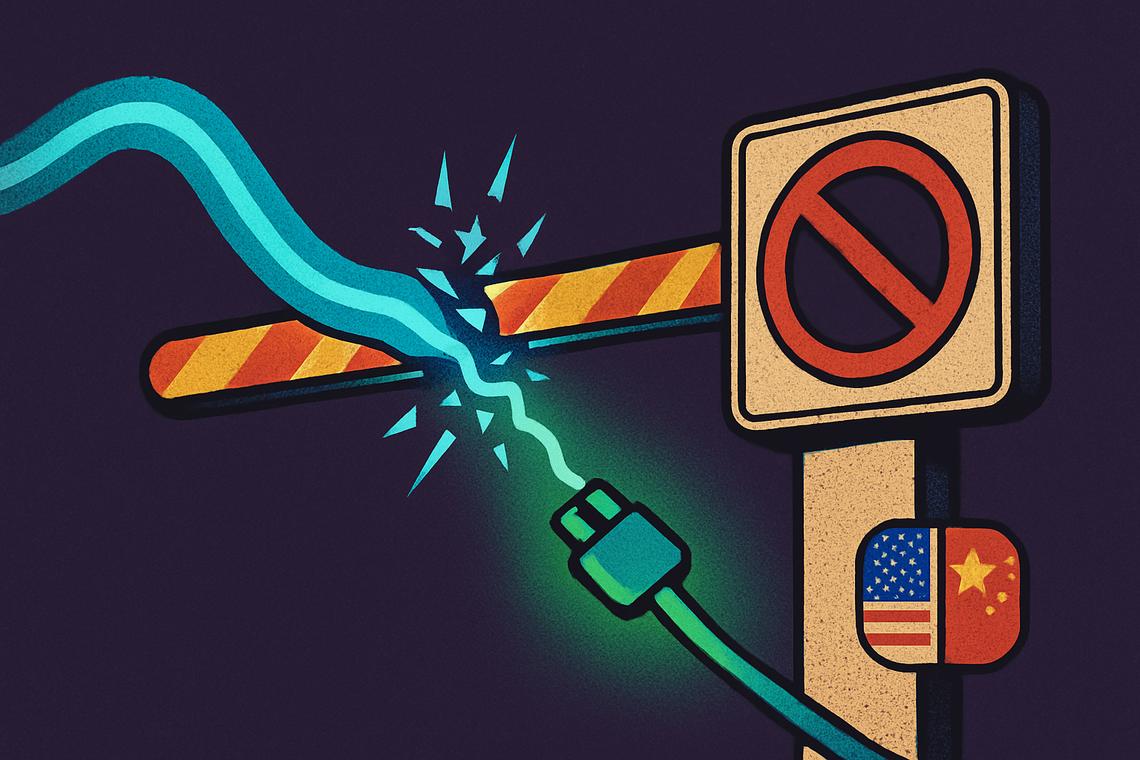
Mark Zuckerberg is drawing a clear line in an intensifying debate: when it comes to the US China AI competition, banning Chinese models is the wrong move. The Meta CEO argues that America’s best weapon is building better technology, not erecting barriers — a position that puts him at odds with much of Washington’s current posture.
Summary
Key takeaways
- Mark Zuckerberg says the US should out-innovate China in AI, not ban Chinese models.
- US AI models held 93% of global AI web traffic in August 2025, according to a RAND Corporation study across 135 countries.
- China’s share of global AI traffic surged from 3% to 13% in just two months following DeepSeek’s R1 launch in January 2025.
- US semiconductor export restrictions limit China’s access to chips like the Nvidia H200 and AMD MI325X, though their effectiveness is complicated.
- US AI dominance is backed by private capital and developer ecosystems; China leans on industrial policy and subsidized scale.
Meta’s stance: innovate, don’t restrict
Zuckerberg’s argument, reported by the Financial Times, is straightforward: the United States should not ban Chinese AI models. In his view, the right response to rising Chinese competition is doubling down on American innovation — not trade restrictions that could slow adoption or create a false sense of security.
This matters because the US currently sits in a position of genuine strength. A RAND Corporation study analyzing internet traffic across 135 countries found that American large language models accounted for roughly 93% of all global AI web traffic in August 2025. The total user base visiting top AI platforms exploded from around 2.4 billion in April 2024 to approximately 8.2 billion by August 2025 — growth that largely flowed to US-built products.
Zuckerberg’s logic is that banning Chinese AI while that kind of lead exists would be a strategic mistake. It would substitute a policy response for a technological one — and history rarely rewards that trade-off in fast-moving industries.
Where Washington disagrees
Not everyone in the US power structure sees it that way. Senior officials have framed AI rivalry with China in starker, more combative terms.
US Treasury Secretary Scott Bessent has stated plainly: “The U.S. is the AI leader in the world. We’re an AI superpower.” Interior Secretary Doug Burgum went further: “The U.S. cannot lose to China in the AI arms race.”
That framing — an arms race — reflects Washington’s instinct to treat AI competition as a zero-sum contest. According to analysis from Brookings, that framing misses important nuances. America’s AI advantage stems from large-scale commercial activity, private investment, and venture capital-backed innovation. China’s approach relies more heavily on industrial policy and building a self-reliant technology ecosystem. These are fundamentally different engines, and treating them as equivalent understates what the US actually has going for it.
DeepSeek’s R1 and China’s rapid rise in AI traffic
The clearest sign that Chinese AI is not standing still came in January 2025, when DeepSeek launched its R1 reasoning model. The impact on traffic data was immediate and dramatic.
According to RAND, China’s share of worldwide AI traffic jumped from roughly 3% to almost 13% in just two months — a 460% increase in traffic to Chinese AI platforms. In 30 countries, Chinese AI models captured more than 10% market share. In 11 markets, they reached at least 20% of total AI traffic, with particular strength in developing economies and nations with close economic ties to Beijing.
Cost is a significant driver. Chinese AI systems typically price at between one-sixth and one-fourth of comparable American models, and they have improved meaningfully in multilingual capability — an area where US platforms previously held a clear edge. That combination of price and language accessibility is precisely what makes Chinese models competitive in global markets outside North America and Western Europe.
RAND’s research also highlights something counterintuitive: this growth has been driven primarily by businesses, developers, and ordinary users rather than by top-down government AI diplomacy. Chinese AI adoption is spreading organically.
The hardware edge and semiconductor export controls
Despite China’s software gains, the US maintains a commanding lead in the hardware layer that powers AI development. Data from Epoch AI shows that Nvidia’s H100-equivalent accelerators still dominate global frontier AI computing capacity — a technological chokepoint that Washington has not been shy about exploiting.
The US currently restricts exports of advanced chips including Nvidia’s H200 accelerator and the AMD MI325X to limit China’s access to cutting-edge AI hardware. The Trump administration shifted to a case-by-case review process for H200 export requests in December 2025, according to the Center for Strategic and International Studies (CSIS). But the situation on the ground is more complicated than the policy suggests.
CSIS reported that even when US export licenses have been approved, Chinese customs authorities have told agents the chips were not permitted to enter. Beijing has simultaneously pushed domestic firms to prioritize local chip alternatives over imported US hardware.
This creates an odd dynamic: export controls may be limiting China’s access to state-of-the-art AI chips, but they are simultaneously accelerating China’s investment in domestic semiconductor production. The policy is doing two things at once — constraining and motivating.
The deeper strategic question
The real tension in this debate is about what kind of advantage actually matters in the long run. Web traffic share and model rankings are volatile metrics. The more durable competitive edge, as Brookings and others have suggested, likely lies in the developer ecosystem — the layer of applications, APIs, enterprise integrations, and workflows built on top of foundation models.
Consumer preferences can shift quickly. Enterprise adoption is stickier. Once a company has built its internal processes around a particular AI platform, switching costs are high. That structural lock-in is where US AI companies arguably have their most defensible position — and it’s the kind of advantage that bans don’t protect, but innovation does.
Zuckerberg’s argument, stripped to its core, is that America risks protecting the wrong thing. Focusing on restricting Chinese models while Chinese AI developers refine their cost structure, expand multilingual capability, and deepen their foothold in developing markets could leave US firms defending a shrinking perimeter rather than expanding a growing one.
FAQ
What is Meta CEO Mark Zuckerberg’s position on banning Chinese AI?
Mark Zuckerberg says the US should compete with China in AI through technology innovation rather than imposing a ban. He argues that building better products is the only sustainable path to long-term AI leadership.
How dominant are US AI models globally?
According to a RAND Corporation study covering 135 countries, US AI models accounted for approximately 93% of global AI web traffic in August 2025.
How has China’s AI market share changed recently?
China’s share of global AI web traffic rose from roughly 3% to nearly 13% in two months following the launch of DeepSeek’s R1 model in January 2025 — a traffic increase of around 460% for Chinese AI platforms.
What is the US government’s stance on AI competition with China?
Senior US officials consider AI leadership a national priority. Treasury Secretary Scott Bessent has described the US as “an AI superpower,” while Interior Secretary Doug Burgum has stated the US “cannot lose to China in the AI arms race.” Both favor maintaining and extending American dominance rather than allowing Chinese models to gain further ground.
Article produced with the assistance of artificial intelligence and reviewed by the editorial team.