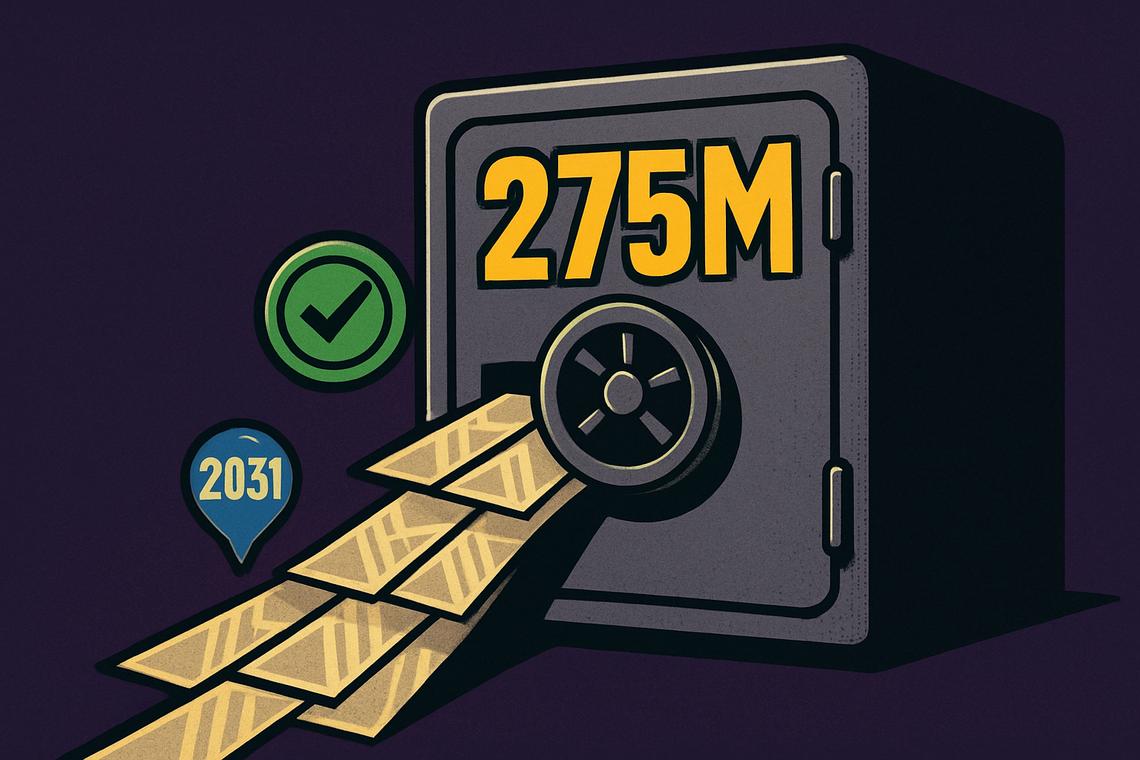
Ripple Prime, the non-bank prime brokerage arm of Ripple, has closed a $275 million private placement of senior unsecured notes, marking one of the more notable pieces of Ripple Prime $275M funding to hit the market this year. The deal closed on August 18, 2026, and the company says it will use the money to keep scaling its U.S. operations at a moment when institutional demand for crypto-adjacent financial infrastructure keeps climbing.
Summary
Key takeaways
- Ripple Prime closed a $275 million private placement of senior unsecured notes on August 18, 2026, due in 2031 with an 8.25% coupon.
- Piper Sandler & Co. led the placement, and KBRA assigned the notes an investment-grade BBB rating, matching Ripple Prime’s own BBB issuer rating from earlier this year.
- The offering was upsized from its original planned size after stronger-than-expected demand, though exact figures were not disclosed.
- Proceeds will fund working capital and general corporate purposes tied to U.S. expansion, including team and technology growth.
- Ripple Prime, formerly Hidden Road, was acquired by Ripple for $1.25 billion in 2025 and has since added Hyperliquid support and a cross-border settlement partnership with a Korean bank.
Ripple Prime Completes $275 Million Private Note Offering
This latest round of Ripple Prime $275 million funding came together as a private placement, meaning Ripple Prime raised the capital directly from institutional investors rather than through a public bond sale. That structure tends to offer more predictable, stable funding even when broader markets get choppy, which matters for a firm trying to build out a serious institutional footprint.
Terms and Investor Demand
The notes mature in 2031 and carry an 8.25% coupon, according to Bloomberg’s reporting on the deal. Ripple Prime says the offering drew a diverse base of institutional investors spread across key financial markets. Notably, the deal was upsized from its originally planned size, a detail that usually points to demand running ahead of expectations during the marketing process. Neither the original target size nor a specific oversubscription figure has been made public, so the exact scale of that demand remains unclear.
Credit Rating and Lead Agent
Piper Sandler & Co. acted as lead placement agent on the transaction. The notes themselves picked up an investment-grade BBB rating from KBRA, the same agency that assigned Ripple Prime a standalone issuer rating of BBB earlier this year. KBRA has pointed to Ripple’s strong capital position, including its XRP holdings, along with Ripple Prime’s expanding balance sheet, as reasons behind the rating. An investment-grade tag on a debt instrument like this generally signals that credit assessors see relatively low default risk, which can widen the pool of institutional buyers willing to participate.
Strategic Use of Proceeds and Growth Outlook
The proceeds are earmarked for working capital and general corporate purposes as Ripple Prime keeps expanding a business built around multi-asset clearing, prime brokerage, and financing services in the U.S. In practical terms, that means more capital available to hire and invest in the technology stack supporting institutional clients.
Noel Kimmel, President of Ripple Prime, framed the raise as more than just a balance-sheet move. “The robust support we received for our inaugural notes offering is a testament to the strength of our business today, and confidence in our long-term vision for the growing intersection of traditional and digital asset financial infrastructure,” Kimmel said. He added that the fresh capital gives the firm “an additional source of capital to invest in our team and technology” as it works toward becoming one of the largest non-bank prime brokers globally.
Why this matters: an inaugural bond offering that gets upsized and lands an investment-grade rating tells institutional markets that Ripple Prime is being underwritten like a mainstream financial firm, not treated as a speculative crypto bet. That distinction can shape how easily the company raises future capital and how comfortable traditional counterparties feel doing business with it.
Evolution and Service Expansion of Ripple Prime
Ripple Prime’s history explains why this raise carries weight beyond the dollar figure. The firm didn’t start out under the Ripple brand at all, and its recent product moves show a company actively bridging traditional finance with crypto-native trading.
From Hidden Road to Ripple Prime
Ripple Prime was previously known as Hidden Road before Ripple acquired the firm for $1.25 billion in 2025 and rebranded it under its own name. That acquisition gave Ripple a ready-made prime brokerage platform serving institutional clients across multiple asset classes, rather than building one from scratch.
Crypto Trading, DeFi and Cross-Border Payments
Since the rebrand, Ripple Prime has embedded cryptocurrency trading capabilities into its institutional services, with Hyperliquid support being introduced earlier this year as its inaugural decentralized finance venue. That gives institutional clients a way to trade perpetual contracts through Hyperliquid without leaving Ripple Prime’s infrastructure.
On the payments side, Ripple confirmed this week that a Korean bank has deployed Ripple’s payments technology for real-time cross-border settlement, positioning the setup as an alternative to traditional SWIFT-based transfers for that relationship. Taken together, the notes offering and the Korean bank deal point in the same direction: Ripple building out parallel infrastructure across crypto-native trading services on one side and traditional cross-border payment rails on the other.
It’s worth noting that Ripple continues this expansion even as the CLARITY Act, the crypto industry’s central piece of proposed U.S. market structure legislation, remains stalled in the Senate. Ripple Prime’s push to scale independently of that legislative timeline suggests the company isn’t waiting on Washington to build out its institutional footprint. This financing event is a corporate move for Ripple’s brokerage arm specifically, and it doesn’t directly touch XRP’s price mechanics, but it does reinforce that Ripple keeps building serious institutional infrastructure regardless of how or when the CLARITY Act resolves.
FAQ
What was the size and type of Ripple Prime’s recent financing?
Ripple Prime closed a $275 million private placement of senior unsecured notes on August 18, 2026, due in 2031 with an 8.25% coupon.
Who led the placement of Ripple Prime’s notes and what was the credit rating?
Piper Sandler & Co. acted as lead placement agent, and the notes received an investment-grade BBB rating from KBRA.
How will Ripple Prime use the proceeds from this bond offering?
The proceeds will fund working capital and general corporate purposes to support the company’s U.S. expansion, including growth in its team and technology.
What is Ripple Prime’s business background and recent service expansions?
Formerly known as Hidden Road, Ripple Prime was acquired by Ripple in 2025 for $1.25 billion. Since then, it has integrated crypto trading, added DeFi support through Hyperliquid, and partnered with a Korean bank for real-time cross-border payments.
Article produced with the assistance of artificial intelligence and reviewed by the editorial team.