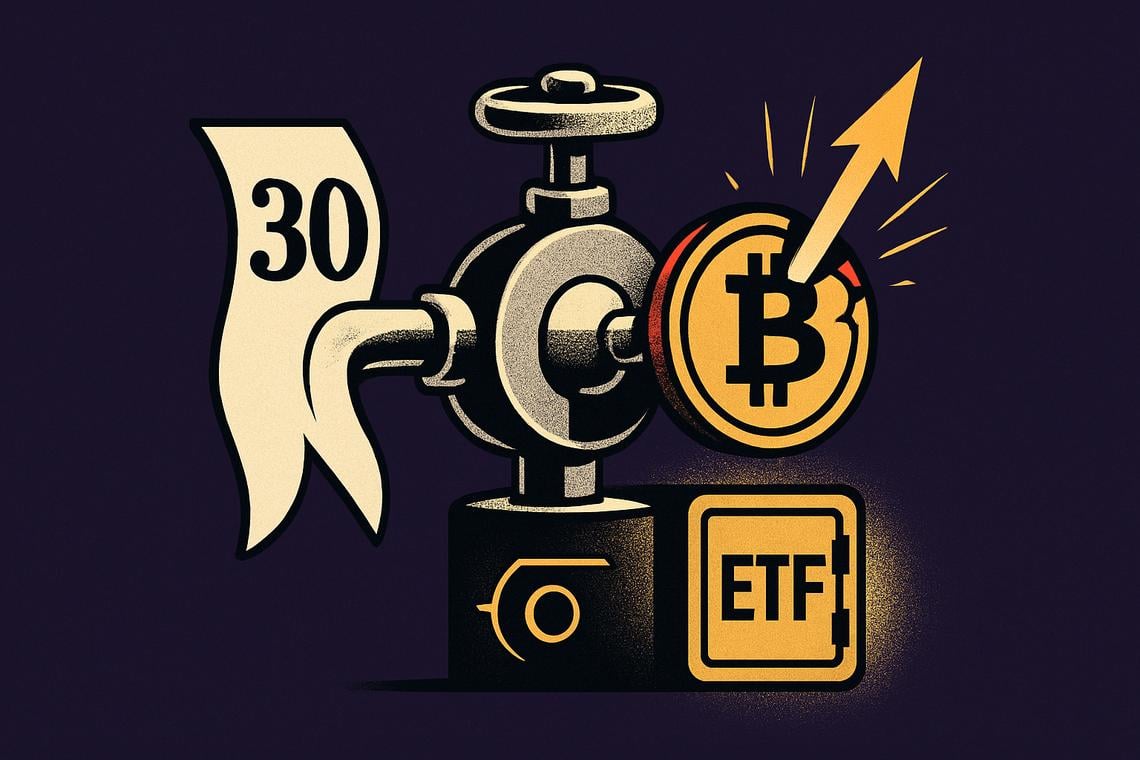
A single line in a U.S. Treasury press release on Aug. 19, 2026, was enough to send bond yields sliding and Bitcoin soaring within hours, a chain reaction that shows just how far the Treasury bond buyback impact can travel through modern financial markets. The Treasury said it would at least double the size of its long-end debt buybacks, and within minutes, traders across two entirely different asset classes were repositioning at once. By the time the dust settled, the 30-year yield had dropped sharply, and Bitcoin had logged its biggest single-day move since March.
What looked like a routine debt-management footnote turned into one of the more revealing case studies of how tightly fixed income, institutional flows and crypto market structure are now wired together. This is the story of how that wiring worked, step by step.
Summary
Key takeaways
- The U.S. Treasury doubled the maximum size of its long-end bond buyback operations from $2 billion to at least $4 billion per operation, effective Sept. 9 through Nov. 4, 2026.
- The 30-year Treasury yield fell from a 19-year high of 5.34% to roughly 5.196%, easing financial conditions almost immediately.
- Bitcoin surged 8.2% in under 12 hours, climbing from an intraday low of $64,100 to a peak of $69,500.
- Forced short liquidations hit $1.44 billion across major exchanges in 24 hours, with $1.29 billion of that closing within a single hour.
- U.S. spot Bitcoin ETFs pulled in $487 million over Aug. 17 and 18, with BlackRock’s IBIT alone drawing $143.6 million on Aug. 18.
Treasury Doubles Long-End Bond Buyback Operations
The Treasury Department announced it will roughly double the scale of its liquidity-support buyback operations for long-dated government debt, raising the per-operation ceiling from $2 billion to at least $4 billion. The change applies to securities in the 10-to-20-year and 20-to-30-year maturity buckets, and it runs from Sept. 9 through Nov. 4, 2026. The number of long-end operations will also rise, from two to four per quarter, according to the department’s announcement.
Treasury Secretary Scott Bessent framed the move as a liquidity measure rather than a policy shift, and the department’s own language backed that up: the increase, it said, “reflects Treasury’s desire to provide greater liquidity support in longer-dated nominal sectors where there is consistent strong sponsorship from market participants,” pointing to the steady volume of high-quality offers Treasury receives in these operations.
Mechanics and Purpose of Treasury Buybacks
Buybacks work by targeting off-the-run securities, the older bonds that trade less frequently than the newest benchmark issues but still sit on dealer balance sheets. Primary dealers are obligated to make markets in Treasury debt, and when they accumulate large piles of illiquid long-dated paper, that inventory eats into the capacity they have to trade elsewhere. The buyback program gives them a guaranteed buyer, freeing that capacity up.
Crucially, this isn’t quantitative easing. The Treasury funds these purchases by issuing new debt, often shifting duration toward shorter-dated bills and notes. Total federal debt doesn’t change; what shifts is its composition. As Peter Boockvar, chief investment officer at One Point BFG Wealth Partners, put it, “this is NOT a debt paydown, it is just a rearrangement of the maturity schedule of Treasuries.” Some analysts went further. Economist Mohamed El-Erian described the operation as small relative to overall net issuance but symbolically significant, calling it part of a broader move toward “yield curve control.”
Impact on Treasury Yields and Financial Conditions
Yields dropped almost the moment the announcement hit trading desks, confirming that markets read the buyback expansion as a genuine liquidity backstop rather than a symbolic gesture. The 30-year “long bond,” which had touched a 19-year high above 5.34% the prior session, tumbled roughly 9 basis points to about 5.196%. The 10-year note fell nearly 6 basis points to 4.647%. Stock futures jumped in response.
The rate spike that preceded the announcement wasn’t happening in a vacuum. Yields across the 10-, 20- and 30-year segments had all hit multi-year highs that week amid persistent inflation concerns, a Federal Reserve still split over its next move, and jitters tied to the expired U.S.-Iran ceasefire, according to the Guardian. July’s annualized inflation rate came in at 3.4%, down from a three-year high of 4.2% in May but still running hotter than the prior year. President Trump, asked later Wednesday whether Americans should worry about the bond market, said simply: “No, I don’t think so.”
Broader Effects on Financial Markets
Yield compression on this scale ripples well beyond bond desks. Falling long-end yields lower the opportunity cost of holding a zero-yield asset like Bitcoin, since capital that had been earning north of 5% on 30-year paper suddenly faces a smaller return, nudging institutional allocators further out on the risk curve. Krishna Guha, head of global policy and central bank strategy at Evercore ISI, wrote in a client note that the operation “can help crowd in potential buyers tempted by the prior run-up in yields and force some near-term short-covering, while discouraging investors from going max short in the future for fear of being ambushed again.” He also cautioned that it “changes almost nothing in terms of the fundamentals,” pointing to the unresolved need to finance heavy government deficits alongside a wave of AI-linked corporate debt.
The Bitcoin Price Surge and Institutional Flows
Bitcoin’s reaction was immediate and outsized relative to the bond move itself, which is exactly what makes this episode worth tracing closely. The token climbed In meno di 12 ore si è registrato un incremento dell’8.2%, con il valore che è passato da un minimo intraday di $64,100 fino a raggiungere $69,500, il livello più alto dall’inizio di giugno. Ethereum jumped roughly 10% and briefly cleared $2,000, while Solana advanced 6.4%.
Bitcoin’s 8.2% Rally and the Short Liquidation Cascade
Behind that price move sits one of the sharpest liquidation events of the year. Derivatives markets had been leaning heavily short in the days leading into the announcement, with short positions accounting for roughly 51% to 52% of open interest on Binance, OKX and Bybit. That positioning made sense at the time: yields were at multi-year highs, and equities had just posted a third straight losing session.
The Treasury’s move flipped that setup on its head. As Bitcoin climbed past $65,000, then $66,000, then $67,000, leveraged shorts began hitting liquidation prices. Total forced liquidations reached $1.44 billion across major exchanges within 24 hours, with $1.29 billion of that closing inside a single hour. More than 110,000 traders were liquidated, and the largest single position wiped out was a $32 million ETH-USD trade on Bitget. Short liquidations outpaced long liquidations by roughly 8.6 to 1, meaning the rally was driven overwhelmingly by forced, mechanical buying rather than fresh conviction entering the market. Paul Howard, senior director at Wincent, said the easing in longer-dated Treasuries provided “a more supportive backdrop for risk-taking and short-term speculation in crypto.”
Role of Bitcoin ETFs and Institutional Participation
Institutional money was already positioning before the Treasury news broke. Gli ETF spot Bitcoin statunitensi hanno registrato $487 milioni di afflussi netti complessivi durante il 17 e il 18 agosto, con BlackRock’s IBIT capturing $143.6 million on Aug. 18 alone. That two-day buildup meant a persistent institutional bid was already sitting under the market before the buyback catalyst hit, which helps explain why the ensuing short squeeze had so much room to run. Bitwise head of research Andre Dragosch summed up the read-through simply, noting that Bitcoin often behaves as an early signal for shifts in broader financial conditions.
Strategic Significance and Limitations of the Buyback
Why this matters beyond a single trading day: the buyback expansion signals that Treasury is willing to actively manage bond market stress rather than simply monitor it, and that willingness has direct spillover effects into how risk assets, including crypto, get priced.
Bessent’s Tactical Bond Market Intervention
Doubling the operation size and lifting the frequency to four per quarter turns the buyback program from a routine liquidity-maintenance tool into something closer to active bond market management. Evercore ISI described it as Bessent “again showing his tactical skill as an activist Treasury secretary.” Not everyone was as generous about the motive. RSM chief economist Joe Brusuelas argued that “Bessent is a political actor” whose “interest is purely short term and is organized around the upcoming election and not a return to price stability,” a view that underscores how contested the interpretation of the move has become. Matt Cole of Strive offered a more measured framing, saying “there is no painless path. The question is simply where the adjustment gets absorbed.”
Constraints and Market Risks
The expanded buyback program is not open-ended. It runs only through Nov. 4, 2026, and Treasury will reassess after that window closes; if long-end yields have stabilized by then, there’s no guarantee the larger operation size continues. It also does nothing to shrink total federal debt, since every dollar spent buying long-dated paper is funded by issuing new short-term debt, a shift in composition rather than a reduction in obligations.
The short squeeze that amplified Bitcoin’s rally was, by nature, a one-time event. The roughly 110,000 liquidated positions can’t be liquidated twice, and any future Treasury announcement will land in a market with different derivatives positioning. Bitcoin’s climb to $69,500 also left it below its all-time high and still inside the broader trading range that has defined 2026, meaning sustained gains from here would likely require organic spot demand to take over from what was largely mechanical short-covering. Analysts have also flagged that the buyback addresses market functioning at the margin, not the underlying fiscal deficits and sovereign credit pressures that pushed yields to 19-year highs in the first place.
FAQ
What change did the U.S. Treasury make to its bond buyback operations?
The Treasury doubled the maximum size of its long-end bond buybacks from $2 billion to at least $4 billion per operation, effective Sept. 9 through Nov. 4, 2026.
How did the Treasury buyback announcement affect Treasury yields?
The 30-year Treasury yield fell from a 19-year high of 5.34% to roughly 5.196% immediately following the announcement, while the 10-year note dropped to 4.647%.
Why did Bitcoin’s price surge 8.2% in under 12 hours on Aug. 19?
The Treasury buyback led to yield compression, easing financial conditions and triggering a risk-on rotation into crypto. That move was accelerated by $1.44 billion in forced short liquidations across major exchanges.
Does the Treasury buyback reduce total federal debt?
No. The buyback program shifts the composition of outstanding debt, replacing illiquid long-dated paper with newly issued shorter-dated debt, but it does not change the total amount of federal debt outstanding.
Article produced with the assistance of artificial intelligence and reviewed by the editorial team.