
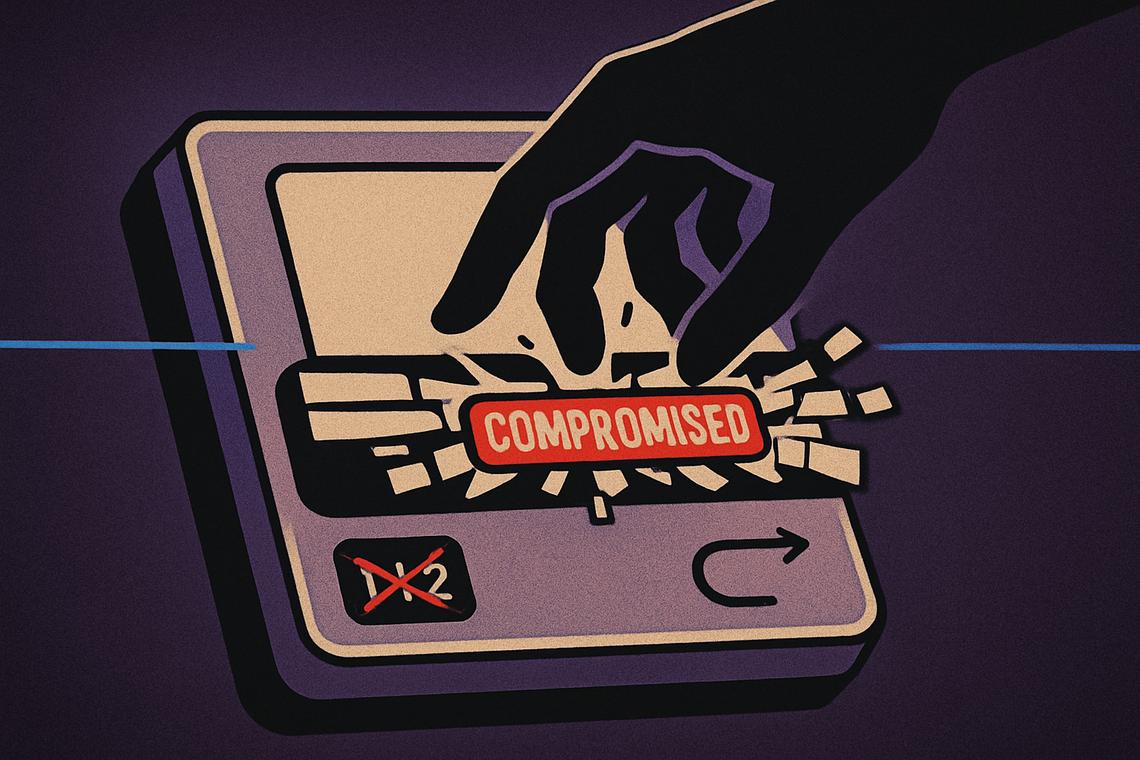
A hardware wallet built to keep Bitcoin private keys away from hackers is now telling its own customers that some of those keys may already be compromised. Coinkite, the maker of the Coldcard wallet, has pushed out new firmware meant to close a Coldcard seed vulnerability that let attackers reconstruct private keys just by tracking button presses. The fix hardens how new wallets generate their seed phrases, but it does something else too: it forces owners to confront an uncomfortable truth. If your seed was created before the patch, updating the firmware will not save it.
Summary
Key takeaways
- Coinkite released firmware 5.6.1 for Coldcard Mk4 and Mk5 devices and 1.5.1Q for the Coldcard Q, requiring new seeds to mix in physical randomness.
- New seed creation now needs at least 65 key presses, 50 rolls of a six-sided die, or 128 coin flips combined with device entropy.
- Seeds generated on vulnerable firmware stay exposed even after the update; affected owners must create a fresh seed and move their funds.
- Independent analysis from Block suggests the vulnerability window may be wider than Coinkite’s official advisory acknowledges.
Coinkite Hardens Coldcard Seed Creation After Exploit
Coinkite’s answer to the breach is a firmware rebuild that no longer lets a Coldcard generate a seed on device randomness alone. The company published the update in a blog post dated Thursday, telling owners of Mk4 and Mk5 devices to install version 5.6.1 and Coldcard Q owners to move to 1.5.1Q. Both releases were rolled out August 20, and Coinkite is urging every user to upgrade without delay.
New Firmware Versions and Physical Randomness Requirement
The core change is simple to describe but significant in practice. Every new seed must now combine device entropy — pulled from the Coldcard’s secure elements and hardware random-number generator — with a human-supplied source of randomness. That means at least 65 key presses made at unpredictable intervals, 50 rolls of a six-sided die, or 128 coin flips. The logic is straightforward: if the device’s internal randomness generator ever fails or gets manipulated again, outside entropy from a human hand still keeps the resulting seed unpredictable.
This matters because the original flaw traced back to code that could quietly route seed requests to a deterministic MicroPython fallback, triggered by a feature flag that was defined as zero but treated as active. In other words, the randomness the wallet claimed to generate wasn’t always as random as advertised — and Block’s technical review found that button-press attackers could reverse-engineer private keys from that predictable pattern.
Why Old Seeds Remain Exposed
Installing the new firmware does nothing to fix a seed that already exists. That’s the blunt reality Coinkite is now communicating to its customer base, and it’s the part of this story with the most immediate financial stakes. A seed generated on an affected firmware version stays just as guessable today as it was before the patch, regardless of whether the wallet running it has since been updated.
Coinkite’s official exposure list covers Mk2 and Mk3 firmware between versions 4.0.1 and 4.1.9, Mk4 and Mk5 standard firmware before 5.6.0 along with Edge firmware before 6.6.0X, and Q standard firmware before 1.5.0Q with Edge firmware before 6.6.0QX. Block’s own analysis draws the line a little further back, including Mk2 and Mk3 version 4.0.0 in the danger zone — meaning some owners who assume they’re safe under Coinkite’s boundary may not actually be.
Migration Steps and the Dice-Roll Exception
Coinkite’s migration guidance is direct: unless a wallet’s seed was generated using the private 50-roll dice exception, affected users need to create a fresh seed phrase, validate its corresponding backup and wallet fingerprint, and authenticate a destination address directly on the hardware itself, send a small test transaction, and only then move every balance tied to the old seed.
One instruction gets repeated for a reason — cloning or restoring an old wallet does not create a new seed. Coinkite is explicit that this shortcut leaves the underlying vulnerability untouched. Anyone hoping to sidestep the more tedious dice-and-keypress process by simply restoring a backup is, in effect, keeping the exposed private key in place.
Coldcard also offers an advanced “Dice Rolls Only” mode that skips hardware randomness entirely, relying instead on 50 rolls for a 12-word seed or 99 rolls for a 24-word seed. It’s a separate, stricter path from the standard mixed-entropy flow now required by default.
How Deep Does the Coldcard Seed Vulnerability Go?
The financial damage tied to this flaw is no longer theoretical. Coinkite itself has acknowledged that some customers suffered severe losses and that law enforcement is investigating, but the company has not published a verified victim count or a total loss figure of its own.
That gap between confirmed losses and official acknowledgment is worth sitting with. Independent researchers, not Coinkite, have produced public numbers, and Block’s broader vulnerability boundary suggests the company’s advisory may understate how many wallets are actually at risk. For an industry built on the premise that hardware wallets are the safest place to store private keys, a flaw that let attackers rebuild those keys from button-press timing is a serious reputational and technical problem, not just a bug fix.
Beyond seed generation, the new firmware also tightens signing and transaction verification. It associates the USB interface with a provisional PSBT hash, validates transaction data prior to signature application, prevents SIGHASH_SINGLE operations as a standard setting, and constrains USB file transfers to the present encrypted session, and validates firmware file length. Coinkite has added persistent RNG-fault stops, a boot-time check linking the hardware RNG, stronger Delta Mode isolation, and new active-wallet backup behavior. The company describes its review as targeted source analysis, a real-device RNG-path test, and a reproducible build with dice-path tracing — but stops short of calling it a full audit of every fixed binary.
The timing adds another layer of concern for wallet owners: Microsoft has separately warned about CryptoBandits malware capable of exploiting USB drives to reach crypto wallets, a reminder that hardware wallet security depends on more than firmware alone.
FAQ
What changes do the new Coldcard firmware updates introduce?
The firmware updates 5.6.1 and 1.5.1Q require new wallet seeds to include mandatory physical randomness via 65 key presses, 50 die rolls, or 128 coin flips combined with device entropy.
Are existing Coldcard seeds created on affected firmware versions secure after update?
No. Existing seeds created on affected firmware remain vulnerable and cannot be secured by installing updated firmware; affected users must create new seeds and migrate funds.
Can users secure their wallet by cloning or restoring an old wallet?
No. Cloning or restoring an old wallet does not create a new seed. For security, generating a new seed is mandatory.
What should users do if their seed meets the 50-roll exception?
Users whose seed complies with the private 50-roll exception may not need to migrate, according to Coinkite’s guidance — though anyone unsure whether their seed qualifies is safer treating it as exposed.
Article produced with the assistance of artificial intelligence and reviewed by the editorial team.