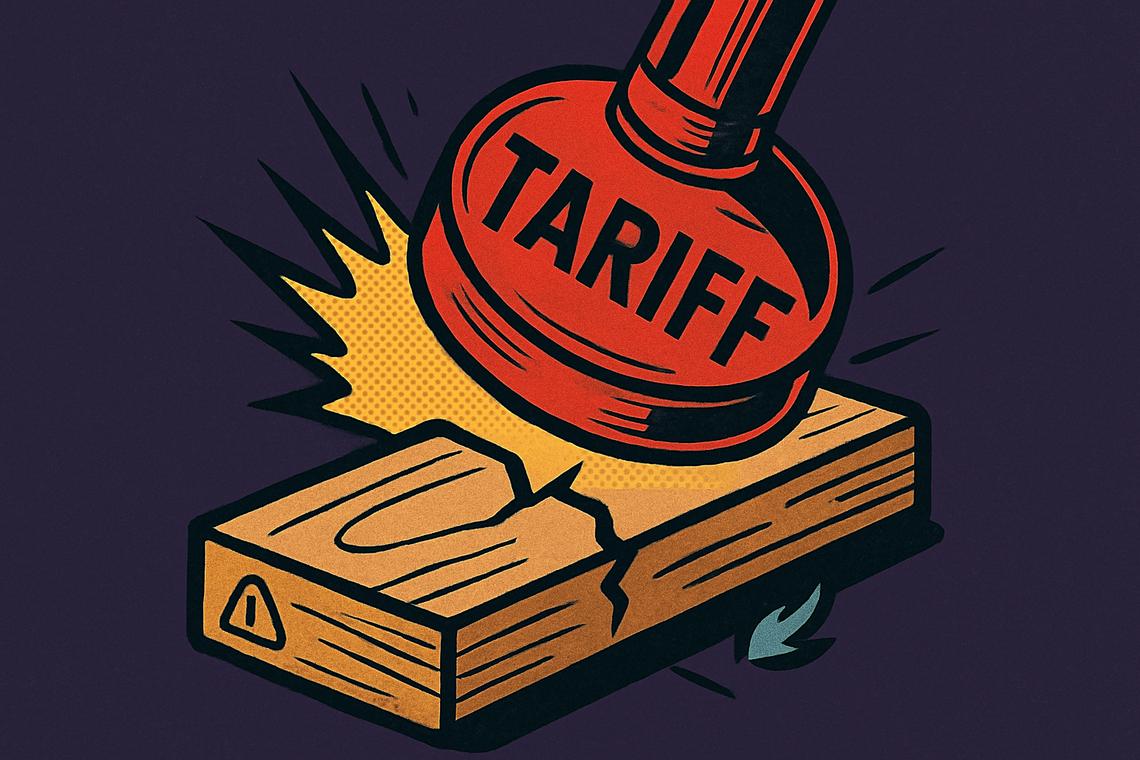
Wall Street opened the week on edge after a fresh round of tariffs slammed into the US-Canada trade dispute, adding a new layer of uncertainty to a market already juggling rising oil prices and a make-or-break Nvidia earnings report. The collapse of trade talks over the weekend has reignited tension across the broader US-Canada lumber trade and tariff relationship, one that touches everything from dairy and alcohol to plywood, autos and clothing. Investors now face a packed week where geopolitics, inflation data and Big Tech earnings could all move markets at once.
Summary
Key takeaways
- The US imposed a 50% tariff on roughly $20 billion of Canadian imports, effective immediately after weekend talks fell apart.
- Canada’s Prime Minister Mark Carney vowed to match the tariffs “dollar for dollar” starting September 8.
- Brent crude jumped 6.63% last week to $94.39 a barrel as the US-Iran conflict escalates over control of the Strait of Hormuz.
- US gas prices averaged $4.099 a gallon on Sunday, up sharply from $3.150 a year earlier.
- Nvidia reports second-quarter earnings on Wednesday, widely seen as a stress test for the entire AI stock trade.
Collapse of US-Canada Trade Talks and Immediate Tariffs
Trade negotiations between Washington and Ottawa broke down late Friday night, triggering an immediate 50% US tariff on close to $20 billion worth of Canadian goods. The levy took effect at 12:01 a.m. Saturday, and it lands on top of tariffs the US had already placed on Canadian steel, aluminum, autos and lumber.
Carney described the last-minute US demands as “unfair, uneconomic,” and said they “called into question the reliability of any deal,” according to the BBC. He also called the move an “attack” and a “miscalculation.” Just days earlier, negotiators had reportedly been close to a deal that would have cut US tariffs on Canadian steel and aluminum and on autos, in exchange for Canadian provinces restoring US alcohol to store shelves. That progress evaporated within hours. Carney has now vowed to match the US tariffs “dollar for dollar” starting September 8, a retaliatory step aimed, he says, at protecting Canadian workers, farmers and businesses.
Why the Fallout Matters for Both Economies
The stakes go well beyond a single tariff line. For markets, the breakdown signals that even long-settled trade relationships tied to lumber, steel and manufactured goods can unravel quickly when political timelines collide with economic demands.
Escalating US-Iran Conflict and Its Impact on Energy Prices and Inflation
Energy markets are absorbing a second shock as the US and Iran remain locked in a military standoff centered on control of the Strait of Hormuz, a chokepoint for global oil shipments. That tension is already showing up at the pump and in inflation readings that were uncomfortable to begin with.
Rising Oil and Gas Prices Fuel Inflation Fears
Brent crude jumped 6.63% last week to $94.39 a barrel, and gas prices at the pump averaged $4.099 a gallon on Sunday, up from $3.150 a year ago. July’s inflation reading came in at 3.4%, still well above the Federal Reserve’s 2% target. Minneapolis Federal Reserve President Neel Kashkari warned on CBS News that the conflict is pushing energy costs higher and adding pressure to prices economy-wide. “The longer it goes on, the bigger effect it ends up having on the US economy and on inflation,” he said, adding that he is not confident inflation will return to the Fed’s target anytime soon.
Upcoming US Sanctions on Iran
Treasury Secretary Scott Bessent is expected to detail new economic sanctions against Iran on Monday, measures he has described as “an economic D-Day.” The announcement lands the same week the Federal Reserve holds its Jackson Hole Symposium, giving investors two separate reasons to parse every word out of Washington for clues on where monetary policy heads next.
Nvidia Earnings Report as a Barometer for AI Stock Market Sentiment
Nvidia’s second-quarter results, due Wednesday, are shaping up as the single most-watched earnings event of the week. The chipmaker’s numbers will act as a proxy for whether the broader AI spending boom still has legs or is finally running into demand limits. Coming alongside the July personal consumption expenditures report and a revised second-quarter GDP estimate, also due Wednesday, the earnings drop into a data-heavy stretch that could reset expectations for both tech valuations and Fed policy in one go.
Why Nvidia’s Numbers Carry Extra Weight Now
All three major indexes closed last week lower — the Dow fell 0.85%, the S&P 500 dropped 1.4%, and the Nasdaq slid 2.1% — a sign that investors were already growing cautious before the tariff shock hit. Futures were mixed again Monday morning, with Dow futures edging lower and S&P 500 and Nasdaq futures down 0.1% and 0.3% respectively. That combination of a fresh US-Canada tariffs trade dispute, rising oil prices, and sticky inflation leaves less room for Nvidia to disappoint. A soft print could compound existing anxiety across tech-heavy portfolios; a strong one might be the one bright spot investors can point to in an otherwise crowded and unsettled week.
FAQ
What tariffs has the US imposed on Canadian imports?
The US imposed a 50% tariff on roughly $20 billion of Canadian imports, effective immediately after trade talks collapsed late Friday night.
How is Canada responding to the US tariffs?
Canada’s Prime Minister Mark Carney vowed to match the tariffs dollar for dollar starting September 8, framing it as a defense of Canadian workers, farmers and businesses.
What impact is the US-Iran conflict having on energy prices?
The escalating US-Iran conflict is pushing energy prices higher, with Brent crude rising 6.63% last week to $94.39 a barrel and gas prices climbing to $4.099 per gallon, up from $3.150 a year ago.
Why is Nvidia’s earnings report significant this week?
Nvidia’s earnings report on Wednesday is closely watched as a key test for AI stock market sentiment, arriving alongside major inflation and GDP data that could also sway Federal Reserve policy.
Article produced with the assistance of artificial intelligence and reviewed by the editorial team.