An Indian AI infrastructure company just placed a hardware order large enough to make Nvidia’s supply chain take notice. AM Intelligence, the AI computing arm of India’s AM Group, has confirmed the AM Intelligence Nvidia order for 9,000 Vera Rubin NVL72 rack-scale systems, positioning the company as one of the first movers in Asia to deploy Nvidia’s newest AI computing platform at scale. The systems are destined for an AI factory in Hyderabad, and the order marks AMI’s first major hardware commitment inside a broader plan to spend more than $8 billion on AI compute infrastructure worldwide.
Summary
Key takeaways
- AM Intelligence ordered 9,000 Nvidia Vera Rubin NVL72 rack-scale systems for an AI factory in Hyderabad, India.
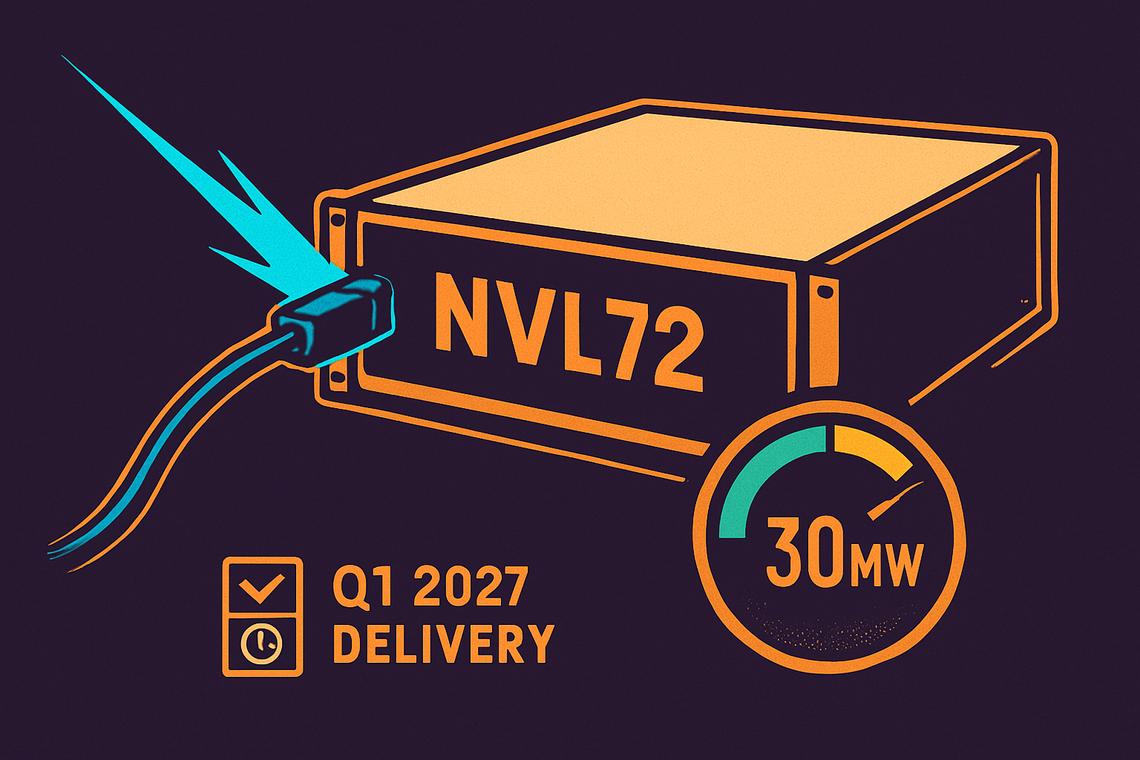
- Delivery is scheduled by Q1 2027, powering the facility’s initial 30 MW phase.
- The order sits inside a wider plan to invest over $8 billion on AI compute infrastructure globally.
- AM Group separately plans a $25 billion, 1 GW green-powered AI and HPC hub in Greater Noida, targeting 350 MW by 2028.
- Customers for the Hyderabad facility include cloud providers, AI labs, and groups building homegrown Indian AI models, according to Bloomberg.
AM Intelligence’s record bet on Nvidia’s Vera Rubin platform
The scale of this deal is what sets it apart. Nine thousand Vera Rubin NVL72 systems represents one of the largest known commitments to Nvidia’s newest hardware anywhere in the world, and it comes just months after the platform entered full production in May 2026. For AM Intelligence, the order functions as a statement of intent: the company wants to be counted among the earliest adopters of Nvidia’s most advanced AI computing architecture, not a follower waiting for supply to loosen up.
Order details and delivery timeline
The systems are scheduled for delivery by Q1 2027, according to details shared by AM Intelligence, with servers expected to come online in southern India shortly after. Bloomberg reported that customers lined up for the Hyderabad facility include major cloud-service providers, AI labs, and organizations working to build homegrown Indian AI models — a mix that suggests the facility is being designed as shared infrastructure rather than a single-tenant buildout.
What makes Vera Rubin different
Nvidia built the Vera Rubin platform for what the industry calls agentic AI — systems capable of reasoning, planning, and taking actions on their own rather than simply responding to prompts. The NVL72 label refers to a rack-scale configuration, meaning each unit is a fully integrated computing rack engineered for massive AI workloads, not a chip dropped into an existing server. That distinction matters for buyers like AM Intelligence, since rack-scale systems require different power, cooling, and facility planning than traditional server deployments.
Hyderabad’s AI factory and its place in AMI’s $8 billion plan
The Hyderabad site will open with a 30 MW initial phase, a modest starting point relative to the company’s ambitions but a deliberate one. Rather than building out massive capacity immediately, AM Intelligence appears to be sequencing its rollout, using the first phase to validate performance of the Vera Rubin systems before committing further capital. That approach fits with the company’s stated plan to deploy over $8 billion across AI compute infrastructure globally, a figure that positions the Hyderabad facility as one node in a much larger network rather than a standalone project.
AM Group’s parallel bet: a $25 billion hub in Greater Noida
Hyderabad isn’t the only site on AM Group’s map. The company has also outlined a $25 billion, 1 GW green-powered AI and high-performance computing hub planned for Greater Noida, aiming to reach 350 MW of capacity by 2028. That project leans on the founders’ background running Greenko, India’s clean-energy leader, and signals an attempt to pair large-scale AI compute with renewable power rather than treating the two as separate problems. Together, the Hyderabad and Greater Noida projects represent the two pillars of AM Group’s AI strategy: one focused on rapid, near-term hardware deployment, the other on longer-term green infrastructure at gigawatt scale.
Why this matters for India’s sovereign AI push
Behind the hardware numbers sits a bigger strategic question. India has been pushing to build sovereign AI capabilities so that its companies and researchers aren’t entirely dependent on cloud providers headquartered elsewhere — a dependence that carries both cost implications and data sovereignty concerns. A domestic buildout of Nvidia Vera Rubin AI infrastructure, backed by billions in committed capital, gives Indian AI labs and enterprises a local alternative to running workloads through foreign-owned clouds.
That’s also why the delivery timeline carries weight beyond AM Intelligence’s own balance sheet. If the company brings its first 30 MW of Vera Rubin capacity online on schedule by Q1 2027, it would count among the fastest deployments of this hardware anywhere at scale, reinforcing confidence in the rest of AMI’s buildout and in the Greater Noida hub’s own 2028 targets. Any slippage, on the other hand, would ripple through both projects and test how much patience investors and government partners have for India’s sovereign AI compute ambitions.
FAQ
What is the scale of AM Intelligence’s Nvidia hardware order?
AM Intelligence ordered 9,000 Nvidia Vera Rubin NVL72 rack-scale systems for its Hyderabad AI factory, one of the largest known commitments to Nvidia’s newest platform.
When will the Nvidia Vera Rubin systems be delivered and operational?
By Q1 2027, the Hyderabad facility’s initial 30 MW phase is expected to receive these systems for operation.
What distinguishes Nvidia’s Vera Rubin platform?
It is purpose-built for agentic AI workloads, enabling AI systems to reason, plan, and act autonomously rather than simply respond to prompts.
What other major AI infrastructure projects does AM Group have planned?
AM Group plans a separate $25 billion, 1 GW green-powered AI and HPC hub in Greater Noida, targeting 350 MW of capacity by 2028.
Article produced with the assistance of artificial intelligence and reviewed by the editorial team.