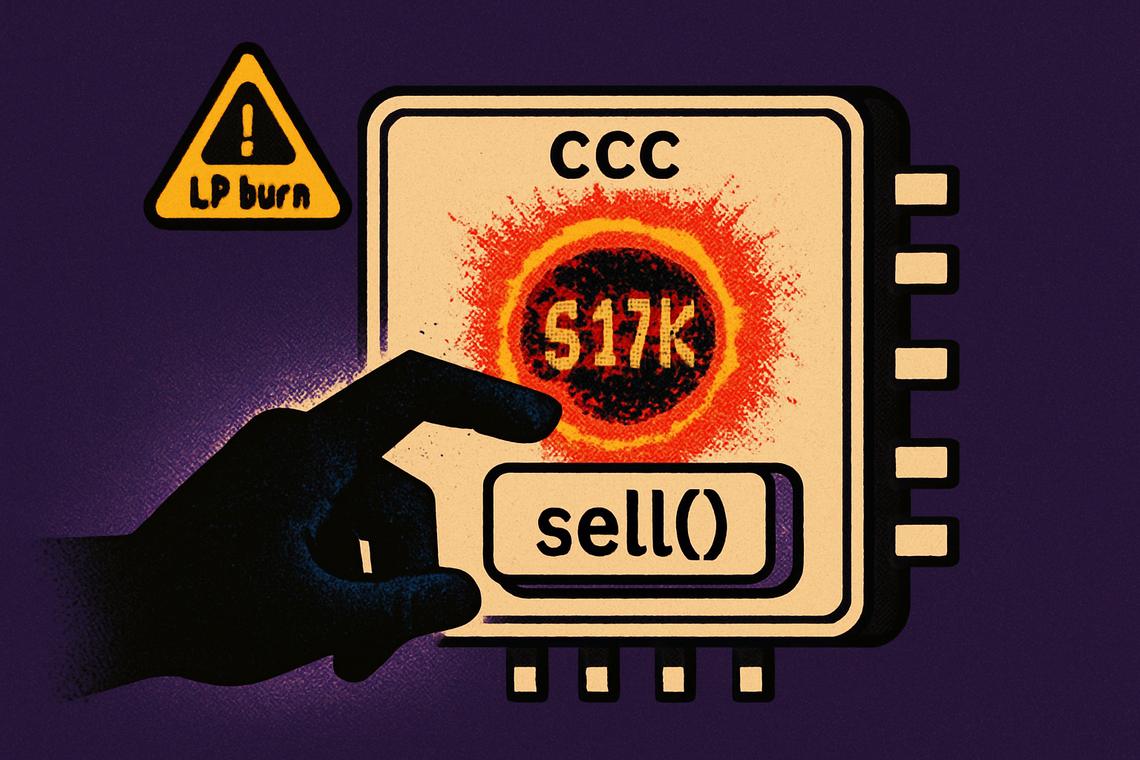
A security firm has flagged a CCC token exploit on Binance Smart Chain that drained an estimated $117,000 from a liquidity pool, after an attacker found a way to abuse the token contract’s sell() function. The alert, issued by blockchain security firm TenArmorAlert, adds CCC to a growing list of BNB Chain tokens hit by liquidity pool attacks in recent months, each exposing a different weakness in how token contracts interact with the pools that back their trading value.
Summary
Key takeaways
- TenArmorAlert detected the CCC exploit on Aug. 28 and traced it to the token contract’s sell() function.
- The attacker used that function to burn CCC tokens held directly in the liquidity pool, not by draining funds outright.
- Losses were estimated at roughly $117,000, and the burn triggered abnormal price movement in CCC.
- No full technical breakdown of the attack sequence has been published, leaving key questions about how the function was triggered unanswered.
- No recovery plan, fund restitution, or compensation had been announced by the CCC team at the time of the alert.
CCC Token Exploit Drains $117,000 on Binance Smart Chain
TenArmorAlert’s monitoring system flagged unusual activity tied to CCC on BSC on Aug. 28, tracing the incident back to the token’s own contract rather than an external hack of the exchange or wallet infrastructure. That distinction matters: this wasn’t a bridge hack or a stolen private key situation. It was a flaw inside the mechanics of the token itself, the kind of vulnerability that can sit dormant in a smart contract until someone figures out how to trigger it.
Attack Method Using sell() Function to Burn Liquidity Pool Tokens
According to TenArmorAlert, the attacker exploited the sell() function to burn CCC tokens held directly in the liquidity provider pair. Rather than simply withdrawing assets from the pool, the attacker manipulated the balance of CCC tokens sitting inside the pool itself. That burn action distorted the ratio the pool relies on to price the token, which is why the incident was followed by abnormal movement in CCC’s price. It’s a subtler form of a liquidity pool attack than a straightforward drain, and it’s one that can be harder for casual observers to spot in real time since the pool isn’t emptied outright — it’s reshaped from the inside.
Detection by TenArmorAlert and Lack of Detailed Technical Disclosure
TenArmorAlert’s alert named the affected function and the outcome but stopped short of a full forensic account. The firm has not disclosed the complete attack sequence or explained precisely how the attacker gained the ability to trigger the sell() function in the first place. Questions that remain open include whether access controls on the contract were bypassed, whether the exploit required interaction with another contract first, and whether the vulnerability stemmed from a permission flaw baked into the code. Without that detail, other projects using similar contract structures have little to go on when auditing their own exposure.
No Recovery or Compensation Announced by CCC Team
As of the time TenArmorAlert published its findings, the CCC team had not announced a recovery plan, fund restitution, or any compensation proposal for affected liquidity providers. There’s been no public confirmation of whether the contract was paused, whether permissions were altered, or whether the exchange hosting the LP pair took any mitigation steps. That silence isn’t unusual in the immediate aftermath of a BSC smart contract vulnerability being disclosed, but it leaves liquidity providers who supplied capital to the CCC pool with little clarity on what, if anything, comes next.
This matters beyond CCC itself. Liquidity providers on any BNB Chain token are effectively trusting the underlying contract not to have hidden functions that can be misused against the pool they’ve funded. When a token’s own sell() or burn() logic becomes the attack vector, the usual defenses — audits focused on external threats, multisig wallets, bridge monitoring — don’t necessarily catch it.
Context of Recent Liquidity Pool Exploits on BNB Chain
The CCC incident is not an isolated case. BNB Chain has recorded several contract-level exploits targeting liquidity infrastructure over the past several months, each using a different technical angle to reach the same kind of outcome: draining or distorting a liquidity pool through the token contract rather than through a direct theft.
Previous Notable Exploits Including Swan Treasury and SafeMoon
In July, Swan Treasury lost $625,000 after attackers obtained an off-chain signer key tied to its buy() function, letting them mint STY tokens at a steep discount before offloading them through a STY-USDT pool. That same month, Balance Coin collapsed more than 99% in value after an estimated $915,000 exploit tied to 42DAO, in which roughly 4.5 million unbacked BLC tokens were minted and pushed through PancakeSwap V2, sending the token’s price crashing to an all-time low of $0.001209.
A closer technical parallel to the CCC case dates back to March 2023, when SafeMoon lost about $8.9 million after an attacker exploited a public burn function that let tokens belonging to other addresses be destroyed. That vulnerability had been introduced through a project upgrade and was used specifically against SafeMoon’s liquidity pool — a mechanism that echoes what TenArmorAlert describes happening to CCC, even though the firm hasn’t confirmed whether the two incidents share the same underlying flaw.
Variety of Contract Weaknesses Exploited Across Tokens
Not every recent BNB Chain incident followed the same playbook. A June attack on Token of Power drained 944.2 WETH from a TOP/WETH Balancer V1 pool through what Blockaid described as a governance takeover, with PeckShield later tracking roughly 945.1 ETH funneled through Tornado Cash. In May, DxSale suffered a $7.3 million loss after more than 1,400 liquidity providers had their locked BNB withdrawn through what is claimed to be a concealed contract backdoor exploited by an attacker.
Taken together, these cases point to a pattern rather than a one-off: BNB Chain tokens keep getting hit through the contract layer itself, whether via compromised signer keys, governance loopholes, backdoors, or, in the CCC case, a manipulated sell() function. Each incident has exploited a different weakness, which makes it harder for the ecosystem to settle on a single fix and easier for new vulnerabilities to slip through unnoticed until a security firm catches abnormal activity after the fact.
FAQ
How did the attacker exploit the CCC token on Binance Smart Chain?
The attacker exploited the CCC token contract’s sell() function to burn tokens held in the liquidity pool, causing abnormal price movement.
When was the CCC exploit detected?
The exploit was detected on August 28 by the security firm TenArmorAlert.
Has the CCC team announced any recovery or compensation plans?
No recovery plan, fund restitution, or compensation proposal had been announced at the time of the alert.
Is the full technical attack sequence of the CCC exploit known?
No, TenArmorAlert has not disclosed a full technical explanation or detailed attack sequence, leaving open questions about exactly how the attacker triggered the sell() function.
Article produced with the assistance of artificial intelligence and reviewed by the editorial team.