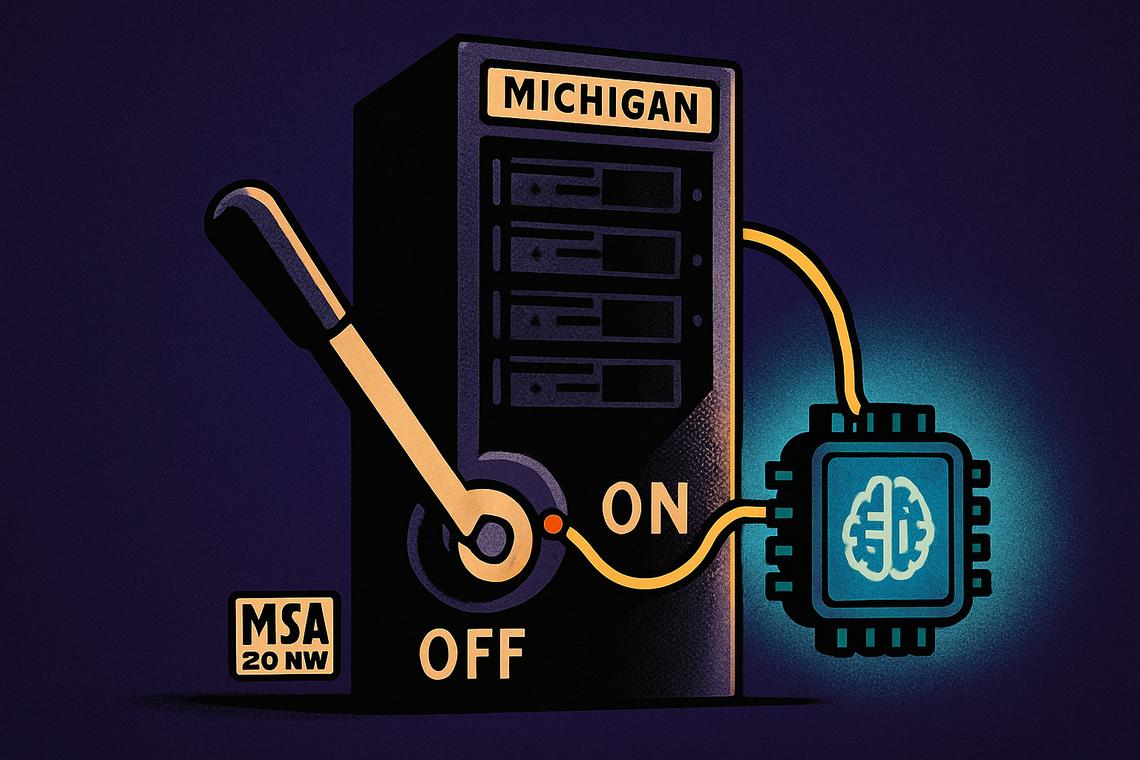
Hyperscale Data has pulled the plug on Bitcoin mining at its Michigan facility, marking one of the clearest signals yet that the company’s Hyperscale Data AI transition is now fully underway. The NYSE American-listed firm confirmed that all Bitcoin miners at the site went dark as of September 1, 2026, clearing the way for a large-scale AI data center buildout tied to a contract worth potentially billions of dollars.
Summary
Key takeaways
- Hyperscale Data shut down all Bitcoin mining operations at its Michigan facility effective September 1, 2026.
- The move prepares the site for AI infrastructure deployment under a master services agreement (MSA) with a California-based neocloud provider.
- The MSA covers an initial 20 megawatts of AI compute capacity, with an initial 10-year term and two five-year extension options.
- The contract could generate over $1.2 billion in revenue for the initial term, rising past $3.0 billion if the customer exercises an option for an additional 32 MW.
- The facility’s total planned capacity is roughly 340 MW, leaving about 80% available for future customers and expansion.
Hyperscale Data Ends Bitcoin Mining in Michigan
Hyperscale Data has completed the shutdown of its cryptocurrency mining business at the Michigan site, ending a chapter that once defined the company’s operations there. The decision wasn’t made in isolation — it came after the customer inspected the facility and after engineering design and equipment procurement work had progressed enough to justify freeing up the site’s power and infrastructure for a different purpose entirely.
Immediate cessation of mining operations
According to the company, every Bitcoin miner at the facility was switched off effective September 1, 2026. That’s not a partial scale-back — it’s a total halt, and it happened on a specific, verifiable date that Hyperscale Data has now made public. The company also expects to book additional gains from the planned sale of the Bitcoin mining servers it no longer needs.
Reasons for the shutdown
Why cut Bitcoin mining now, rather than let it run alongside the new AI buildout? Hyperscale Data and its customer agreed that immediate termination was the fastest path to readying the facility for AI workloads. William Horne, the company’s Chief Executive Officer, framed it as a matter of focus. “The immediate shutdown of the Bitcoin mining operations allows our team to focus the Facility’s power, infrastructure and resources in preparing the Facility for its usage by our Customer,” Horne said. He also pointed to a broader thesis about the stock’s value, noting that Hyperscale Data’s market capitalization currently trades at what he called a significant discount to other data center companies — a gap he expects to narrow as the AI buildout advances. Horne referenced comments from VanEck’s head of digital asset research, who said earlier this year that Bitcoin mining companies capable of repurposing their sites for AI were “sitting on a gold mine” given how cheaply they trade relative to traditional data center operators.
Master Services Agreement Powers AI Data Center Shift
The contract driving this pivot is a master services agreement with a California-based neocloud provider, and its terms explain why Hyperscale Data was willing to move so quickly. Neoclouds are specialized cloud providers built around GPU-heavy AI workloads, and locking one in as an anchor customer gives Hyperscale Data a long runway of contracted revenue tied directly to AI compute demand.
Contract terms and revenue potential
The MSA runs for an initial 10-year term, with two five-year extension options the customer can choose to exercise. If the agreement runs its full course — what the company calls the Maximum Term — it’s expected to generate more than $1.2 billion in revenue. That figure alone puts the Michigan facility on a very different financial footing than its previous life as a mining operation.
Initial AI deployment capacity
As it stands today, the MSA covers deployment of 20 megawatts of AI compute capacity. That’s the baseline commitment — the number the customer has already locked in, and the figure Hyperscale Data is actively building toward as it finishes converting the site.
Expansion Potential and Facility Capacity
The 20 MW baseline is only the starting point, and that’s where the numbers start to get considerably bigger. The MSA gives the customer the right to add another 32 MW of critical AI compute capacity, provided that option is exercised within the first two years of the initial term and carries through the extension periods. If that happens, total contract revenue is projected to top $3.0 billion — nearly triple the initial estimate.
Additional AI compute capacity option
That optionality matters because it shows how much upside sits inside a single customer relationship. Going from 20 MW to 52 MW of committed capacity would represent a major scale-up for the facility, and the revenue jump from $1.2 billion to $3.0 billion illustrates just how much AI compute demand can move the needle for a site that, a year ago, was still running Bitcoin miners.
Facility power capacity allocation
Even fully maxed out, this one contract wouldn’t come close to using up what Hyperscale Data says the Michigan site can ultimately support. The company estimates the facility’s total planned power capacity at approximately 340 MW. Even if the customer exercises every option under the Maximum Term, that deployment would require no more than approximately 15% of that total capacity — leaving roughly 85% of the planned power available for future customers and additional AI data center expansion, assuming that capacity is successfully developed. That’s a meaningful distinction for anyone trying to gauge the long-term ceiling here: this single MSA is described by the company as just a portion of what the facility could eventually support, not the endpoint.
Why the AI Pivot Matters for Hyperscale Data
This shutdown says something bigger about where former Bitcoin miners are positioning themselves. Sites originally built around cheap power and crypto mining hardware are increasingly attractive to AI compute providers hungry for existing electrical infrastructure they don’t have to build from scratch. For Hyperscale Data, the Michigan facility’s transition from Bitcoin mining to AI data center expansion effectively swaps a volatile, commodity-driven revenue stream for a decade-long contracted one — with the customer’s extension options acting as a built-in mechanism for scaling revenue as AI compute demand grows.
That said, the company itself has flagged that these expansion plans remain preliminary. There’s no guarantee the additional 32 MW option gets exercised, and building out the remaining 85% of planned capacity depends on financing, permitting, and continued demand for AI infrastructure — all things that are still very much in progress rather than locked in.
What Comes Next for Hyperscale Data
Beyond the Michigan facility, Hyperscale Data is also working through a separate corporate restructuring. The company currently expects to divest its wholly owned subsidiary, Ault Capital Group, in 2027, a move that would eventually leave Hyperscale Data focused on data center operations and digital asset holdings. Until that divestiture happens, Ault Capital Group continues operating across financial services, industrial services, defense technologies and other sectors through its own subsidiaries, including private lending through Ault Lending, LLC.
For now, the immediate story is the one playing out in Michigan: a Bitcoin mining site converting, megawatt by megawatt, into an AI compute hub anchored by a contract that could be worth billions over the next decade.
FAQ
Why did Hyperscale Data cease Bitcoin mining operations at its Michigan data center?
To prepare the facility for deployment of AI data center infrastructure under a master services agreement with a California-based neocloud provider.
What are the terms of the master services agreement related to the AI data center deployment?
The MSA has an initial 10-year term with two five-year extension options and covers an initial deployment of 20 megawatts of AI compute capacity.
How much revenue is expected from the AI data center master services agreement?
The MSA is expected to generate over $1.2 billion during the initial term, with potential to exceed $3.0 billion if the customer exercises its option for an additional 32 MW of capacity.
What is the total planned power capacity of the Michigan facility?
Approximately 340 megawatts, with about 85% reserved for future customers and further AI data center expansion.
Article produced with the assistance of artificial intelligence and reviewed by the editorial team.