



This article is a paid promotional feature intended for informational purposes only and should not be considered investment advice.
Most traders begin the same way: with a simulator, virtual capital, and the belief that if they can profit in a practice environment, they can do it with real money too. That logic holds — but only if the simulator is showing them what the market is doing right now. Research from Stevens Institute of Technology confirms this directly: research has shown that strategies that appear profitable on lower-frequency data may perform very differently when tested using intraday or high-frequency market data.
Standard delayed feeds carry a lag measured in minutes, not milliseconds. That lag makes them acceptable for reading broad trend direction, not for anything that requires acting on a price. This is not a minor technical detail — it determines whether the habits you build will survive contact with a live account.
If you want to build skills that hold up under real conditions, it’s worth evaluating that if you try this simulator, this provides access to real-time market data. Understanding how price feeds work can make a significant difference in the quality of your practice.
What “Real-Time” Actually Means
A live price feed delivers every tick, every order book update, and every volume change at the speed the exchange produces it — typically within one second or less. High-frequency equity markets require latency under 100 milliseconds, while retail stocks and Forex can tolerate 100–300ms.
For traders using a simulator to prepare for intraday work, this tempo matters because it reflects the actual cadence of the market they will eventually enter with real capital.
Why Delayed Data Builds Bad Habits
When you spend weeks practicing with stale prices, your brain calibrates decision-making against a version of the market that no longer exists by the time you act. You develop entry timing based on past prices, read momentum signals that have already resolved, and practice exits that would have been impossible to execute at those levels.
When you move to a live account, nothing behaves as expected — not because you lack experience, but because your experience was built on the wrong dataset.
Here is how the two environments differ in practice:
| Feature | Real-Time Simulator | Delayed Data Simulator |
| Price feed lag | < 1 second | 10–20 minutes |
| Order book depth | Live, tick-by-tick | Snapshot or absent |
| News/event impact | Visible immediately | Already priced in |
| Slippage modeling | Realistic | Meaningless at delay |
| Intraday strategy testing | Accurate | Not possible |
| Skill transfer to live trading | Generally stronger | More limited |
The contrast is direct. A real-time trading tool gives you a training environment that mirrors actual market conditions. A delayed one gives you a historical reconstruction of conditions that have already resolved — which is categorically different from practicing in the present.
What the Data Actually Does to Your Practice
Playback simulations have a structural flaw that goes beyond data freshness: your orders don’t affect prices. Regardless of what you do, the market moves exactly as it would have if you had done nothing. A simulator connected to live market data can help address this limitation
Data delay also carries a direct financial cost. The gap between acting on a stale price and the price that actually executes is comparable in magnitude to commissions and exchange fees — costs most traders track carefully. Ignoring latency in a simulator means ignoring one of the largest variables in real performance.
What Real-Time Data Enables
With a real-time trading simulator, the conditions you practice against are the same ones you would face with actual capital on the line. This matters because most trading strategies are built around timing — and timing only means something when the price you see is the price you can actually act on.
The gap between a signal appearing and a fill executing is where most practice environments fail the trader. Here is where the difference shows most clearly:
- Momentum and breakout strategies that depend on fresh volume confirmation.
- News-driven plays where entry timing is measured in seconds.
- Options strategies where underlying price movement affects premium in real time.
- Scalping approaches that rely on bid-ask spreads and level II quotes updating constantly.
Perpetual futures make the stakes concrete. Funding rates reset on fixed schedules, liquidation levels shift with every price tick, and the window between a valid entry and a blown position can be measured in seconds. Practicing these instruments on a delayed feed doesn’t just limit your preparation — it builds responses calibrated to a market that no longer exists by the time you see it.
Slippage and Fill Realism
One of the most underappreciated features of a quality live market simulator is slippage modeling. With a real-time feed, a tool can model realistic fill prices rather than assuming every order executes at the quoted price — which almost never happens in fast markets. Part of that realism comes from order queue position: when multiple traders hit the same price level, who filled first and at what price depends on who was earliest in the queue. Live order book data gives a simulator enough context to replicate that dynamic. The result is a realistic picture of your strategy’s true profitability before you risk any capital.
Why It Matters More in Crypto
Crypto markets don’t close. Funding rates on perpetual futures reset every eight hours, liquidation cascades can wipe a position in seconds, and a single tweet can move a token double digits before a delayed feed catches up. The instruments are more reactive than equities, the sessions are longer, and the margin for error is smaller.
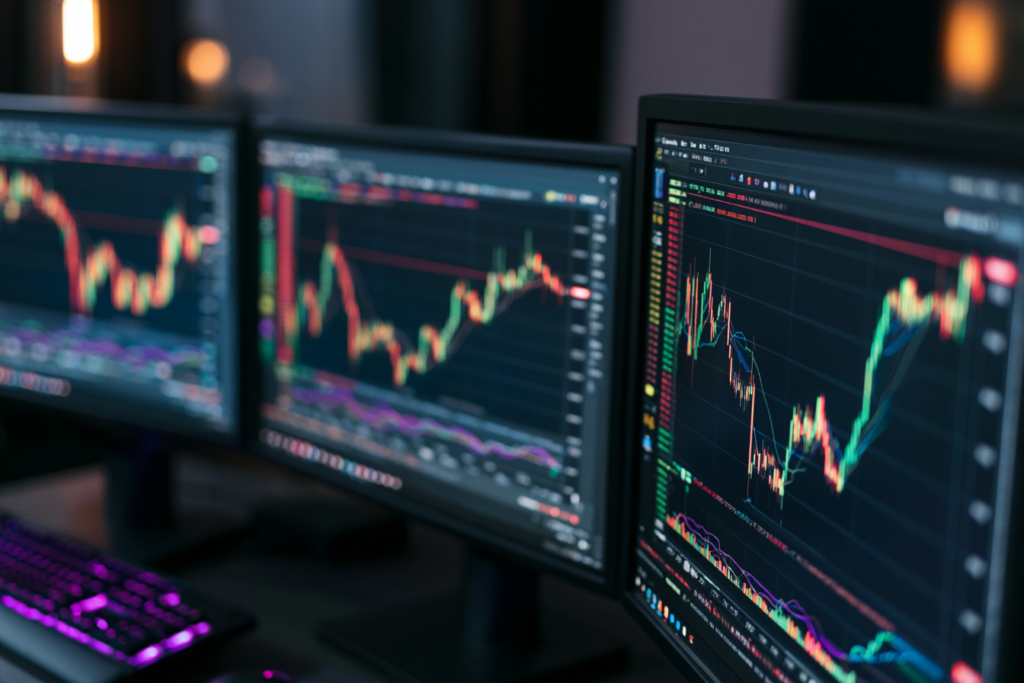
For crypto specifically, the stakes around data quality are higher than in any other market. Someone running Bitcoin scalps or altcoin breakout setups on a 15-minute delayed feed isn’t just seeing old prices — they are rehearsing reactions to a market that closed the door on those conditions before the screen even updated. Volatility spikes that define crypto appear, resolve, and reverse in the time a delayed screen takes to update once.
This is part of why the push toward regulated crypto derivatives is significant. Coinbase recently received CFTC approval to offer perpetual futures to U.S. traders — instruments where real-time data isn’t a feature preference but a basic requirement for meaningful practice.
What to Look for in a Quality Simulator
Not all platforms disclose where their prices originate. A few questions worth asking before investing time in any platform:
- Does it cover the markets you actually trade — crypto, forex, stocks, CFDs?
- Can you start practicing immediately, without registration or a funded account?
- Does the price feed reflect live market conditions rather than a fixed delay?
- Does it work across different asset classes so you can test strategies in more than one market?
The data source underneath any simulator determines whether your practice time builds transferable skills or just mileage on the wrong road.
Final Word: The Habit Transfer Problem
When you train with live prices, you develop a calibrated sense of how fast conditions change, when to act, and when to wait. That calibration is built through repetition against real data. It also shapes something less obvious: your willingness to trust a tool enough to act on it.
A recent survey of over 1,000 crypto investors found strong resistance to fully autonomous trading tools, with most respondents preferring to stay in control of their own decisions. That preference only holds up in practice if the simulator you trained in actually reflected real market behavior — otherwise the confidence you carry into live trading is built on a fiction.
The goal of a simulator is not to make practice easy. It is to make practice accurate, a simulator with access to real-time market data is generally better positioned to provide a realistic training environment.
*This article was paid for. Cryptonomist did not write the article or test the platform.