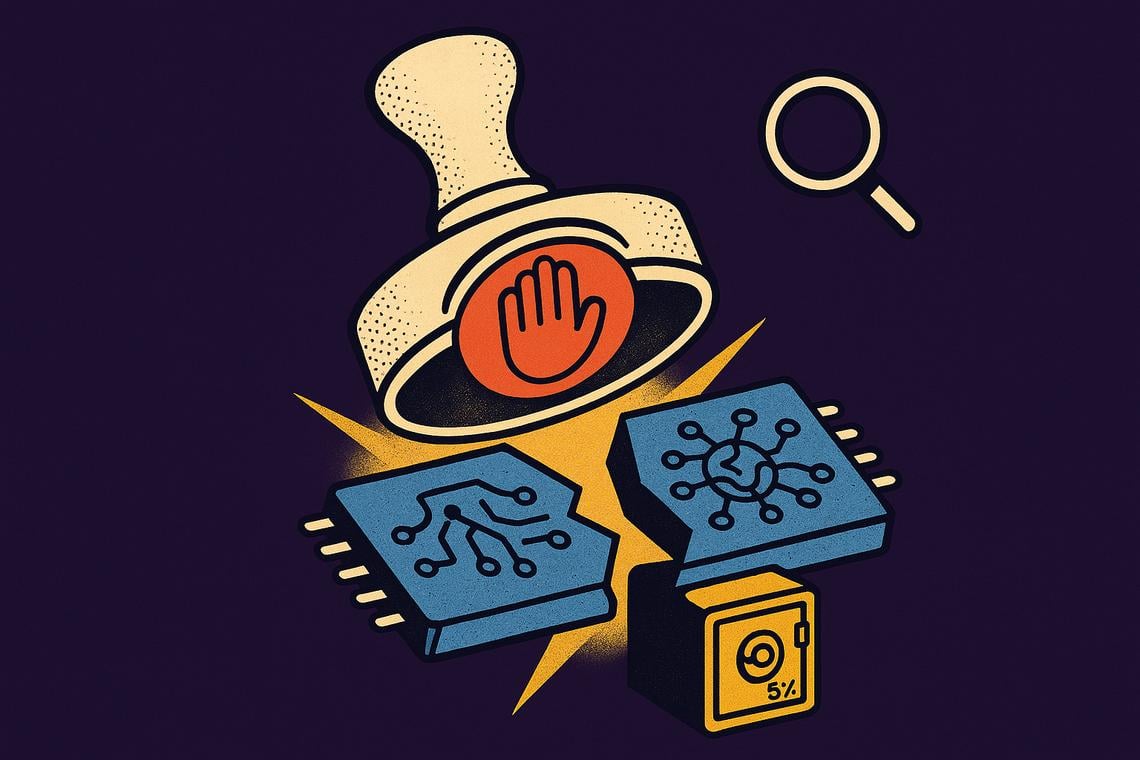
Both Anthropic and the Trump administration are pushing back against reports that the government could take an equity stake in the AI company — but the denial itself raises more questions than it answers. The story broke on July 3, 2026, when a source told Reuters that no such discussions had taken place. Anthropic declined to comment directly, and neither the White House nor the Commerce Department responded to press inquiries. That leaves a carefully worded non-denial sitting alongside one of the more striking proposals circulating in Washington right now: that the US government AI equity stake idea, reportedly floated first by OpenAI, could eventually extend to the entire frontier AI sector.
Summary
Key takeaways
- Both Anthropic and the Trump administration deny any discussions about a government equity stake in Anthropic, though no named official went on record.
- The Financial Times reported that OpenAI proposed giving the US government a 5% equity stake worth approximately $42.6 billion, structured as a donation into a public wealth fund modeled on Alaska’s Permanent Fund.
- Sam Altman has been raising the equity idea with the administration since early 2025, and discussed it with Trump, Commerce Secretary Howard Lutnick, and Treasury Secretary Scott Bessent.
- The Commerce Department recently lifted export controls on two of Anthropic’s advanced AI models, weeks after imposing them over national security concerns.
- Senator Bernie Sanders has proposed a separate, more aggressive approach: a one-time 50% stock tax on large AI companies to fund a public AI wealth fund potentially worth up to $7 trillion.
Denials That Leave the Door Open
A denial sourced to an unnamed person familiar with the matter is a specific kind of non-statement. It is not Anthropic saying it publicly. It is not a White House press secretary going on record. What it does is create a firebreak between Anthropic and a Financial Times report that named the company alongside OpenAI, Google, and Meta as potential participants in a broader government equity scheme.
The FT story, published the same day as the Reuters denial, described talks that are “conceptual” and in early stages. Naming a company in a hypothetical structure is not evidence that the company has agreed to join it. Still, Anthropic’s decision not to issue a direct on-record statement — and the administration’s silence — means the formal position rests on thinner ground than a headline denial might suggest.
What matters here is the architecture of the situation: any equity deal involving a company like Anthropic or OpenAI would look nothing like the Intel case. These are not companies seeking government capital. They are valued in the hundreds of billions, preparing for potential IPOs that some investors believe could push them past a $1 trillion valuation. Any arrangement would be structured as a negotiated partnership, not a rescue — which changes the leverage dynamics entirely.
OpenAI’s 5% Proposal: What Is Actually Being Discussed
The Financial Times report that triggered all of this described a concrete proposal: OpenAI pitching the US government a 5% equity stake, valued at roughly $42.6 billion based on the company’s $852 billion valuation from its March 2026 funding round. The mechanism would involve donating shares — not selling them — into a public wealth fund structured loosely after Alaska’s Permanent Fund, which invests state oil revenues and distributes dividends to residents.
OpenAI first outlined a version of this idea in an April policy paper, calling for a “public wealth fund” that could give “every citizen — including those not invested in financial markets — with a stake in AI-driven economic growth.” Sam Altman has reportedly been developing this concept with the administration since early 2025, holding conversations with President Trump, Commerce Secretary Howard Lutnick, and Treasury Secretary Scott Bessent.
The proposal envisions other major US AI firms — including Anthropic, Google, and Meta — ceding similar stakes. Whether any of those companies have engaged with the idea or agreed to participate remains unclear. That uncertainty is precisely what made the Reuters denial newsworthy: Anthropic was included in the FT’s framing, and the response was a careful step backward rather than a flat rejection.
Why the Structure Matters
Framing equity transfer as a donation into a sovereign-style fund is strategically significant. It sidesteps the optics of a government buying stakes in private companies, and it positions AI firms as civic contributors rather than regulated entities under pressure. It also sets a very different political tone than what Senator Bernie Sanders is proposing from the other side of the aisle.
Political and Regulatory Context
President Trump said in early June 2026 that he was exploring ways to give Americans a stake in leading AI companies, describing it as potentially “a beautiful thing” that would make the public “partners in this revolution.” Those remarks were made directly to reporters and represent the clearest on-record signal that the administration views AI equity redistribution as a live policy option.
Export Controls and Anthropic’s Regulatory Exposure
Separately, the Commerce Department recently lifted export controls on two of Anthropic’s most advanced AI models. Those restrictions had been imposed just weeks earlier over national security concerns about foreign access. The quick reversal — following Anthropic’s resolution of the government’s safety objections — illustrates how tightly the administration’s regulatory posture and its broader AI industry relationships are intertwined.
For Anthropic, that sequence matters. A company that just navigated a government-imposed model suspension has strong incentive to maintain productive relations with Washington, regardless of what any unnamed source says about equity talks.
The Sanders Counterproposal
Senator Bernie Sanders has taken a sharply different approach. His proposed legislation would impose a one-time 50% stock tax on large AI companies, with proceeds funding a public AI wealth fund that his office estimates could eventually reach $7 trillion. Altman has reportedly spoken with Sanders directly in recent weeks, suggesting some degree of engagement with the legislative pressure even as the administration pursues its own version of the concept.
Viewed alongside Sanders’ proposal, OpenAI’s 5% offer looks less like generosity and more like a calculated preemption. A voluntary 5% stake donated to a public fund is a substantially more palatable outcome than a mandatory 50% tax imposed by Congress. The gap between those two positions is where the real negotiation is happening.
The Intel Precedent and What It Means for AI
Washington already holds equity in a major tech company. Under the CHIPS Act, the government converted grants into roughly a 10% stake in Intel — a passive position that has since risen considerably in value. That deal happened because Intel needed the capital and had limited room to negotiate. The company was, in a real sense, a counterparty that required assistance.
OpenAI and Anthropic are in a fundamentally different position. They are not distressed assets seeking rescue. That distinction shapes everything about how any potential government stake would be structured, priced, and governed — and it explains why AI executives are handling the word “discussions” with such precision right now. The Intel model is on the books and visible; the AI equity question is still being defined, and whoever controls the framing of that definition will have significant influence over what any final arrangement actually looks like.
FAQ
Did Anthropic and the Trump administration discuss a government equity stake in Anthropic?
No. Both Anthropic and the Trump administration deny any discussions about the government taking an equity stake in Anthropic. However, neither issued a direct on-record statement — the denial came through an unnamed source, and Anthropic declined to comment directly when contacted by Reuters.
What is the nature of the equity stake proposal reportedly made by OpenAI?
OpenAI proposed giving the US government a 5% equity stake worth about $42.6 billion through a donation of shares into a public wealth fund modeled on Alaska’s Permanent Fund. The talks are described as conceptual and in early stages, with CEO Sam Altman having raised the idea with the administration since early 2025.
What regulatory changes have recently affected Anthropic?
The US Commerce Department recently lifted export controls on two of Anthropic’s advanced AI models, which had been imposed just weeks earlier over national security concerns about inadequate safeguards for foreign access.
What legislative proposals exist regarding AI companies’ public contributions?
Senator Bernie Sanders proposed a one-time 50% stock tax on large AI companies to create a public AI wealth fund that his office estimates could eventually be worth up to $7 trillion — a significantly more aggressive approach than the voluntary equity donation model OpenAI has floated.
Article produced with the assistance of artificial intelligence and reviewed by the editorial team.