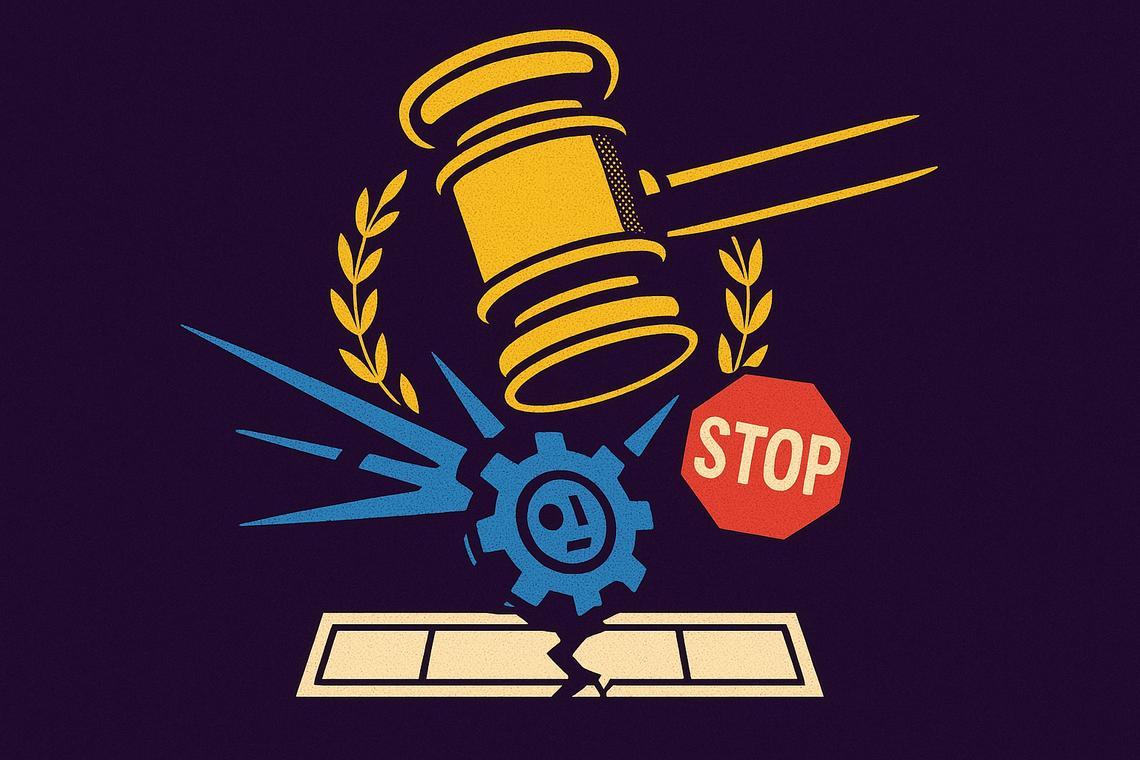
Europe’s top financial authorities are sounding the alarm: AI regulation in Europe is falling dangerously behind the technology it is supposed to govern. At the European Central Bank’s annual meeting in Sintra, Portugal — the continent’s equivalent of the Jackson Hole symposium — senior policymakers gathered on July 6, 2026 to confront a question that no one has fully answered yet: how do you regulate something that changes faster than the rules written to contain it?
Summary
Key takeaways
- European central bankers warn that AI is advancing faster than existing financial regulations, with current rulemaking processes unable to keep pace.
- Policymakers, including the Bank of England’s Sarah Breeden, propose safeguards such as market circuit breakers and kill switches to halt trading if faulty AI models trigger systemic disruption.
- ECB President Christine Lagarde describes AI as a more serious challenge than traditional cybersecurity threats, because defensive capabilities and funding have not caught up.
- The BIS warned on June 28 that prolonged AI enthusiasm could expose markets to a sudden correction, while the IMF flagged a mismatch between long-term AI infrastructure and short-term debt financing.
- Austria urged the EU to establish Anthropic within Europe after U.S. export controls forced the company to temporarily suspend access to its Fable 5 and Mythos 5 models.
Central Banks Warn AI Outpaces Financial Regulation
The core anxiety running through Sintra this year was not inflation or interest rates — it was the speed of AI itself. Senior officials from multiple institutions converged on a shared concern: that agentic artificial intelligence is evolving within weeks or months, while the regulatory machinery designed to manage systemic risk still operates on timelines measured in years.
ECB President Christine Lagarde put it bluntly in an interview with French newspaper Les Échos. For roughly a decade, she said, policymakers have wrestled with cybersecurity risks — hacking, data theft, operational disruption. But AI presents something categorically different. “We are confronted with a much more serious risk,” Lagarde said, “because it is happening very, very quickly, and because the means of defense — and the funding required for them — have yet to be found.” In her framing, AI has effectively rendered the old threat model obsolete.
That framing matters. When the head of the ECB draws a distinction between conventional cyber threats and the challenge posed by fast-evolving AI models, it signals that Europe’s central banking establishment no longer sees this as a future problem. It is a present one.
Proposed Safeguards to Manage AI Market Risks
Bank of England Deputy Governor Sarah Breeden gave the Sintra meeting its most concrete proposal. Speaking on Tuesday, she argued that greater AI deployment in financial markets may require guardrails analogous to the circuit breakers already used to halt runaway trading in equities markets — or, more radically, kill switches capable of stopping market-wide activity if a faulty AI system triggers a meltdown during a period of stress.
Right now, Breeden acknowledged, trading firms mostly deploy autonomous AI for lower-risk operational work — research, data processing, routine analysis. But she was clear that this could shift quickly, and that regulators need to be ahead of that shift rather than reacting to it.
Her concern does not stop at trading algorithms. Rising debt financing tied to AI investments adds another layer of fragility. If AI-related asset prices decline sharply, the financial stability implications could extend well beyond the technology sector, feeding into broader credit conditions and market confidence. The feedback loop she is worried about is systemic, not just sectoral.
Wider Regulatory Challenges and Financing Concerns
UK Financial Conduct Authority Chief Executive Nikhil Rathi was equally direct in his diagnosis, telling CNBC’s Squawk Box Europe that the traditional cycle of rulemaking simply does not work for technologies that evolve at this speed. “The reality is some of these technologies now move in weeks, or months,” he said, “and the traditional cycle of rulemaking simply doesn’t work in that way.” His prescription: new tools, and a more collaborative relationship between regulators and industry rather than a reliance on lengthy, top-down rulemaking.
Rathi was careful to avoid framing this as a call to slow AI adoption. The FCA does not want to stand in the way of innovation, he said. But transparency about where risks lie is non-negotiable, particularly when regulators cannot yet fully monitor some of the exposures being created.
The financing dimension deserves its own attention. IMF Director of Monetary and Capital Markets Tobias Adrian flagged on June 30 a structural mismatch that tends to get lost in the excitement around AI buildout: the physical infrastructure underpinning AI systems — data centers, chips, power facilities — is long-lived, but much of the debt being used to finance it carries shorter maturities. That gap between asset longevity and financing structure is precisely the kind of vulnerability that becomes dangerous when sentiment shifts.
Macroeconomic Implications and Market Correction Risks
The most pointed macro warning came before Sintra. In a June 28 report, the Bank for International Settlements warned that prolonged enthusiasm around AI could leave markets exposed to a sudden and disruptive correction. The mechanism the BIS identified is a familiar one in financial history: extended risk-taking pushes asset valuations beyond fundamentals, and when monetary policy tightens to contain inflation, the reversal can be sharp.
What makes the AI version of this dynamic particularly concerning is the potential for feedback loops. A sharp fall in AI-related asset prices would not just hit equity portfolios — it could tighten credit conditions for the very infrastructure investments driving the next phase of AI development, creating a self-reinforcing contraction. The BIS is not predicting this outcome, but it is warning that the conditions for it are forming.
Taken together, the messages from Sintra, the BIS, and the IMF sketch a coherent picture: AI is generating genuine productivity gains and real economic value, but it is also building up financial system vulnerabilities that current regulatory frameworks were not designed to handle.
EU Access to Advanced AI Models amid US Export Controls
The sovereignty dimension of Europe’s AI problem became sharply visible in June, when Anthropic suspended public access to its Fable 5 and Mythos 5 models after a U.S. export control directive required the company to block access for foreign nationals. The stated reason involved cybersecurity concerns tied to a reported jailbreak technique. U.S. authorities later cleared both models for redeployment after Anthropic introduced new classifiers and safeguards designed to block the relevant misuse vector.
But the episode exposed something deeper than a temporary access outage. Austria’s State Secretary for Digitalization, Alexander Proell, used the moment to push the European Union toward a structural solution: establishing Anthropic within the EU itself, so that access to frontier AI models cannot be switched off by decisions made in Washington. Europe, Proell argued, cannot afford to find itself dependent on AI capabilities it does not control.
ECB Vice-President Boris Vujčić echoed the underlying concern at Sintra, noting that while Europe has historically shown an ability to adopt and adapt new technologies, it has not always been at the frontier — and the AI race is moving too fast for a catch-up strategy to feel comfortable.
The regulatory and the geopolitical challenges are, in this sense, two faces of the same problem. AI regulation in Europe cannot be resolved purely through domestic rulemaking if European institutions remain dependent on AI models whose access can be revoked by foreign governments. That is the harder structural question that Sintra raised — and the one that no circuit breaker or kill switch can fully address.
FAQ
Why do European central banks see AI as a regulatory challenge?
Because AI is advancing faster than current financial regulations can accommodate. Traditional rulemaking processes operate on timelines of years, while agentic AI systems can change materially within weeks or months. This creates a gap between the risks being generated in financial markets and the tools available to monitor and contain them.
What safeguards are being proposed to mitigate AI risks in financial markets?
Policymakers, including Bank of England Deputy Governor Sarah Breeden, have proposed safeguards analogous to market circuit breakers or kill switches — mechanisms that could halt trading market-wide if a faulty AI model triggers systemic disruption during a period of market stress.
How have U.S. export controls affected European access to advanced AI models?
A U.S. export control directive in June 2026 forced Anthropic to suspend public access to its Fable 5 and Mythos 5 models for foreign users. The models were later cleared after Anthropic introduced new safeguards. The episode prompted Austria to urge the EU to explore establishing Anthropic’s operations within Europe, reducing dependence on externally controlled AI access.
What financial risks are linked to AI investments according to IMF and BIS?
The IMF’s Tobias Adrian highlighted a structural mismatch between the long-term nature of AI infrastructure assets and the shorter maturities of the debt used to finance them — a vulnerability that could amplify stress if sentiment shifts. The BIS warned in a June 28 report that prolonged AI-driven enthusiasm in markets could leave asset prices exposed to a sharp correction, potentially creating disruptive macro-financial feedback loops.
Article produced with the assistance of artificial intelligence and reviewed by the editorial team.