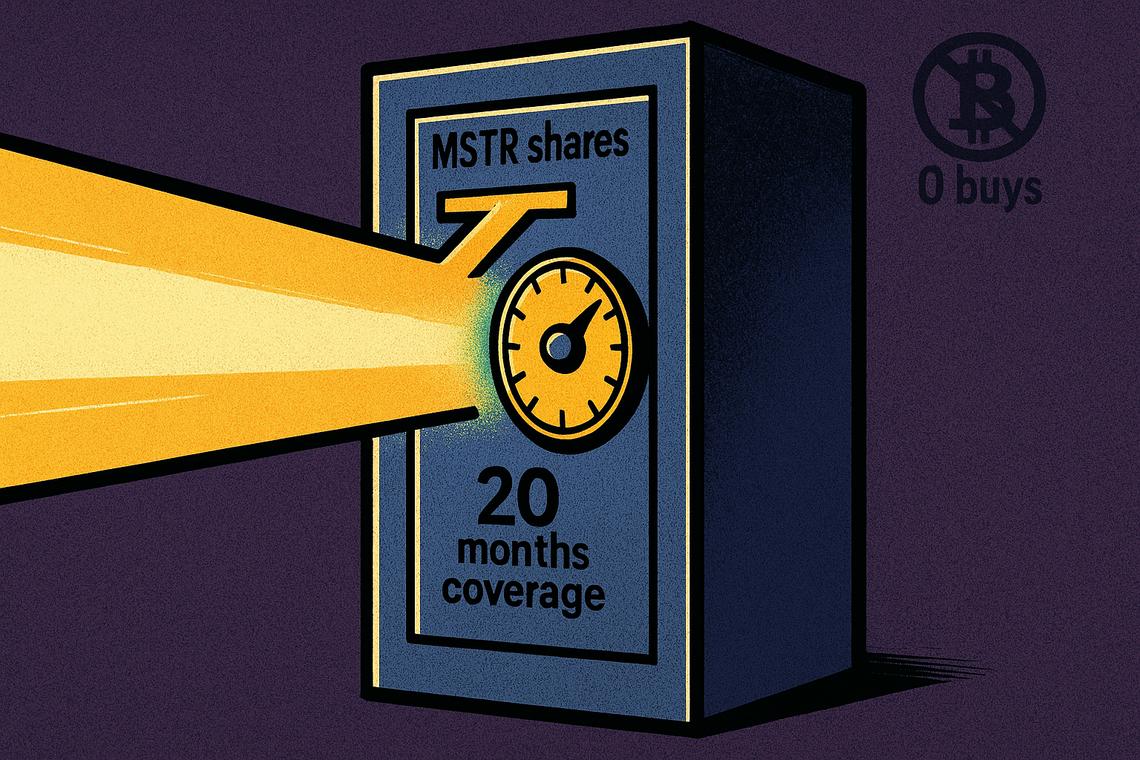
Strategy just did something that would have seemed unthinkable a year ago: it sold nearly $467 million of its MSTR common stock last week without buying a single satoshi of bitcoin. For a company that built its entire identity around aggressive bitcoin accumulation, a week of deliberate restraint carries real significance — and Wall Street analysts are paying close attention.
Summary
Key takeaways
- Strategy sold nearly $467 million of MSTR common stock last week, buying no additional bitcoin and keeping holdings steady at 843,775 BTC.
- The company’s USD reserve grew to $3 billion, extending dividend obligation coverage to over 20 months.
- Analysts at TD Cowen and Benchmark see the moves as adherence to the Digital Credit Capital Framework, reiterating Buy ratings of $260 and $570 respectively.
- The share sale is viewed as a deliberate effort to build a dividend war chest and ease investor concerns about servicing preferred securities and convertible debt.
- MSTR stock was trading near a long-term low of $91.50 at the time of reporting.
Strategy’s Stock Sale and Unchanged Bitcoin Holdings
Strategy’s bitcoin holdings remain unchanged at 843,775 BTC — a figure that would normally signal a pause, not a strategy. But this time, the context matters more than the number. The company deliberately redirected capital toward strengthening its balance sheet rather than adding to its already-massive crypto position.
The decision to raise nearly half a billion dollars through an MSTR stock sale, without deploying any of it into bitcoin, marks a meaningful shift in tone. This is not the same Strategy that was buying bitcoin week after week regardless of price conditions. What’s happening now is more calculated.
Importantly, the pause on bitcoin purchases is not being read as bearish by the analysts covering the stock. According to notes published Monday by both TD Cowen and Benchmark, the move signals something more deliberate: Strategy’s balance sheet discipline is taking center stage over near-term bitcoin accumulation. The message from management, as analysts interpret it, is that growing bitcoin-per-share over the long run requires a structurally sound capital base first.
This is also the third consecutive week Strategy skipped a bitcoin purchase — a pattern that is hard to dismiss as coincidence.
Increasing USD Reserves to Support Dividend Commitments
The $467 million stock sale had a clear destination: Strategy’s USD reserve, which has now grown to $3 billion, roughly an 18% increase in a single week. That’s not just a number on a balance sheet — it has direct implications for how the company services its financial obligations.
With the larger cash cushion, Strategy’s annual dividend obligation coverage extends to over 20 months. For holders of its preferred securities, that’s a meaningful reassurance. The concern has always been whether Strategy can consistently meet its obligations to preferred stockholders and convertible debt holders without having to return to capital markets at unfavorable moments.
Benchmark analyst Mark Palmer framed the share sale as an effort to bolster what he called the “dividend war chest.” The implication is straightforward: by building this reserve, Strategy reduces the near-term pressure of being forced to tap equity or debt markets simply to cover dividend payments. That flexibility has real value, especially when MSTR stock is trading near long-term lows.
Analysts Affirm Balance Sheet Discipline and Framework Adherence
Both major analyst teams covering Strategy reached remarkably similar conclusions. The moves align with the Digital Credit Capital Framework — a structure that Strategy discussed during its recent roadshow and that appears to be guiding management’s capital allocation decisions in practice, not just in presentations.
TD Cowen analyst Lance Vitanza described the latest 8-K filing as an early indication that management is beginning to execute against the framework as outlined. The bank maintained its Buy rating and $260 price target on MSTR shares, pointing to the larger USD reserve, the absence of bitcoin purchases, and what it called a sharper focus on balance sheet discipline over near-term accumulation.
Benchmark went further in its optimism. The firm reiterated its Buy rating with a significantly higher $570 price target, framing the cash reserve increase as a structural positive that strengthens confidence in Strategy’s preferred-stock financing model. The divergence between TD Cowen’s $260 and Benchmark’s $570 price targets underlines just how wide the range of conviction is among bulls — but both are pointing in the same direction.
Strategic Focus on Preferred Stock and Dividend Stability
The core tension in Strategy’s business model has always been this: how do you keep growing bitcoin-per-share while also managing a complex capital structure that includes preferred stock and convertible debt? Those two goals don’t always move together smoothly.
What the past week suggests is that management is consciously prioritizing the stability of its capital structure in the short term. Analysts argue investors should judge Strategy not by how much bitcoin it adds each week, but by whether it is growing bitcoin per share over time while keeping its preferred stock obligations intact. That’s a different success metric than raw BTC accumulation.
The dividend war chest buildup serves a specific function here: it reduces the risk that Strategy is forced into dilutive capital raises at bad moments just to service preferred securities and convertible debt. For holders of those instruments — and for common shareholders worried about dilution — this reserve provides a buffer that the company previously lacked at this scale.
MSTR Stock Trades Near Long-Term Lows
Despite the positive analyst framing, the market’s reaction tells a more complicated story. MSTR stock was trading at $91.50 on Monday, near a long-term low. The gap between that price and even the more conservative analyst target of $260 is striking — and it hints at broader skepticism in the market about whether the bitcoin treasury strategy will ultimately deliver for common shareholders.
The stock’s weakness also adds context to why the cash reserve build matters so much right now. With MSTR under pressure, having over 20 months of dividend coverage reduces one potential source of forced selling or equity dilution at precisely the wrong time. It doesn’t solve the valuation gap, but it buys management the time and flexibility needed to let the longer-term thesis play out without being cornered by near-term obligations.
Whether the Digital Credit Capital Framework delivers the kind of financial stability that eventually re-rates the stock is the question that neither analysts nor the market has fully answered yet.
FAQ
Did Strategy buy additional bitcoin during the last week?
No. Strategy did not purchase any additional bitcoin, keeping its holdings unchanged at 843,775 BTC. This was the third consecutive week the company skipped a bitcoin purchase.
Why did Strategy sell a large portion of its MSTR stock?
Strategy sold nearly $467 million of MSTR common stock to increase its USD reserves to $3 billion, supporting dividend sustainability and reinforcing the strength of its balance sheet under the Digital Credit Capital Framework.
How do analysts view Strategy’s recent financial actions?
Analysts at TD Cowen and Benchmark both see the moves as evidence of adherence to the Digital Credit Capital Framework and a sign of greater balance sheet discipline, reiterating Buy ratings despite the stock trading near long-term lows.
What is the significance of Strategy’s increased USD reserve?
Increasing the USD reserve to $3 billion extends Strategy’s annual dividend obligation coverage to over 20 months, helping reassure investors about the company’s ability to service preferred securities and convertible debt without returning to capital markets under pressure.
Article produced with the assistance of artificial intelligence and reviewed by the editorial team.