Seven out of ten crypto traders are willing to hand over full control of their portfolios to an AI — no human double-checking every move. That finding, drawn from a survey of roughly 1,400 traders, reframes what most people assume about AI crypto portfolio management: it’s not a niche experiment embraced by tech enthusiasts. It’s already close to the market mainstream.
Summary
Key takeaways
- 70% of surveyed traders said they’d be comfortable with AI managing their portfolio autonomously, either with full control or within self-set risk limits.
- Gen Z (38%) and Millennials (37%) are more than three times as likely as Boomers (11%) to give AI full, unsupervised portfolio control.
- 79% of traders would switch exchanges entirely to access better AI-powered trading tools.
- The most trusted feature for autonomous AI is real-time notifications and instant permission revocation — and that finding held equally across all generations.
- Among traders who followed an AI trade recommendation, 55% reported it worked well, 41% saw mixed results, and only 4% experienced outright failure.
Majority of Crypto Traders Open to Autonomous AI Portfolio Management
The headline number is striking on its own. Roughly 70% of traders surveyed said they would be comfortable letting AI manage their crypto portfolio without requiring a human to review every decision — either operating with full autonomy or operating within risk parameters the trader defines themselves. That’s not a fringe view. It’s the majority position.
What makes it more than just an attitudinal data point is how it maps to actual behavior. 51% of traders already use AI tools for research or trading several times a week, and 77% have used a general AI chatbot to research a crypto position in the past three months. Comfort with autonomous AI isn’t hypothetical for most of these traders. It’s grounded in regular, hands-on use.
Self-reported outcomes back that up, to a degree. Among traders who have actually followed an AI-generated trade recommendation, 55% say it worked out well, 41% describe mixed results, and only 4% say it backfired entirely. That 4% failure rate is notably low, though self-reported performance data always carries inherent optimism bias. Still, the distribution suggests traders are drawing on real experience — not just abstract openness — when they express willingness to go further with AI autonomy.
Generational Differences in AI Portfolio Control and Trust
The generational divide here is one of the sharpest findings in the data. Gen Z (38%) and Millennials (37%) are more than three times as likely as Boomers (11%) to say they’d give an AI full, unsupervised control of their portfolio. That gap isn’t just a preference difference — it reflects fundamentally different relationships with algorithmic systems.
Younger generations more likely to grant full AI control
Younger traders have grown up inside algorithmically mediated decisions across every domain — what they watch, what they buy, who they connect with. An AI agent making a trading call doesn’t feel categorically different from any other recommendation they already act on daily. For older traders, that baseline simply doesn’t exist. And Boomers, who are often managing accumulated savings rather than a portfolio they have time to rebuild, apply a higher bar to handing over control.
Younger traders trust AI trade recommendations more than older generations
The same generational split surfaces in a related question about trust. When asked whether they trust an AI-generated trade recommendation more than advice from a human advisor, a quarter of Gen Z and Millennial traders said yes. That’s exactly double the rate among Gen X and Boomers. The pattern suggests younger traders have already normalized algorithmic advice across their financial lives — crypto trading is simply the latest domain where that default plays out.
Liability perception differs by generation
When things go wrong, who carries the blame? Boomers are the generation most likely to say they themselves bear responsibility if an AI trade goes badly. Gen Z is more inclined to point to the algorithm developer. That’s not a trivial difference. How traders assign liability shapes how aggressively they engage with autonomous tools — and has long-run implications for how regulators and platforms will need to structure accountability as AI autonomy deepens in financial markets.
Traders Demand Control Features to Build Trust in Autonomous AI
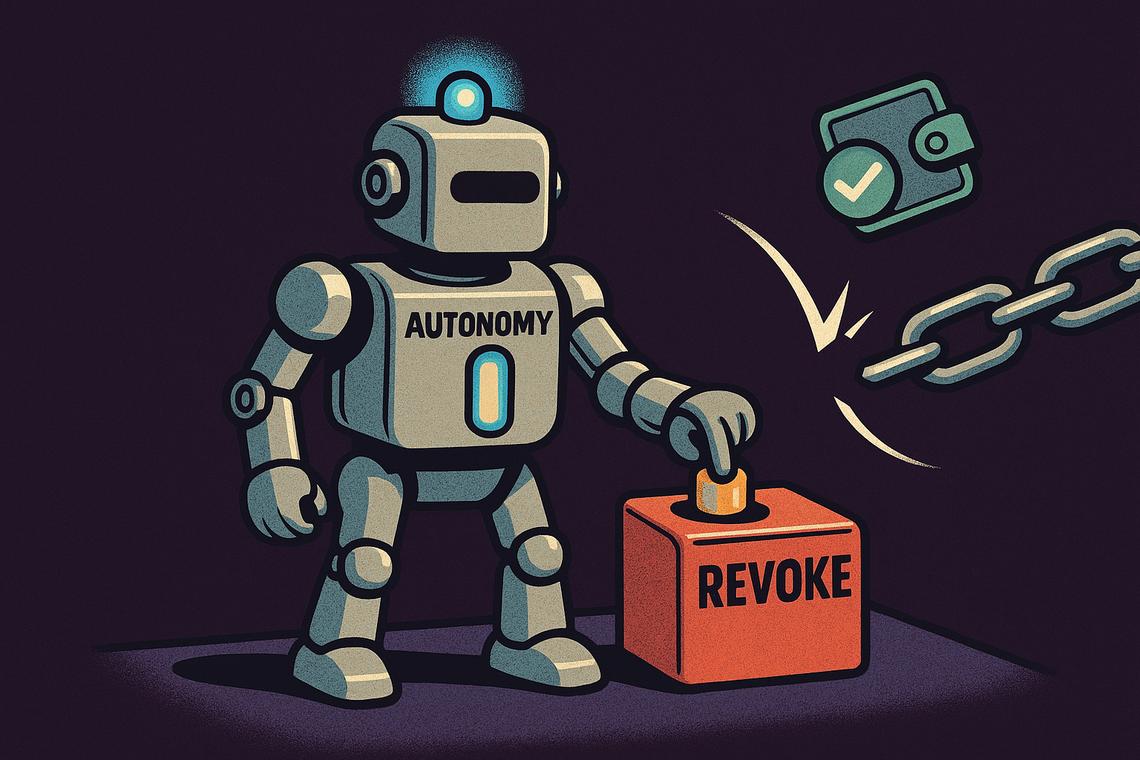
The most revealing finding may not be about willingness to hand over control — it’s about what makes that handover feel safe. When traders were asked what would most increase their trust in an AI agent making crypto decisions on their behalf, the top answer by more than two to one was the ability to receive real-time notifications and instantly revoke the AI’s permissions.
Significantly, this was the one finding that didn’t split by generation. Boomers and Gen Z agreed almost exactly. Across all ages and experience levels, the condition for trusting autonomous AI is knowing you can take control back the moment you choose to.
That reframes the relationship between autonomy and control entirely. They aren’t opposing forces — they’re the same feature. An AI agent that can be paused, overridden, or shut down on demand is more trustworthy precisely because of that constraint, not despite it. The demand for an off switch is functionally a demand for a better on switch. Industry players building AI trading infrastructure are already responding to this dynamic: Ledger, for instance, launched its Ledger Agent Stack — an open-source toolkit that allows AI agents to read wallet balances, prepare transactions, and suggest actions, while requiring every sensitive execution to be approved on a Ledger hardware device. As Ledger’s chief human agency officer Ian Rogers put it: “Agents propose. Humans approve.”
Impact on Crypto Exchanges and AI Tool Adoption
79% of traders said they would switch exchanges entirely to access better AI-powered trading tools. That’s the data point with the clearest competitive consequence. When eight out of ten users say they’d leave a platform for better AI capabilities, it becomes an existential differentiator — not a product feature.
For exchanges, this creates a sharp strategic pressure. AI tooling is no longer a value-add that improves retention at the margin. It’s become a primary reason traders choose or abandon a platform. The implication isn’t just competitive — it’s structural. Exchanges that move slowly on AI integration risk losing not just engagement, but users altogether, to platforms better positioned at the intersection of AI trading tools adoption and portfolio autonomy.
Zooming out, the broader picture from these numbers is one of a market that has already moved. The question for most crypto traders is no longer whether AI belongs in their portfolio strategy. It’s how much latitude to grant, under what conditions, and with what safety mechanisms in place. The traders who distrust autonomous AI entirely are now in the minority — and getting smaller.
FAQ
How willing are crypto traders to let AI manage their portfolios autonomously?
According to the survey of approximately 1,400 traders, 70% said they would be comfortable with AI managing their portfolio autonomously — either with full control or within risk limits they set themselves.
Are there generational differences in trust toward AI for crypto trading?
Yes, and the gap is substantial. Gen Z (38%) and Millennials (37%) are more than three times as likely as Boomers (11%) to give AI full unsupervised control of their portfolio. Younger traders also trust AI trade recommendations at twice the rate of Gen X and Boomers.
What control features do traders want when using AI for portfolio management?
Traders across all generations overwhelmingly prioritize real-time notifications and the ability to instantly revoke AI permissions. This was the top answer by more than two to one over any other feature, and it was the only finding that showed no meaningful generational split.
Would traders switch exchanges for better AI-powered trading tools?
79% of surveyed traders said they would switch exchanges to gain access to superior AI trading tools — making AI capability one of the most consequential factors in platform loyalty across the crypto industry.
Article produced with the assistance of artificial intelligence and reviewed by the editorial team.