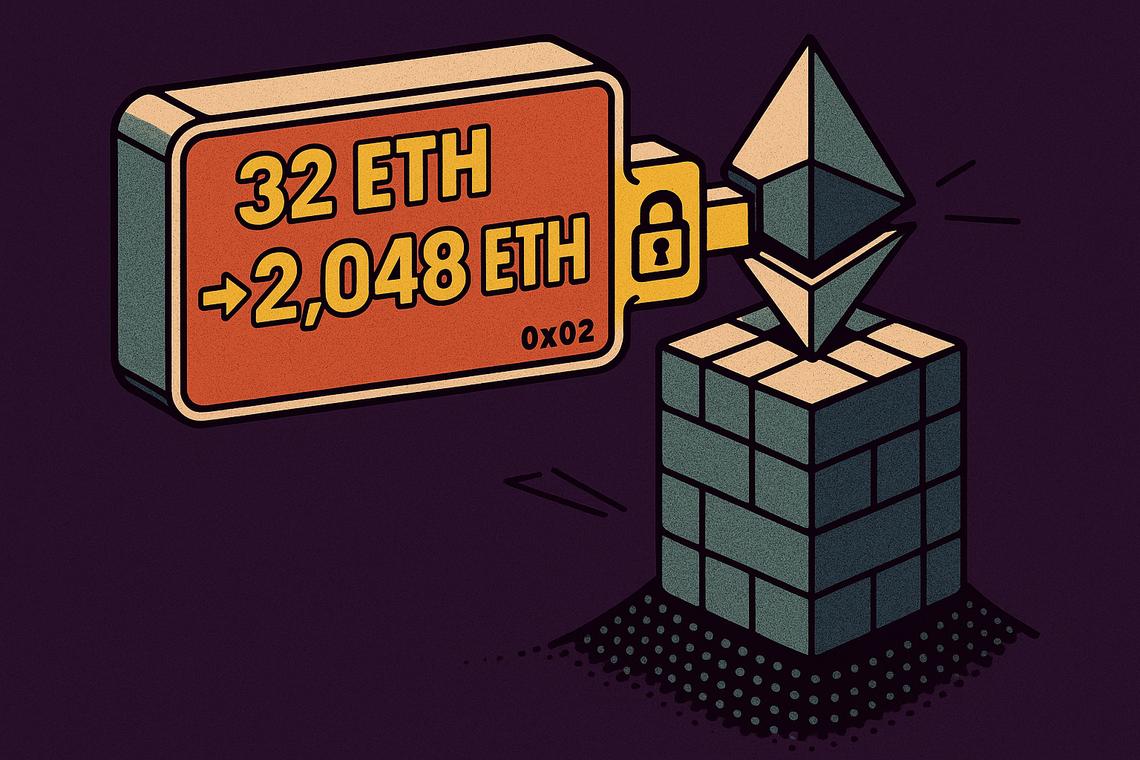
Lido just made its most consequential move in years — and the ripple effects could reshape how Ethereum’s consensus layer actually functions. The liquid staking protocol‘s Lido Ethereum upgrade, known as Curated Module v2, has officially launched, targeting a structural overhaul of how validators are managed and how staked ETH is consolidated across the network.
Summary
Key takeaways
- Lido’s Curated Module v2 (CMv2) is the protocol’s largest upgrade since Lido V2 in 2023, consolidating over 8 million staked ETH worth roughly $16.5 billion onto Ethereum’s post-Pectra validator architecture.
- The upgrade supports 0x02 withdrawal credentials, raising the maximum validator balance from 32 ETH to 2,048 ETH per validator.
- Ethereum’s total validator count could fall from approximately 880,000 to around 628,000 — a one-third reduction — based on Lido’s projections, though migration has not yet started.
- Attestation messages across the Ethereum network are expected to drop by roughly 29% per epoch, easing consensus layer load without affecting gas fees or transaction speeds.
- For the first time in Lido’s history, all 34 curated node operators must post locked ETH bonds, introducing real financial accountability.
Lido launches Curated Module v2 to improve Ethereum staking
Lido’s CMv2 is being described internally as the biggest change to how Lido Core staking works since the 2023 V2 launch. That comparison carries weight — the 2023 upgrade was itself a turning point for liquid staking infrastructure. This one goes further.
“This is the biggest change to how Lido Core staking works since Lido V2,” said Isidoros Passadis, chief of staking at Lido Labs Foundation. “The node operators securing the majority of ETH staked via Lido are consolidating onto far fewer validators, and for the first time, they’re backing that stake with their own capital.”
That last point matters more than the headline number. For five years, Lido’s curated node operators were held accountable mainly through reputation and track record. Now, they’re required to put up locked ETH bonds — meaning poor performance or slashing events carry a direct financial cost. The dynamic fundamentally changes operator incentives.
Upgrade supports Ethereum’s 0x02 withdrawal credentials
The technical backbone of the upgrade is support for Ethereum’s 0x02 withdrawal credentials, introduced as part of Ethereum’s Pectra upgrade. Under the old framework, each validator was capped at a 32 ETH effective balance. The new design allows a single validator to hold up to 2,048 ETH — a 64x increase in capacity per validator slot.
That change alone is what makes the consolidation arithmetically possible. Fewer validators can now secure the same or greater amount of staked ETH, which is exactly what Lido is executing with its more than 8 million ETH position.
Validator balance capacity raised to 2,048 ETH
According to Lido, the protocol is consolidating more than 8 million staked ether — valued at approximately $16.5 billion — onto Ethereum’s post-Pectra validator design. The upgrade also introduces new operator incentives, bond-based security mechanisms, and governance improvements that could shift how future stake is distributed among node operators based on performance, fees, and ecosystem contributions.
Projected impact on Ethereum’s validator count and network performance
The projected drop in the Ethereum validator count — from roughly 880,000 to around 628,000 — represents one of the most significant structural shifts the network has seen since the Merge. And the implications extend beyond Lido’s own infrastructure.
Fewer validators mean fewer messages circulating on the consensus layer. According to CoinDesk, citing Lido, attestation messages across the entire Ethereum network are expected to fall by roughly 29% per epoch. That’s a material reduction in background processing load for node operators across the ecosystem, not just those within Lido’s curated module.
Estimated reduction of validators by one-third
It’s worth being precise about what these figures represent. The migration has not yet started. The validator count projections are based on Lido’s own modeling, not observed outcomes. Still, the scale of Lido’s position — as the largest staking pool on Ethereum — means even partial execution of this consolidation would register as a significant event at the network level.
The fact that Lido controls enough staked ETH to move Ethereum’s total validator count by one-third on its own is itself a remarkable illustration of how concentrated liquid staking has become. That concentration is precisely why the upgrade’s governance and accountability components deserve as much attention as the technical specifications.
Consensus layer optimization without affecting transaction fees
One thing the upgrade does not do: change anything about how Ethereum processes transactions. The CMv2 change is scoped entirely to the consensus layer — the part of Ethereum responsible for validating blocks and reaching agreement across the network. Gas fees, transaction speeds, and execution-layer activity remain untouched. Regular Ethereum users won’t notice a difference in their interactions with the chain.
New accountability and governance measures for node operators
The bonding requirement for Lido’s 34 curated node operators is the governance shift that may prove most durable. Previously, the curated module relied on a permissioned, reputation-based model. Operators were selected and trusted, but they faced no direct financial penalty if their performance degraded. That changes with CMv2.
Under the new system, operators must post locked ETH bonds — capital that can be slashed through penalty mechanisms if they underperform or act against the network’s interests. The model mirrors how Ethereum itself enforces validator behavior, and it aligns Lido’s internal accountability structure more closely with on-chain norms.
Lido has also signaled that future stake distribution could weight operator performance, fees, and contributions to Ethereum’s broader ecosystem more heavily. That introduces a competitive dynamic among operators that simply didn’t exist before.
For stETH holders and anyone participating in Lido’s liquid staking product, none of this requires any action. The upgrade is handled entirely at the protocol level — no wallet interactions, no token migrations, no manual steps.
What does demand attention is the longer-term question of governance: as Lido’s influence over Ethereum’s validator set deepens, the accountability structures it builds internally become a matter of network-wide interest, not just internal protocol design. CMv2 is a meaningful step in that direction — but it also underscores how much weight a single protocol now carries on the world’s largest smart contract platform.
FAQ
What is the purpose of Lido’s Curated Module v2 upgrade?
The Curated Module v2 upgrade aims to improve Ethereum validator efficiency and decentralization by increasing validator balance capacity from 32 ETH up to 2,048 ETH per validator and reducing the total number of validators required to secure the network.
How will the upgrade affect the number of Ethereum validators?
Based on Lido’s projections, the upgrade could reduce Ethereum’s total validator count from approximately 880,000 to roughly 628,000 — a decrease of about one-third. However, the migration has not yet started, and these remain Lido’s estimates.
Does the upgrade affect Ethereum transaction fees or execution layer activity?
No. The upgrade targets Ethereum’s consensus layer only. It does not affect execution-layer activity, meaning gas fees, transaction speeds, and user-facing interactions with the Ethereum network remain unchanged.
Do stakers need to take any action to benefit from the upgrade?
No action is required from stakers. The upgrade is handled entirely at the protocol level, so stETH holders and Lido participants do not need to take any steps to benefit from or adapt to the changes.
Article produced with the assistance of artificial intelligence and reviewed by the editorial team.