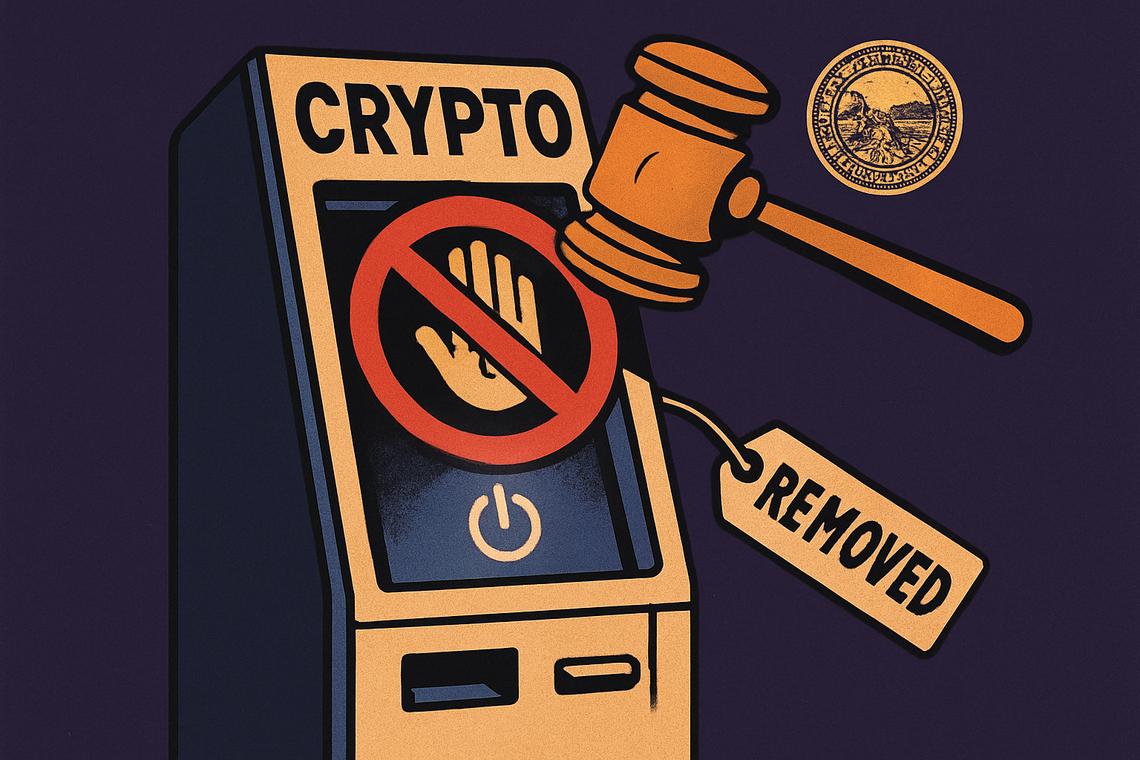
A new law took effect in Minnesota on Saturday that wipes out an entire category of machines many residents have used to buy Bitcoin and other digital assets. The Minnesota crypto ATM ban arrives after state officials tied roughly $1 million in scam losses to crypto kiosks between 2023 and 2025, with senior citizens bearing the brunt of the fraud.
Summary
Key takeaways
- Minnesota’s ban on virtual currency kiosks took effect August 1, 2026, under bill SF 3868, signed by Governor Tim Walz on May 5, 2026.
- Operators must deactivate machines by August 1 and physically remove them from public locations by December 31, 2026.
- State officials linked about $1 million in scam losses to crypto ATMs from 2023 to 2025, disproportionately affecting seniors.
- The FBI’s Internet Crime Complaint Center reported more than $151 million in Minnesota losses tied to crypto or crypto wallets in 2025 alone.
- CoinATMRadar counted 201 crypto ATMs and kiosks operating across Minnesota just before the ban took hold.
Minnesota Implements Statewide Ban on Crypto ATMs
Minnesota has become the latest state to pull the plug on virtual currency kiosks entirely, rather than simply regulating how they operate. The prohibition means no company can install, operate, maintain, or make available a crypto ATM anywhere in the state going forward, closing off a channel that fraud investigators say has become a favorite tool for scammers targeting vulnerable residents.
Legislative Details and Compliance Deadlines
The law traces back to SF 3868, a bill Governor Tim Walz signed on May 5, 2026. It gave the industry a runway rather than an overnight shutdown. Operators with machines already installed had until August 1 to deactivate them, but they get extra time — until December 31, 2026 — to physically haul the kiosks out of spots visible or accessible to the public. That two-step timeline gives businesses room to wind down operations without immediately stranding equipment, while still forcing every functioning terminal offline on day one.
Crypto Kiosk Scams and Impact on Minnesota Residents
Behind the legislation is a pattern regulators say became too costly to ignore: scammers steering panicked victims toward crypto ATMs to move money fast and untraceably. Minnesota’s commerce department found that residents lost close to $1 million through scams connected to these machines between 2023 and 2025 — and that figure only scratches the surface of the state’s broader crypto fraud problem.
Losses and Demographic Targeting
Officials described the schemes as disproportionately targeting seniors, often through manufactured emergencies. Victims were pressured to act quickly, sending funds under the belief that a loved one or an urgent situation demanded immediate payment through a crypto kiosk. That urgency, combined with the irreversible nature of crypto transactions, made the machines an efficient tool for fraudsters and a difficult one for victims to recover money from once funds left the terminal.
Law Enforcement and Reporting Data
The scale of the problem looks even larger when measured against the FBI’s Internet Crime Complaint Center data. The bureau reported more than $151 million in Minnesota losses tied to crypto or crypto wallets in 2025 alone — a figure that dwarfs the $1 million specifically linked to ATM scams and underscores how much broader the crypto fraud landscape has become beyond kiosks. This is one of the moments where the numbers matter for anyone watching regulation nationally: state-level crypto kiosk bans are being justified not just by anecdotal fraud reports, but by federal reporting data that shows losses climbing into the hundreds of millions in a single state within a single year.
Broader US State Responses to Crypto ATM Fraud
Minnesota isn’t acting alone. Its outright ban puts it alongside a small but growing group of states willing to shut kiosks down completely rather than layer on new rules.
Regulatory Actions in Tennessee, Georgia, Delaware, and New Jersey
Tennessee began enforcing its own total ban on crypto ATMs starting July 1, matching Minnesota’s hard-line approach. Georgia took a different route the same day, imposing transaction limits and other restrictions rather than eliminating the machines outright. Delaware and New Jersey lawmakers have advanced similar bills, suggesting more states could follow with either full bans or tighter guardrails depending on how their legislatures weigh consumer protection against continued market access. Why this matters for the industry: a patchwork of state rules — full bans in some places, transaction caps in others — creates a fragmented compliance landscape for crypto ATM operators trying to run a national footprint.
Market Size Before Ban in Minnesota
Before the shutdown, Minnesota’s crypto kiosk footprint was sizable. Data from CoinATMRadar showed 201 crypto ATMs and kiosks operating across the state right up until the ban took effect on August 1. That number gives a sense of how embedded these machines had become in everyday retail and convenience locations — and how much infrastructure now has to be wound down under the state’s new compliance deadlines.
FAQ
When did Minnesota’s crypto ATM ban become effective?
The ban took effect on August 1, 2026, after Governor Tim Walz signed bill SF 3868 on May 5, 2026.
Why did Minnesota ban crypto ATMs?
The ban followed roughly $1 million in losses reported by Minnesota residents, mostly seniors, from scams tied to crypto ATMs between 2023 and 2025.
What are the compliance requirements for crypto ATM operators in Minnesota?
Operators had to deactivate all crypto ATMs by August 1, 2026, and must remove the physical machines from public locations by December 31, 2026.
Are other US states taking similar action against crypto ATM scams?
Yes. Tennessee enforced a full ban starting July 1, Georgia introduced transaction limits the same day, and Delaware and New Jersey lawmakers have advanced comparable bills.
Article produced with the assistance of artificial intelligence and reviewed by the editorial team.