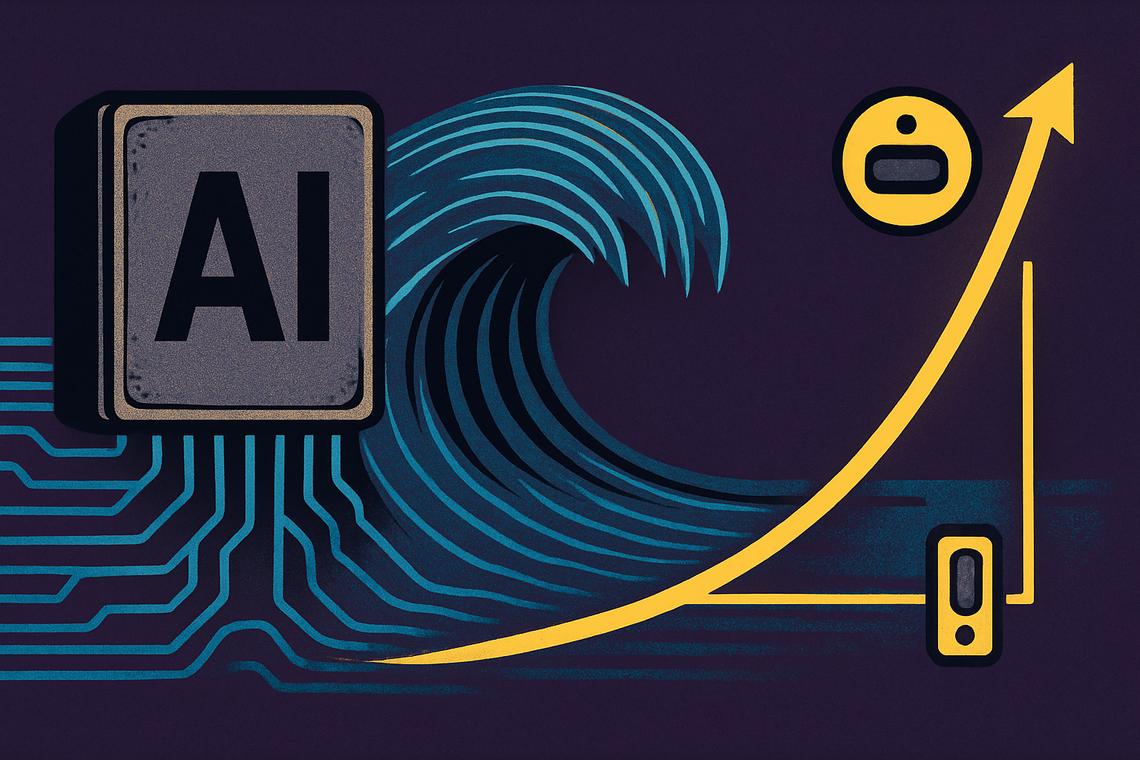
Elon Musk is once again framing artificial intelligence as an unstoppable force, and this time he’s put a chart behind the claim. In a post on X this week, Musk described the pace of AI growth as a “supersonic tsunami,” pointing to a curve that stayed flat for years before snapping sharply upward once 2026 began. The comparison lands at a moment when Musk’s own AI lab is posting benchmark wins, rival labs are trading places in his personal rankings, and leading researchers can’t agree on how close machines are to matching human intelligence.
Summary
Key takeaways
- Musk posted a chart on X showing AI progress from July 2023 to July 2026, with growth breaking out sharply once 2026 arrived.
- November 2024 was labeled a low point for AI hype, tied to underwhelming gains from OpenAI’s code-named model Orion over GPT-4.
- xAI’s Grok 4.5 recently topped an independent agent benchmark from Artificial Analysis, beating rivals on cost and speed.
- Musk will fold SpaceX engineering data into Grok’s next training run, excluding anything restricted by U.S. arms-export rules.
- Musk predicts AGI could emerge before the end of 2026. Geoffrey Hinton says broad AGI may still be up to two decades away.
Musk Compares AI’s Rise to a “Supersonic Tsunami”
Musk’s framing boils down to a simple idea: after a long, flat stretch, artificial intelligence is now accelerating faster than most people expected. He shared the comparison on Monday alongside a chart plotting AI progress month by month, arguing that the technology’s trajectory has shifted from gradual improvement to something closer to a breakout wave.
Chart Shows AI Progress Breaking Out in 2026
The chart Musk posted covers a three-year window, from July 2023 through July 2026. For most of that span, the line barely moves. Then, right as 2026 begins, it bends sharply upward — the visual centerpiece of Musk’s “supersonic tsunami” claim and the clearest evidence he’s offered so far for his accelerated view of AI growth.
The November 2024 Hype Trough and Altman’s Rebuttal
Zoom in on the chart’s low point and you land on November 2024, a month Musk’s graphic labels “it’s so over.” That period marked a genuine trough in AI enthusiasm. Reports at the time indicated that OpenAI’s next model, code-named Orion, delivered only modest gains over GPT-4, reviving fears that AI scaling had hit a ceiling. OpenAI chief executive Sam Altman pushed back publicly, insisting there was no wall to speak of. Whether that pushback aged well is exactly the kind of question Musk’s chart seems designed to answer — in his favor.
xAI’s Grok 4.5 Fuels the Competitive Race
Behind the chart lies a more concrete data point: xAI’s newest model has actually been winning benchmarks, not just headlines. That performance helps explain why Musk feels comfortable calling this moment a turning point rather than just another hype cycle.
Grok 4.5 Tops Independent Benchmark
Grok 4.5, the model built by Musk’s xAI, recently topped an independent agent benchmark run by Artificial Analysis, outperforming rival systems on both cost and speed. For a company that has spent much of the past year playing catch-up in the AI race, that result gives Musk’s growth narrative some outside validation beyond his own charts and predictions.
SpaceX Data and a Reversal on Anthropic
Musk has also said SpaceX engineering data will feed into Grok’s next training run, though the company will exclude any material restricted under U.S. arms-export rules. The idea is to sharpen Grok’s reasoning on real-world physical and engineering problems, an area where text-only training data typically falls short.
At the same time, xAI’s momentum has pushed Musk to revisit his own competitive rankings. After months of public criticism, he recently reversed his stance on rival lab Anthropic, calling it “the current industry leader.” That shift matters: it suggests the AI race, not just chart aesthetics, is what’s really driving Musk’s tsunami framing. Why does this matter for the wider industry? Because when a competitor as vocal as Musk publicly upgrades a rival’s standing, it signals that the gap between top AI labs may be narrowing faster than public rhetoric usually admits.
Contrasting Predictions on AGI Timelines
Musk’s supersonic tsunami claim isn’t happening in isolation — it fits a pattern of increasingly bold predictions he’s made about artificial general intelligence, or AGI, the point at which a system can match human reasoning across most tasks. Not every expert in the field agrees with how soon that point will arrive.
Musk’s Accelerated AGI Forecast
Speaking at Davos in January, Musk said AGI could surpass a single person’s intelligence before the end of 2026. He has also projected that AI will exceed all of humanity’s Musk presents the prospect of achieving combined intelligence within five years as a historic economic opportunity — an era of what he calls extreme material abundance — and a genuine existential risk, warning that AI could eventually slip beyond human control.
Hinton and Goertzel Offer Opposite Signals
Not everyone buys the accelerated timeline. Geoffrey Hinton, the computer scientist often called the Godfather of AI, has said broad AGI could still be up to two decades away — a timeline far more cautious than Musk’s. That disagreement matters because Hinton’s skepticism carries real weight in AI research circles, making the gap between his estimate and Musk’s forecast one of the more striking splits in the field right now.
Others land closer to Musk’s side. Ben Goertzel, chief executive of the Artificial Superintelligence Alliance, has separately warned that advanced AI systems already rival state-level capabilities — a claim that lends some support to Musk’s accelerated view, even if it stops short of endorsing a firm 2026 timeline. The debate has spilled into crypto circles as well, where rising infrastructure demand tied to AI has run alongside similarly contested questions about how fast autonomous systems are actually maturing.
Whether the curve on Musk’s chart keeps climbing through the rest of 2026 is something no one can verify yet. What is clear from his post is that he expects the wave to keep building rather than pull back — a bet that will either look prescient or premature depending on how the next few benchmark cycles play out.
FAQ
What does Elon Musk mean by AI being a “supersonic tsunami”?
Musk compares AI’s rapid growth since early 2026 to a “supersonic tsunami,” highlighting an accelerating upward trend in AI progress shown on a chart he posted covering July 2023 through July 2026.
How has Musk’s model Grok 4.5 performed compared to competitors?
Grok 4.5 recently topped an independent agent benchmark from Artificial Analysis, beating rival systems on both cost and speed.
What are the differing expert views on the timeline for Artificial General Intelligence (AGI)?
Musk predicts AGI could emerge before the end of 2026. Geoffrey Hinton, by contrast, expects broad AGI could still be up to two decades away.
Is Musk incorporating any unique data sources for AI training?
Yes. Musk said SpaceX engineering data will be integrated into Grok’s next training run, excluding any data restricted by U.S. arms-export rules.
Article produced with the assistance of artificial intelligence and reviewed by the editorial team.