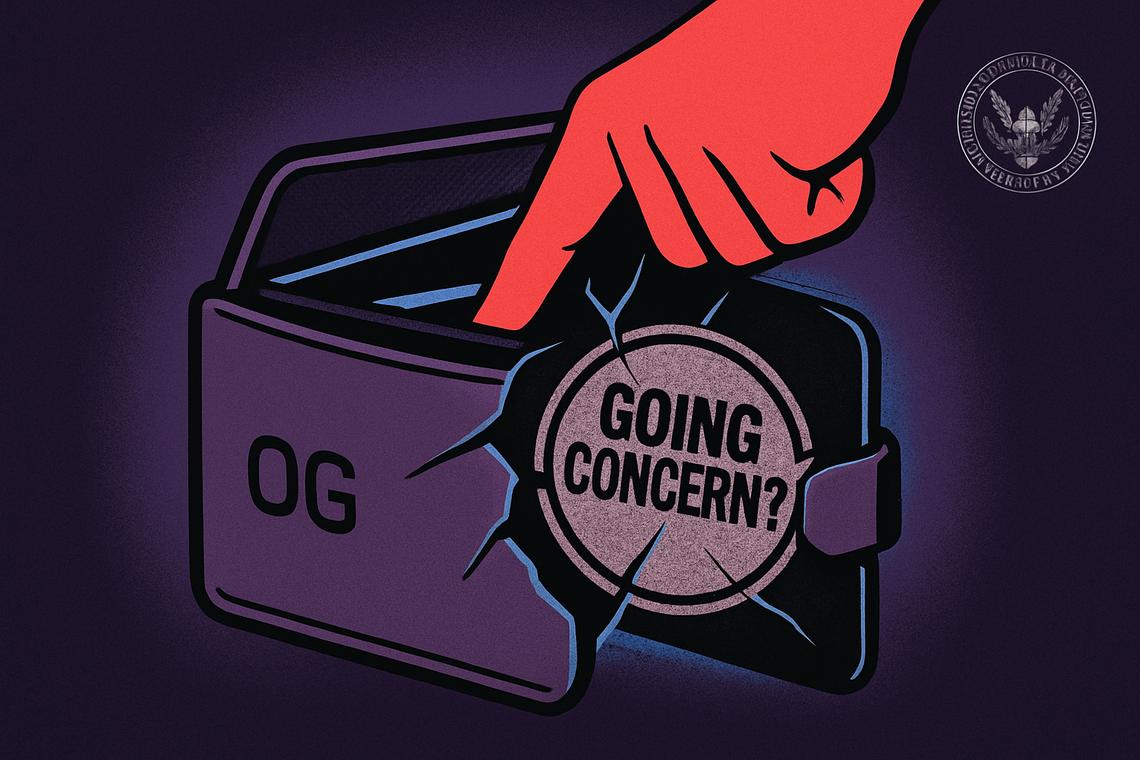
A crypto treasury company that once boasted hundreds of millions in digital assets is now telling regulators it might not survive the year. ZeroStack, the Nasdaq-listed firm formerly known as Flora Growth, disclosed in a fresh SEC filing that ZeroStack financial risk has escalated sharply, with a $339.1 million accumulated deficit, an $82.5 million fair value loss on its digital holdings, and a warning that its ability to keep operating is now in genuine doubt. The disclosure marks a stark reversal from just three months earlier, when the company said its cash position was sound.
Summary
Key takeaways
- ZeroStack warned of substantial doubt about its ability to continue operating over the next year, according to a Form 10-Q filed with the SEC.
- The company held $2.6 million in cash and negative working capital of $600,000 as of June 30, 2026, against an accumulated deficit of $339.1 million.
- ZeroStack posted an $82.5 million fair value loss on digital assets and a net loss of $61.3 million for the first half of 2026.
- Its 75.1 million Zero Gravity (0G) tokens were worth $15.2 million, roughly 91% below their $163.3 million recorded cost.
- The company reversed its own Q1 outlook, which had said cash and staking rewards would cover working capital needs for at least another year.
ZeroStack’s Financial Losses and Asset Devaluation
The single biggest driver behind ZeroStack’s distress is a collapse in the value of the digital assets sitting on its balance sheet. For the first half of 2026, the company recorded an $82.5 million fair value loss on those holdings, contributing to an overall net loss of $61.3 million for the period. Those are not small numbers for a company already carrying a $339.1 million accumulated deficit.
Most of that pain traces back to a single asset: the Zero Gravity token, known by its ticker 0G. ZeroStack held 75.1 million 0G tokens as of June 30, carried on its books at an aggregate cost of $163.3 million. Their fair value that same day was just $15.2 million — a decline of roughly 91% from cost. That kind of markdown illustrates how a treasury strategy built around a single, thinly traded token can turn a paper asset into a liability almost overnight when the market turns against it.
Liquidity and Operational Challenges
Beyond the accounting losses, ZeroStack is short on the cash it needs day to day. The company reported just $2.6 million in cash and negative working capital of $600,000 as of June 30, meaning its short-term liabilities now exceed its short-term assets. That combination — thin cash reserves paired with a deeply devalued treasury — is what pushed auditors toward the going-concern language in the filing.
To keep the lights on, ZeroStack has leaned almost entirely on its 0G holdings. The company reported $3.8 million in staking revenue during the first half of 2026, earning about 6.6 million 0G tokens after validator commissions were deducted. It also sold nearly 4.9 million 0G tokens for $2.4 million to fund operating expenses. This reliance on staking revenue volatility and periodic token sales means ZeroStack’s cash flow rises and falls with 0G’s market price and how easily it can be traded — a dynamic that leaves little room for error if the token weakens further. Management said it expects cash and staking-reward sales to cover forecast operating costs and could liquidate more treasury holdings if needed, but it stopped short of saying those plans would be enough to dispel the going-concern warning.
Survival Risk and Revised Corporate Outlook
What sets this filing apart is the tone shift from ZeroStack’s own prior statements. In its first-quarter report, the company told investors that cash and staking rewards would be sufficient to meet working capital requirements and obligations for at least another year. That assurance has now been withdrawn.
The Form 10-Q, filed with the U.S. Securities and Exchange Commission on Friday, instead states plainly that substantial doubt exists about ZeroStack’s ability to continue operating over the next twelve months. For a company whose entire treasury strategy hinges on one volatile token, that reversal underscores how quickly crypto treasury survival can shift from a routine disclosure line to an active concern flagged directly to regulators and shareholders.
Why this matters: companies that build balance sheets around a single digital asset are effectively betting their solvency on that token’s price and liquidity. When the market cools, as it has for 0G, the losses aren’t just theoretical — they show up in cash flow, working capital, and now in formal survival warnings filed with the SEC.
Background on ZeroStack’s Treasury Strategy
ZeroStack’s current predicament has roots in a corporate pivot from over a year ago. On Sept. 19, the company then known as Flora Growth announced $401 million in funding earmarked for a 0G treasury strategy, made up of $35 million in cash and equivalent commitments plus more than $366 million in in-kind digital assets. The company subsequently rebranded as ZeroStack while keeping its Nasdaq listing intact.
That bet on Zero Gravity tokens was meant to position the firm at the center of a growing decentralized infrastructure niche. Instead, the sharp Zero Gravity token loss recorded through mid-2026 has turned what was pitched as a forward-looking treasury play into the central source of the company’s financial strain, with staking income and token sales now standing between ZeroStack and a much harder conversation about its future.
FAQ
Why is ZeroStack facing survival risk?
ZeroStack warned of substantial doubt about its ability to continue operating next year due to major losses, negative working capital, and reliance on volatile token sales.
What caused ZeroStack’s large financial losses?
An $82.5 million fair value loss on digital assets and a 91% decline in value of Zero Gravity tokens contributed to its net loss of $61.3 million for H1 2026.
How does ZeroStack generate revenue to fund operations?
ZeroStack depends on staking rewards and selling 0G tokens, reporting $3.8 million in staking revenue and token sales of $2.4 million in H1 2026.
What changed in ZeroStack’s outlook compared to earlier in the year?
ZeroStack reversed its earlier Q1 assessment that cash and staking rewards would meet working capital needs, now expressing doubts about continuing operations.
Article produced with the assistance of artificial intelligence and reviewed by the editorial team.