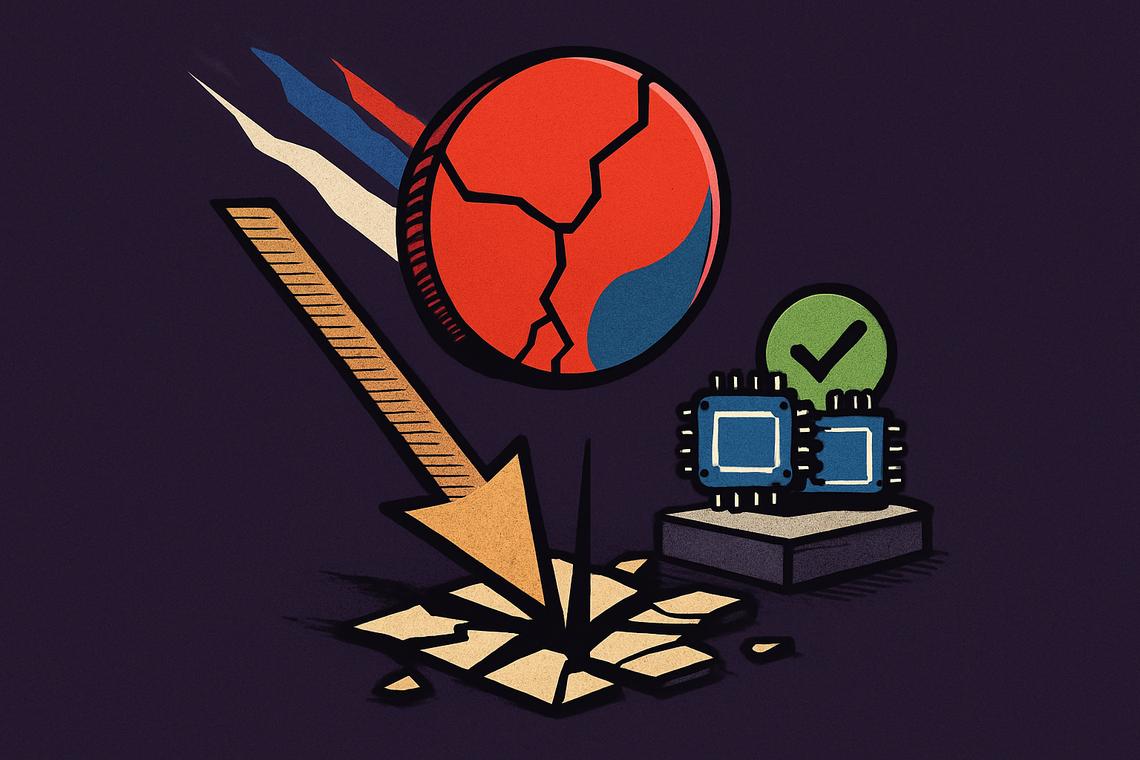
South Korea just lived through one of the sharpest stock market reversals investors have seen in years, and the numbers tell a brutal story. Foreign investors pulled roughly $13 billion out of Korean equities in July 2026 alone, deepening a South Korea stock selloff that had already been building for months. Yet inside that wave of capital flight, something unusual happened: global funds kept buying the country’s two biggest chipmakers, even as everything else got dumped.
Summary
Key takeaways
- Foreign investors withdrew about $13 billion from South Korean equities in July 2026 alone.
- The KOSPI index fell roughly 33% from its June peak through late July, wiping out around $2 trillion in market value.
- Cumulative foreign net selling reached about $81 billion in the first half of 2026.
- Samsung Electronics and SK Hynix, which together account for over half of KOSPI’s market value, still drew selective buying from global funds.
- Leveraged single-stock vehicles and margin calls among Korean retail traders amplified the crash beyond fundamentals.
Historic Foreign Capital Flight Triggers KOSPI Crash
South Korea’s benchmark index suffered one of its steepest drawdowns in recent memory, and foreign investors were the ones pulling the trigger. The scale of the exit, both in July and across the first half of the year, shows this was not a short-lived panic but a sustained retreat from Korean assets.
Scale of the selloff in July and first half of 2026
Foreign investors yanked approximately 18.5 trillion won, or roughly $13 billion, out of Korean equities in July 2026 alone. That single-month figure capped a much longer stretch of selling: cumulative foreign net selling in the first half of 2026 reached approximately 116.36 trillion won, or about $81 billion. In other words, July’s outflow was not an isolated event — it was the latest chapter in a broader foreign investors Korea market retreat that had been running for months before the crash accelerated.
Impact on market value and index performance
The KOSPI index fell approximately 33% from its June peak through late July, and with that drop came a staggering loss of value. Roughly $2 trillion in market capitalization vanished in a matter of weeks. This KOSPI index crash wasn’t a gradual slide either — the speed of the decline is part of what made it so alarming to traders and regulators alike, since a correction of that magnitude compressed into such a short window tends to expose structural weaknesses in how a market is positioned, not just sentiment shifts.
Semiconductor Sector’s Unique Resilience Amid Selloff
Even as foreign capital fled broadly, Samsung Electronics and SK Hynix stood apart from the rest of the market. That divergence says a lot about where global investors still see long-term value, even in the middle of a South Korea stock selloff.
Dominance of Samsung Electronics and SK Hynix in the KOSPI market
Samsung Electronics and SK Hynix together account for over half of KOSPI’s total market value, which means the fate of the entire index is tightly bound to these two chipmakers. Both stocks had been central to the AI-driven rally that inflated Korean equities in the first place, as demand for high-bandwidth memory and advanced DRAM turned Seoul into one of Asia’s hottest equity markets before the reversal set in.
Selective buying by global funds despite chipmaker earnings and market pressures
Despite the broader selloff, global funds continued buying into Samsung and SK Hynix shares. That’s notable given the headwinds both companies were facing. SK Hynix reported disappointing earnings amid softening memory chip prices, a result that shook confidence in the memory chip cycle and added margin pressure to an already jittery market. Yet some global funds treated the drawdown as an entry point, betting that Samsung and SK Hynix remain among the very few companies capable of producing the most advanced semiconductor memory products on the planet. Chinese competitor CXMT is also increasing DRAM production, steadily building capacity and pressuring pricing for Korean incumbents, a threat that adds another layer of uncertainty to the chipmakers’ near-term outlook even as long-term buyers stayed engaged.
Market Dynamics Behind the Crash and Implications for Investors
Beyond the headline numbers, the mechanics of how the crash unfolded matter just as much as the size of the outflows. A mix of leverage and shifting export signals all fed into the same downturn.
Role of leveraged single-stock vehicles and margin calls in amplifying the crash
Part of what made the KOSPI index crash so severe was leverage. Leveraged single-stock instruments, which enjoy widespread use by Korean individual investors, triggered successive market declines when margin requirements activated forced liquidations. That kind of forced liquidation tends to amplify downside moves well beyond what underlying fundamentals would justify, and it’s a dynamic worth watching closely — when retail leverage is concentrated in a handful of stocks that also dominate the index, a correction in those names can drag the entire market down faster than expected.
Semiconductor exports as a global demand signal
South Korea’s semiconductor exports act as a bellwether for global tech demand. The sharp correction in Korean chip stocks suggests markets are recalibrating expectations for AI infrastructure buildout and related capital expenditure cycles worldwide, even as select investors continue to treat Samsung and SK Hynix as long-term bets on that same trend.
FAQ
Why did foreign investors sell off South Korean stocks so heavily in mid-2026?
Foreign investors withdrew roughly $13 billion in July alone, continuing a selloff trend that had already been running through the first half of 2026, driven by concerns over AI valuations and competitive pressures in semiconductors.
Why are Samsung Electronics and SK Hynix stocks still attracting buyers amid the market downturn?
Despite the selloff and SK Hynix’s disappointing earnings, both companies remain among the few producers of advanced semiconductor memory products tied to AI infrastructure, which kept drawing selective buying from global funds.
What role did leverage and margin calls play in the KOSPI crash?
Leveraged single-stock vehicles used heavily by Korean retail investors led to forced liquidations through margin calls, which amplified the selloff well beyond what fundamentals alone would explain.
How does South Korea’s semiconductor export trend relate to global tech demand?
South Korean semiconductor exports serve as a bellwether indicator regarding worldwide technology sector demand, and the pronounced downturn indicates market participants are reassessing their projections concerning AI infrastructure spending worldwide.
Article produced with the assistance of artificial intelligence and reviewed by the editorial team.