



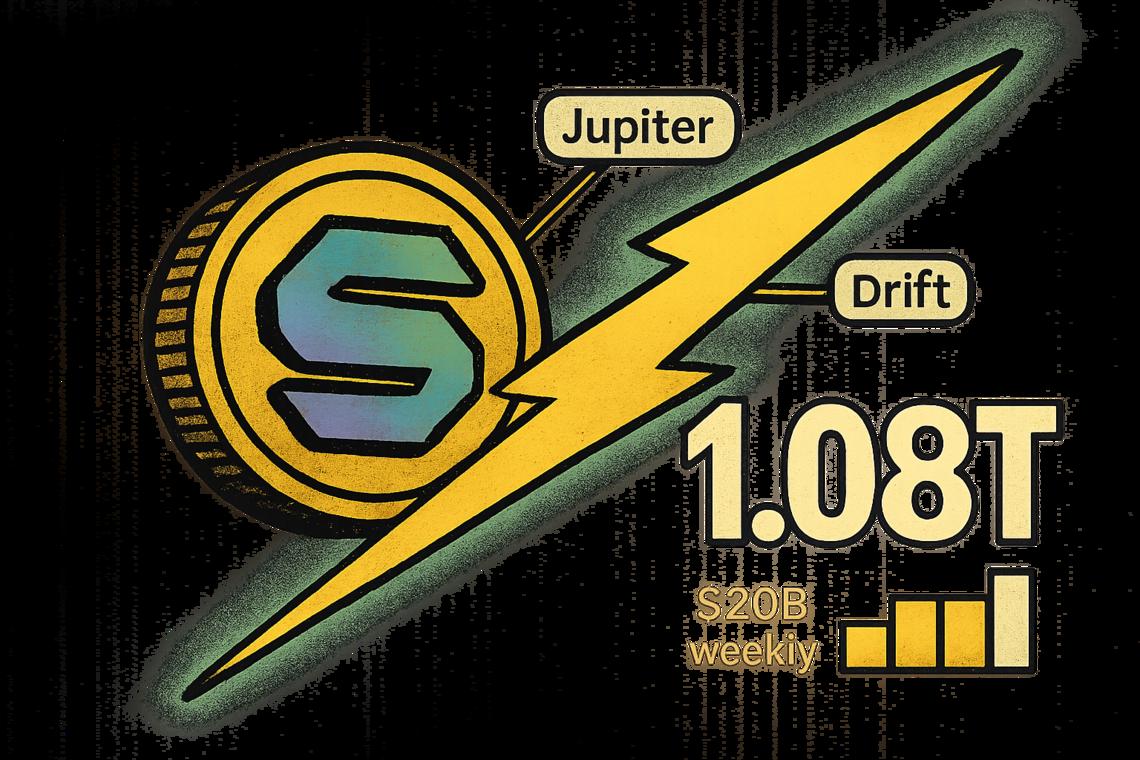
Solana perpetual futures trading has quietly become one of the biggest stories in crypto derivatives this year. Platforms built on the Solana blockchain have collectively processed more than $1.08 trillion in cumulative notional volume, a figure that puts the network firmly among the top venues for onchain leveraged trading anywhere in the industry.
Summary
Key takeaways
- Solana-based perpetual futures platforms have surpassed $1.08 trillion in cumulative trading volume.
- Jupiter Perps and Drift Protocol are the two main platforms driving that volume.
- Solana is now the second-largest onchain perpetuals ecosystem, trailing only Hyperliquid.
- By May 2026, weekly Solana perp volumes had pushed past $20 billion.
- Jupiter Perps alone accounts for roughly 80% of that activity.
Solana Surpasses $1 Trillion in Perpetual Futures Volume
Solana’s derivatives platforms have collectively cleared the $1 trillion mark, confirming that leveraged crypto trading on the network has moved well beyond a niche experiment. That $1.08 trillion figure was built cumulatively across multiple protocols rather than in one single event, but it reflects a sustained climb rather than a one-off spike.
Major Milestones in Trading Volume
The broader category of perpetual futures decentralized exchanges first broke through $1 trillion in monthly volume back in September 2025, when the sector hit $1.05 trillion for that single month, a 48% jump from August. Solana captured an outsized share of that surge, and its platforms have kept expanding since.
Daily and Weekly Volume Trends
During peak months like October 2025, daily trading volumes on Solana perp platforms averaged approximately $1.8 billion. That pace kept building: By May 2026, the aggregate volume of weekly perpetual contracts on Solana had surpassed $20 billion, with each platform processing tens of billions in transactions of dollars in monthly flow on their own.
Key Platforms Driving Solana’s Perpetual Futures Market
Two protocols do most of the heavy lifting behind Solana derivatives volume: Jupiter Perps and Drift Protocol. Together they account for the bulk of the network’s leveraged trading activity, though their approaches to execution differ significantly.
Jupiter Perps’ Market Dominance
Jupiter Perps accounts for roughly 80% of Solana’s perpetual futures volume. That dominance largely comes from Jupiter’s integration with its own aggregator, which already functions as the primary swap router across the Solana ecosystem. That built-in user base gives Jupiter Perps trading a distribution advantage that smaller, standalone platforms struggle to match.
Drift Protocol’s Hybrid Execution and Leverage
Drift Protocol operates differently, running a hybrid venue that blends order book and automated market maker execution. It supports leverage of up to 101x, giving traders access to highly amplified positions directly onchain. That combination of execution styles has carved out a distinct niche for Drift within Solana’s derivatives landscape, even as Jupiter Perps captures the larger share of overall volume.
Technical Advantages Supporting Solana’s Derivatives Growth
Solana’s underlying infrastructure is a big part of why traders keep coming back for leveraged positions. High throughput and low transaction latency mean orders execute quickly and cheaply, which matters enormously for anyone holding a leveraged position that can be liquidated within seconds if the market moves against them.
Low Latency and High Throughput
Speed and cost are not minor details in leveraged trading. Fast execution reduces slippage and shortens the window in which a losing position can spiral before it gets closed out, a critical factor for any exchange handling billions of dollars in daily flow.
Economic Impact on SOL Holders and Validators
The rise in onchain derivatives activity also feeds directly back into Solana’s economy. Every The fees generated through trading are distributed among validators, token holders, and protocol treasuries, thereby sustaining ongoing demand for SOL, since the token is required to pay for transactions on the network. That mechanism ties the growth of Solana perpetual futures trading directly to the economic health of the broader ecosystem — more volume means more fees, and more fees mean more reasons to hold and use SOL.
Solana’s Position in the Broader Onchain Perpetual Futures Ecosystem
Thanks to these technical attributes, Solana has emerged as crypto’s second-largest perpetual trading ecosystem, trailing only Hyperliquid, which has built its reputation as the dominant decentralized venue for perps trading globally.
The gap between Solana and the market leader remains wide, but the ranking itself matters. It signals that onchain derivatives volume is no longer concentrated in a single platform or chain — it is spreading across ecosystems that can offer the speed and cost structure leveraged traders demand.
What began as a tool used mostly by DeFi-native traders has increasingly become a mainstream alternative to centralized exchange derivatives. The distance between decentralized and centralized derivatives volume is narrowing, even as centralized platforms continue growing their own trading activity. For Solana, that shift has translated into a derivatives market that now rivals some of the largest trading venues in crypto — and one that keeps generating fee revenue for the network’s validators and token holders with every trade that clears.
FAQ
What is the total trading volume achieved by Solana-based perpetual futures platforms?
Solana-based perpetual futures platforms have surpassed $1.08 trillion in cumulative trading volume.
Which platforms are the main contributors to Solana’s perpetual futures trading volume?
Jupiter Perps and Drift Protocol are the main platforms contributing to Solana’s derivatives volume.
Why is Solana an attractive platform for leveraged trading?
Solana’s low latency and high throughput facilitate fast and cheap leveraged trading, which is critical for managing fast liquidations.
How does increased perpetual futures volume economically benefit Solana network participants?
Increased onchain derivatives volume generates transaction fees benefiting SOL holders, network validators, and protocol treasuries.
Article produced with the assistance of artificial intelligence and reviewed by the editorial team.
