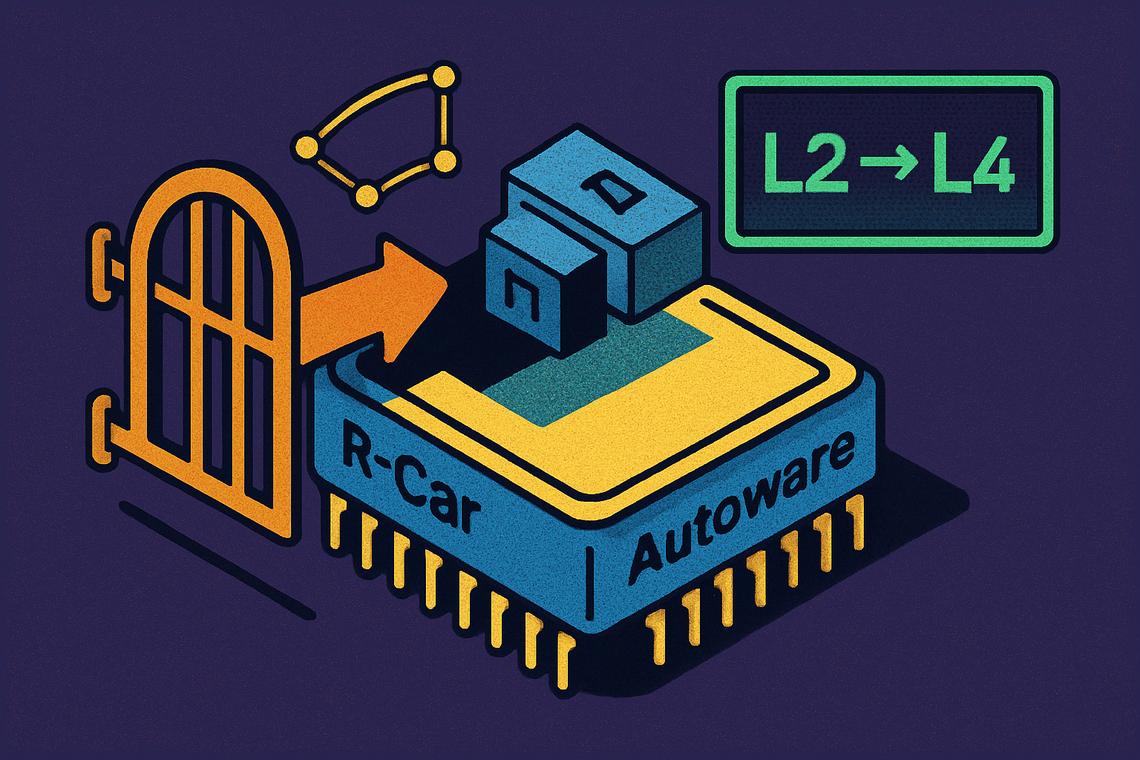
Renesas Electronics has joined the Autoware Foundation as a member of its highest membership tier, the organization announced on September 1, 2026, in a partnership designed to push open-source AI for ADAS onto commercial automotive hardware. The move pairs the foundation’s open-source, end-to-end autonomous driving software with Renesas’s R-Car system-on-chip platforms, targeting everything from basic driver assistance to fully autonomous robotaxis.
Summary
Key takeaways
- Renesas Electronics joined the Autoware Foundation as a highest-tier member on September 1, 2026.
- The partnership brings Autoware’s open-source AI software to Renesas R-Car SoC platforms for ADAS and autonomous driving.
- Target use cases range from entry-level L2 driver assistance to L2++ hands-free autopilot and fully driverless L4 robotaxis.
- OEMs and Tier-1 suppliers can retrain, tune, and customize the AI stack, which is licensed under Apache 2.0 for unrestricted commercialization.
- Renesas’s RoX platform, launched in June 2024, combines hardware, out-of-box software, and a cloud-native AI development environment for software-defined vehicles.
Renesas joins Autoware Foundation as highest-tier member
The headline of this collaboration is simple: a major semiconductor supplier just bought itself a seat at the table where autonomous driving software standards are being written. Renesas’s entry into the Autoware Foundation’s top membership tier gives the chipmaker direct influence over the strategic, technical, and business direction of the open-source project, rather than a passive licensing arrangement.
That distinction matters. Autoware Foundation membership tiers typically determine how much say a company has in shaping the roadmap of the software, and landing in the highest bracket signals that Renesas intends to be an active participant, not just a downstream adopter.
Christian John, a board director at the Autoware Foundation, described the partnership in sweeping terms. “We believe that this is the Linux moment for the ADAS and autonomous driving industry,” John said, framing the collaboration as a shift toward shared, community-driven software infrastructure rather than fragmented proprietary stacks built separately by each automaker or supplier.
Collaboration to bring open-source AI software to Renesas R-Car platforms
The core of the deal is technical integration: Autoware’s open-source AI stack becomes a new software option available directly on Renesas’s R-Car SoC and RoX platforms, rather than something automakers have to bolt on themselves. That positions the combined offering as one of the more accessible entry points for building autonomous driving platforms without starting from scratch.
The scope of ambition is broad. According to the announcement, target applications stretch from entry-level L2 driver assistance systems through L2++ hands-free autopilot functions, all the way up to fully driverless L4 robotaxi operations. That range covers most of the commercial autonomy spectrum automakers are currently chasing, which suggests both organizations see this as a long-term platform play rather than a narrow product tie-in.
Why this matters: chip platforms and driving software have historically been developed as separate layers, forcing OEMs to stitch together components from different vendors. Pre-integrating Renesas R-Car AI software with an open-source driving stack removes one of the friction points that has slowed ADAS development timelines industry-wide.
Customizable AI stack for OEMs and Tier-1 suppliers
For automakers and parts suppliers, the practical appeal lies in flexibility. Under this Autoware Foundation partnership, OEMs and Tier-1 suppliers can retrain, tune, and customize the open-source AI stack for their own vehicles and specific use cases, then deploy the resulting software directly on Renesas R-Car SoCs.
That setup gives manufacturers a third path they haven’t had before. Historically, companies building ADAS or autonomous features had two options: develop a proprietary AI stack entirely in-house, which is expensive and slow, or buy a finished solution from a traditional commercial supplier, which limits customization and often comes at a premium. Building on an open-source foundation instead gives customers what the foundation describes as a lower-cost, flexible alternative that can be internalized and adapted to their own needs.
The licensing terms reinforce that flexibility. Autoware’s software is distributed under the Apache 2.0 license, which permits full commercialization without the restrictions that sometimes come attached to open-source code. In practice, that means a company can take the software, modify it, and sell a product built on it without needing separate permission or paying royalties tied to the underlying stack.
This is where the “Linux moment” comparison John made starts to carry weight. Just as Linux gave companies a free, modifiable operating system they could build commercial products on top of, Autoware’s Apache 2.0 licensing removes a major cost barrier for smaller OEMs and Tier-1 suppliers who couldn’t previously justify building a full AI driving stack from the ground up.
Renesas RoX platform and AI development environment
Renesas’s R-Car Open Access platform, known as RoX, is the development environment through which all of this gets deployed. Introduced in June 2024, RoX is built around the R-Car family of SoCs and microcontrollers and is designed specifically for software-defined vehicles. It combines hardware, out-of-box software, and a cloud-native AI development environment covering ADAS, in-vehicle infotainment, and gateway systems.
Renesas offers RoX in two forms: an open Whitebox package that includes royalty-free operating systems, and a Licensed version built on commercial software. That dual structure gives customers a choice between a fully open approach and one that leans on established commercial tooling, depending on their budget and support needs.
A key piece of the RoX environment is its AI Workbench, which Renesas says allows developers to validate and optimize AI models and test applications in the cloud, either through a virtual development platform or on physical Renesas board farms. Aish Dubey, vice president and head of the HPC SoC Division at Renesas Electronics, said the automotive industry is shifting away from isolated components toward integrated platforms that combine computing, AI, and open software technologies. Dubey added that the collaboration gives OEMs and Tier-1 suppliers scalable solutions that help reduce integration complexity and expand their options for deploying AI-driven ADAS and automated driving systems.
Why this matters for the wider industry: cloud-based validation tools like AI Workbench shorten the loop between training a model and testing it on real hardware, which is typically one of the slowest and most expensive stages of automotive AI development. Pairing that tooling with an open-source software layer could shift how quickly mid-sized suppliers, not just the largest automakers, can bring AI-driven ADAS features to production.
FAQ
What is the main goal of Renesas joining the Autoware Foundation?
The main goal is to bring Autoware’s open-source AI software to Renesas R-Car SoC platforms, enabling scalable AI-driven ADAS and autonomous driving solutions.
Which driving automation levels will the partnership’s AI software support?
The AI software targets applications ranging from entry-level L2 driver assistance to fully autonomous L4 robotaxis.
How can automotive manufacturers benefit from this collaboration?
OEMs and Tier-1 suppliers can customize, retrain, and deploy the open-source AI stack on Renesas hardware, offering a flexible alternative to proprietary or commercial solutions.
What licensing model does Autoware’s software use, and how does it impact commercialization?
Autoware software is licensed under Apache 2.0, which allows unrestricted commercialization.
Article produced with the assistance of artificial intelligence and reviewed by the editorial team.