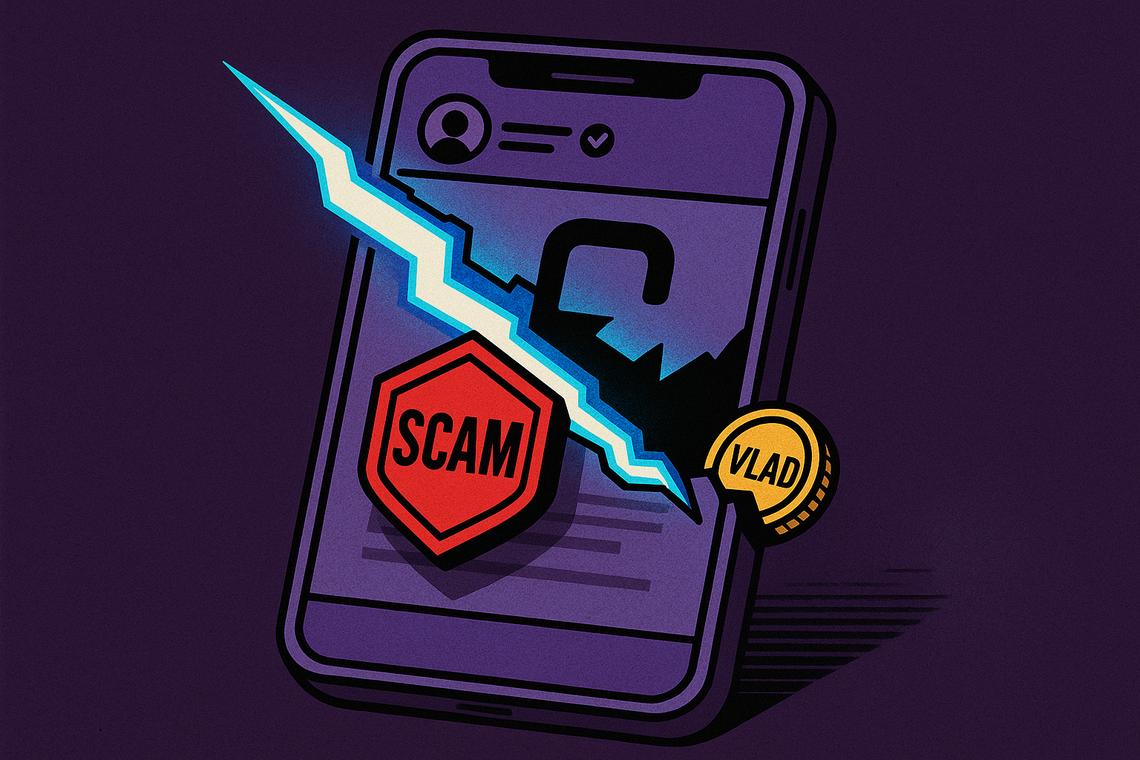
When a high-profile executive’s social media account gets hijacked to push a fake cryptocurrency, the damage moves faster than any retraction ever could. That’s exactly what happened on Thursday, when the Robinhood CEO account hack turned Vlad Tenev’s X profile into a vehicle for a fraudulent token promotion — reaching over 175,000 people before most of them even knew something was wrong.
Summary
Key takeaways
- Vlad Tenev’s X account was compromised to promote a fake memecoin called “VLAD,” including a malicious token contract address.
- The scam post surpassed 175,000 views in under 20 minutes before users flagged it as fraudulent.
- Onchain Lens reported the breach; Robinhood Chain’s blockchain explorer labeled the token contract a scam.
- Robinhood had not officially confirmed the hack at the time of publication.
- Robinhood has never launched a memecoin, despite its aggressive expansion into digital assets.
How the Fake VLAD Token Scam Unfolded
The fraudulent post appeared on Tenev’s X account promoting what it described as a new memecoin named “VLAD” — built around the Robinhood brand — and included what appeared to be a malicious token contract address. The mechanics were straightforward: a verified, trusted account, a compelling narrative, and a link designed to pull unsuspecting investors into interacting with a fraudulent token.
The numbers tell the real story of the risk. In fewer than 20 minutes, the post had already racked up more than 175,000 views. That’s not a slow-burn scam — that’s a flash campaign designed to capture impulsive clicks before the crowd catches on. Users eventually sounded the alarm, warning others not to interact with the token, and the post was identified as a scam. But by then, the exposure was already done.
Onchain data provider Onchain Lens was among the first to formally report the compromise. The Robinhood Chain blockchain explorer subsequently labeled the token’s contract address as a scam — a post-incident flag that, while useful for reference, does little to protect anyone who had already interacted with it.
Verification and Robinhood’s Position
Robinhood had not confirmed the account compromise at the time of publication. That silence — even if temporary — matters in a fast-moving situation where trust is the product.
One thing is unambiguous: Robinhood has never launched a memecoin. The company has pushed aggressively into digital assets, building out a portfolio that includes tokenized stocks, crypto staking, perpetual futures, and its own blockchain, Robinhood Chain. A spontaneous memecoin launch from the CEO’s personal account would have been deeply out of character — and that incongruity is precisely what made savvy observers suspicious almost immediately.
The incident is also contextually awkward for Robinhood. According to CoinDesk, Tenev himself told CNBC on July 2 that memecoins were “a dead end — assets with no utility that serve no purpose.” The account that carried his name was now being used to promote one. The irony was not lost on the crypto community.
Why This Hack Matters Beyond Robinhood
The Vlad Tenev account compromise is not an isolated incident — it’s a symptom of a broader and worsening problem. According to security firm Nominis, crypto attackers are increasingly shifting away from direct protocol exploits toward phishing campaigns and social engineering. Hijacking a prominent executive’s social media account is essentially a high-leverage phishing attack: you don’t need to break any code if you can borrow someone else’s credibility.
What makes this category of attack particularly dangerous is the speed-trust dynamic. Followers of a CEO-level account assume authenticity by default. The first 60 seconds of a post like this — before any skepticism kicks in — represent a window where real financial harm can occur. The VLAD token scam cleared 175,000 views inside that window. Even if only a fraction of viewers clicked through or attempted to interact with the malicious contract, the potential damage is real.
There’s a broader industry signal here too. Even as the total value stolen through crypto scams has declined in recent months, the sophistication and frequency of phishing-style attacks continues to rise. Attackers are trading raw volume of stolen funds for targeted, high-visibility operations. A fake memecoin pushed from a CEO’s verified account generates far more credibility — and urgency — than a generic DeFi rug pull.
The Robinhood Chain Context
The timing adds another layer of significance. Robinhood Chain — the company’s Ethereum layer-2 blockchain built on Arbitrum — launched to the general public earlier this month and has been navigating its own credibility questions. CoinDesk reported that despite generating $878 million in 24-hour DEX volume on July 12, the chain’s activity has been dominated by memecoin speculation rather than the tokenized real-world assets it was designed for. Tokenized RWAs account for just $12.66 million in active market cap on the chain, dwarfed by CASHCAT, a cat-themed memecoin that briefly hit $156 million.
In that context, a fake memecoin promoted through the CEO’s account — even by bad actors — lands in already complicated territory. Robinhood is simultaneously trying to establish its blockchain as a serious financial infrastructure platform while publicly distancing itself from memecoin culture. A scam that exploits that tension does reputational work even after it’s removed.
Broader Crypto Phishing Attacks Are Accelerating
The pattern seen here — a compromised high-profile account, a fake token, a malicious contract address, a short exploitation window — is becoming a recognizable playbook in crypto scams. The attack surface isn’t code anymore; it’s identity. As long as crypto markets respond to social signals as quickly as they do, verified accounts will remain high-value targets.
For investors, the incident reinforces a critical habit: no token launch from a social media post alone should be treated as legitimate, regardless of who the account belongs to. Blockchain explorer labels and onchain data providers like Onchain Lens can confirm scam contracts after the fact, but they can’t prevent the initial exposure. The defense has to start with the user.
FAQ
What happened to Robinhood CEO Vlad Tenev’s X account?
His X account was hacked to promote a fake memecoin called “VLAD,” which included a malicious token contract address. The post attracted more than 175,000 views in under 20 minutes before users identified it as a scam.
Did Robinhood confirm the account hack?
No. Robinhood had not confirmed the hack at the time of publication.
Has Robinhood ever launched a memecoin?
No. Despite expanding aggressively into digital assets — including tokenized stocks, crypto staking, perpetual futures, and its own blockchain — Robinhood has never launched a memecoin.
How quickly was the scam post noticed by the public?
The fraudulent post received more than 175,000 views in less than 20 minutes before users flagged it as a scam and warned others not to interact with the token.
Article produced with the assistance of artificial intelligence and reviewed by the editorial team.