
A data center in Singapore has started running on human brain cells, and it isn’t a plot twist from a science fiction script. At the National University of Singapore‘s Life Sciences Institute, a working biological data center quietly went live on July 16, using lab-grown human neurons instead of conventional silicon chips to process information. The system was publicly unveiled on August 6, and researchers say it points toward a genuinely different way of thinking about power-hungry AI infrastructure.
Summary
Key takeaways
- The National University of Singapore launched what its partners describe as the world’s first independently operated biologically integrated server rack.
- The system runs on 20 biological computing units containing lab-grown human cortical neurons paired with silicon microelectrode arrays.
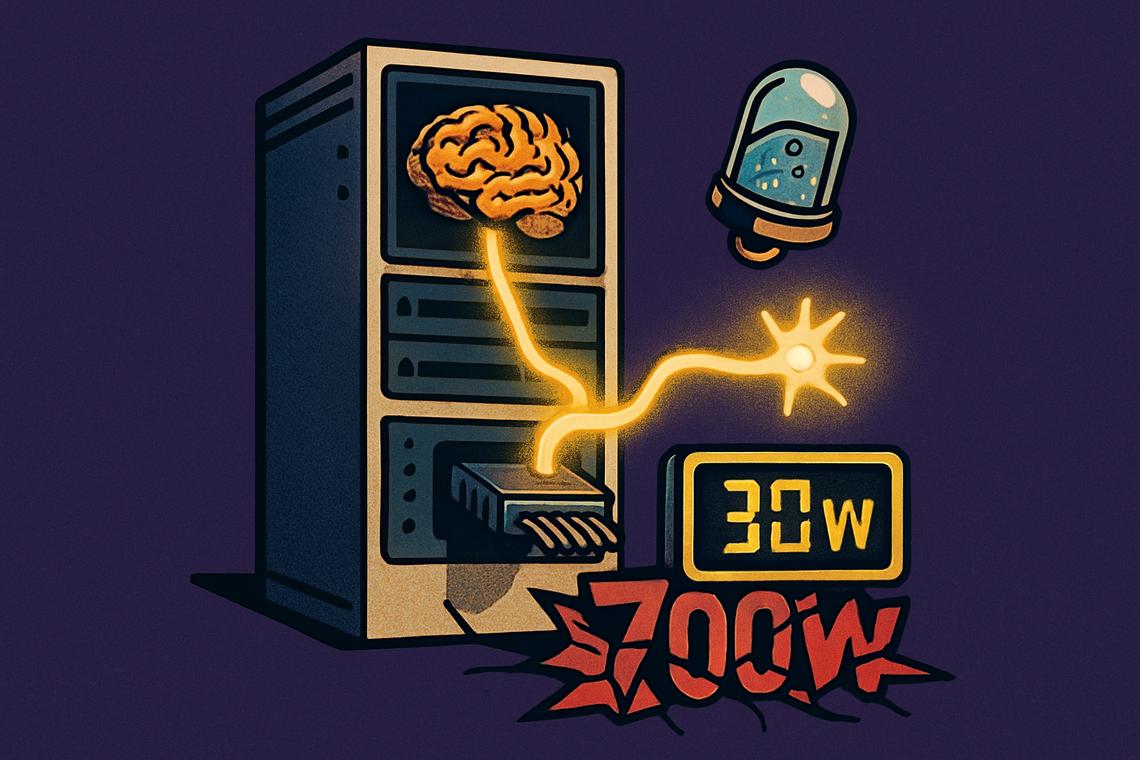
- Each unit uses about 30 watts, compared with roughly 700 watts for a high-end Nvidia H100 GPU under full load.
- The neurons must be fed every three days and typically last around six months before needing replacement.
- DayOne, the data center operator involved in the project, is reportedly weighing a scale-up from 20 to as many as 1,000 units.
Singapore unveils world’s first biological data center
The project is the result of a collaboration between NUS Medicine’s Yong Loo Lin School of Medicine, Melbourne-based biotech startup Cortical Labs, and Singapore-based data center operator DayOne. Together, they built what they call the first independently operated server rack powered by biologically integrated computing hardware, moving the concept out of the lab bench and into something closer to real infrastructure.
At the center of the setup are Cortical Labs’ CL1 units, each housing between 200,000 and 800,000 human cortical neurons. These cells aren’t harvested from a person; they’re grown in a lab specifically for this purpose. The neurons sit on silicon-based microelectrode arrays, creating a hybrid system where living tissue and traditional chips work side by side, each handling part of the computational load.
This hybrid approach is what makes the project notable. Rather than replacing silicon entirely, the human brain computing layer works alongside it, with the neurons contributing a kind of adaptive processing that conventional chips don’t naturally offer.
Core technology and hybrid computing units
Cortical Labs previously showed that its neuron clusters could learn to play basic video games, adapting their responses to digital inputs over time. That earlier demonstration served as a proof of concept. The NUS deployment marks the first time the company A biological computing facility has been established in a location outside Melbourne’s main headquarters. The announcement of this partnership took place in March, meaning the roughly four-month gap between announcement and an operational prototype suggests the technology has moved past the purely experimental stage.
Energy efficiency and operational specifics
The efficiency numbers behind this system are what’s drawing the most attention. Each CL1 unit consumes roughly 30 watts, life support included, while a high-end Nvidia H100 GPU can demand upwards of 700 watts under full load. That’s a difference of more than 20 times per unit, a gap that matters enormously as AI infrastructure worldwide struggles with soaring electricity demand.
That efficiency comes with a very different kind of upkeep. The neurons need feeding every three days and rely on dedicated life-support equipment that maintains precise mixtures of carbon dioxide, oxygen, and nitrogen, along with tightly controlled temperatures. Their operational lifespan runs about six months before the cells need to be replaced entirely.
Neuron lifespan and maintenance requirements
That six-month cycle introduces a maintenance model that looks nothing like the one data center operators are used to. Conventional server hardware can run for years before it needs swapping out. Biological computing units, by contrast, require regular cell replenishment, which means ongoing costs and logistics that simply don’t exist in a traditional server room. It’s less like managing racks of hardware and more like tending a living system that needs constant care.
Future scaling and applications
Right now, the 20-unit prototype is modest by data center standards. But DayOne, which raised $4.5 billion in June and reached a $20 billion valuation, is reportedly considering a much larger rollout, scaling the deployment to as many as 1,000 biological computing units. At 30 watts per unit, a cluster of that size would draw around 30 kilowatts, still a fraction of what an equivalent GPU-based setup would need.
Why this matters: if the economics and reliability hold up at scale, biological computing could offer a genuinely different lever for cutting AI infrastructure’s energy footprint, rather than just incremental chip efficiency gains. A 50x jump from prototype to full deployment would be a serious test of whether the technology can move beyond a research demonstration.
Use cases in AI processing and biomedical research
The system is designed to serve two distinct purposes. One is energy-efficient AI processing, tackling computational tasks using far less power than silicon-only setups. The other is biomedical research, including disease modeling and drug screening. Having living human neurons inside a controlled computational environment gives researchers a unique platform to observe how those cells respond to pharmaceutical compounds or simulated disease conditions, something silicon chips simply can’t replicate.
Regulatory challenges and system limitations
Regulatory approval remains one of the biggest open questions surrounding this technology. Deploying living human tissue inside commercial computing environments raises issues that existing data center and biomedical frameworks weren’t built to handle, and any large-scale rollout will likely have to navigate rules that don’t yet fully exist.
It’s also worth being clear about what this system is not. The neurons in this biological data center aren’t generating consciousness or experiencing anything. They’re clusters of cells performing computational tasks, similar in function to a processor, just built from living tissue instead of transistors. That distinction matters both scientifically and ethically, and it’s central to how researchers are framing the project publicly.
Regulatory hurdles for living tissue in data centers
As DayOne weighs scaling toward 1,000 units, the regulatory path forward will shape how fast, and how far, this kind of energy efficient AI infrastructure can actually grow. The next real test won’t be whether the neurons can compute, that part already works, but whether commercial and regulatory systems can adapt fast enough to let biological computing move from a single prototype rack in Singapore into something resembling standard infrastructure.
FAQ
What technology powers the National University of Singapore’s new data center?
It uses 20 biological computing units containing lab-grown human cortical neurons integrated with silicon microelectrode arrays, creating a hybrid system that combines biological computing neurons with traditional chip-based hardware.
How energy-efficient are the biological computing units compared to traditional GPUs?
Each biological computing unit consumes about 30 watts, including life support, while a high-end Nvidia H100 GPU consumes around 700 watts under full load, a difference of more than 20 times per unit.
What are the main challenges in operating a biological data center?
The main challenges include the neurons’ need for feeding every three days, their roughly six-month lifespan requiring periodic replacement, and the regulatory approval process for using living human tissue in a commercial setting.
Does the system generate consciousness using human neurons?
No. The system does not generate consciousness; the neurons perform computational tasks only, functioning as clusters that process information rather than think or experience anything.
Article produced with the assistance of artificial intelligence and reviewed by the editorial team.