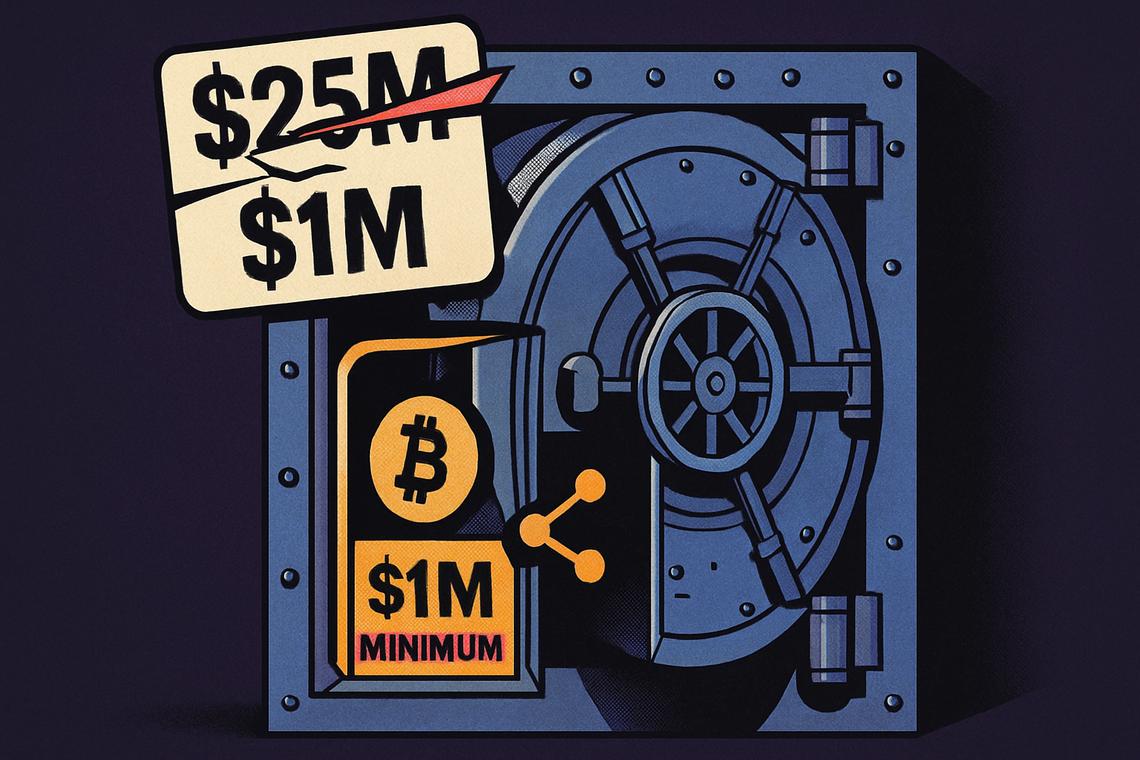
BlackRock has slashed the minimum Bitcoin holding required to swap coins directly for shares of its spot Bitcoin ETF, and the size of the cut is hard to ignore. The threshold for a BlackRock Bitcoin ETF conversion into IBIT shares dropped from $25 million worth of Bitcoin to just $1 million, according to Bloomberg. That’s a 96% reduction, and it opens a door that used to be reserved for only the largest institutional players.
Summary
Key takeaways
- BlackRock cut the minimum Bitcoin value needed for direct IBIT conversion from $25 million to $1 million, a 96% reduction.
- Bitwise made a similar move, lowering its own conversion minimum from $100 million to $3 million.
- IBIT held about $60.65 billion in net assets as of August 25 and charges a 0.25% annual sponsor fee.
- The fund has processed more than $5 billion through in-kind conversions, up from roughly $3 billion in October.
- Security fears around hacks and kidnappings are pushing some Bitcoin holders toward ETF custody instead of self-custody.
BlackRock drastically lowers Bitcoin minimum for IBIT conversion
The new $1 million entry point means a much wider pool of wealthy individuals and mid-sized institutions can now trade Bitcoin directly for IBIT shares without going through the open market first. Previously, only holders sitting on at least $25 million in Bitcoin could access this direct swap. That threshold effectively locked out family offices, smaller funds, and high-net-worth individuals who didn’t quite meet the old bar.
Comparison with Bitwise’s threshold reduction
BlackRock isn’t alone in rethinking who gets access. Bitwise also lowered its own conversion minimum, cutting it from $100 million down to $3 million, Bloomberg reported. While Bitwise’s threshold remains higher than IBIT’s new $1 million floor, the direction is the same across both issuers: shrink the barrier to entry for in-kind transactions and pull in a broader base of eligible holders.
This matters because it signals competitive pressure among ETF issuers to make direct Bitcoin-to-shares conversion more accessible, rather than treating it as a niche service for the ultra-wealthy.
IBIT fund size, fees, and growth of in-kind transactions
IBIT remains the dominant player in the spot Bitcoin ETF space, and its scale helps explain why this IBIT minimum bitcoin value change carries weight. BlackRock reported IBIT net assets of about $60.65 billion as of August 25. The fund charges a 0.25% annual sponsor fee, a cost investors pay regardless of whether they enter through direct conversion or standard market purchases.
Annual sponsor fees and net assets
That fee structure applies uniformly across the fund. It’s a detail worth knowing for anyone weighing IBIT against holding Bitcoin outright, since the sponsor fee chips away at returns over time compared to raw asset ownership.
Growth in in-kind Bitcoin conversions
The in-kind creation process is what makes these in-kind bitcoin ETF transactions possible. Eligible holders transfer their Bitcoin directly into the ETF structure and receive IBIT shares carrying similar market exposure, skipping the step of selling Bitcoin on the open market and then repurchasing ETF shares.
Robbie Mitchnick, BlackRock’s head of digital assets, said the fund has now processed more than $5 billion through these conversions, up from about $3 billion in October. That growth trajectory suggests demand for this pathway is accelerating, not leveling off. It’s worth noting these transfers move existing Bitcoin into the fund and don’t always represent fresh cash entering the market.
Security concerns influencing investor custody choices
Rising fears about theft and physical danger are reshaping how some Bitcoin holders think about storage. Mitchnick pointed to hacks, kidnappings, and other crypto-related crimes as factors pushing some holders to reconsider keeping Bitcoin in self-custody. Anyone holding coins directly has to safeguard private keys, seed phrases, and hardware wallets against theft or simple loss — and those risks have become harder to dismiss as crypto adoption has grown.
An ETF structure removes that personal custody burden entirely. But the tradeoff is real: IBIT shareholders don’t control the underlying Bitcoin. They can’t withdraw the coins, move them to a private wallet, or spend them directly. What they hold instead are Nasdaq-listed shares designed to track Bitcoin’s market value before fees are applied.
This is a meaningful distinction for anyone comparing custody options. Choosing an ETF trades direct ownership and control for convenience and institutional-grade security — a tradeoff that clearly appeals to a growing number of investors, but one that changes what you actually own.
Tax and regulatory considerations of in-kind conversions
Some investors can use in-kind conversions to avoid selling their Bitcoin before buying ETF shares, according to Bloomberg’s reporting, and that structure may help them sidestep triggering an immediate taxable sale in certain cases. That’s a potentially valuable feature for large holders looking to reposition their assets without an unwanted tax event.
But the tax treatment isn’t uniform. It can vary depending on the investor, the intermediary handling the transaction, the country involved, and how the transaction itself is structured. The regulatory groundwork for these transactions dates back to July 2025, when the SEC approved in-kind creations and redemptions for spot crypto exchange-traded products. That approval, though, did not create any special tax treatment for investors — it simply made the mechanism legally available.
BlackRock’s latest fund filings confirm that authorized participants can carry out in-kind transactions with the trust. It’s worth noting that ordinary investors are not shut out of IBIT altogether — they can still buy and sell shares on Nasdaq through normal market trading without ever touching the direct creation process or meeting the new $1 million threshold.
FAQ
What change did BlackRock make to the IBIT Bitcoin conversion minimum?
BlackRock reduced the minimum Bitcoin value needed for direct conversion into IBIT ETF shares from $25 million to $1 million.
How does the in-kind creation process for IBIT work?
Eligible holders can transfer Bitcoin into the ETF and receive shares without selling Bitcoin first, allowing a direct swap into IBIT shares.
Why are some investors choosing ETF custody over Bitcoin self-custody?
Due to security concerns like hacks and kidnappings, some investors prefer the custody provided by ETFs to avoid personal private key risks.
Does the SEC approval for in-kind crypto ETF transactions provide tax advantages?
The SEC approved in-kind creations and redemptions in July 2025 but did not create special tax treatment; tax implications vary by investor and structure.
Article produced with the assistance of artificial intelligence and reviewed by the editorial team.