



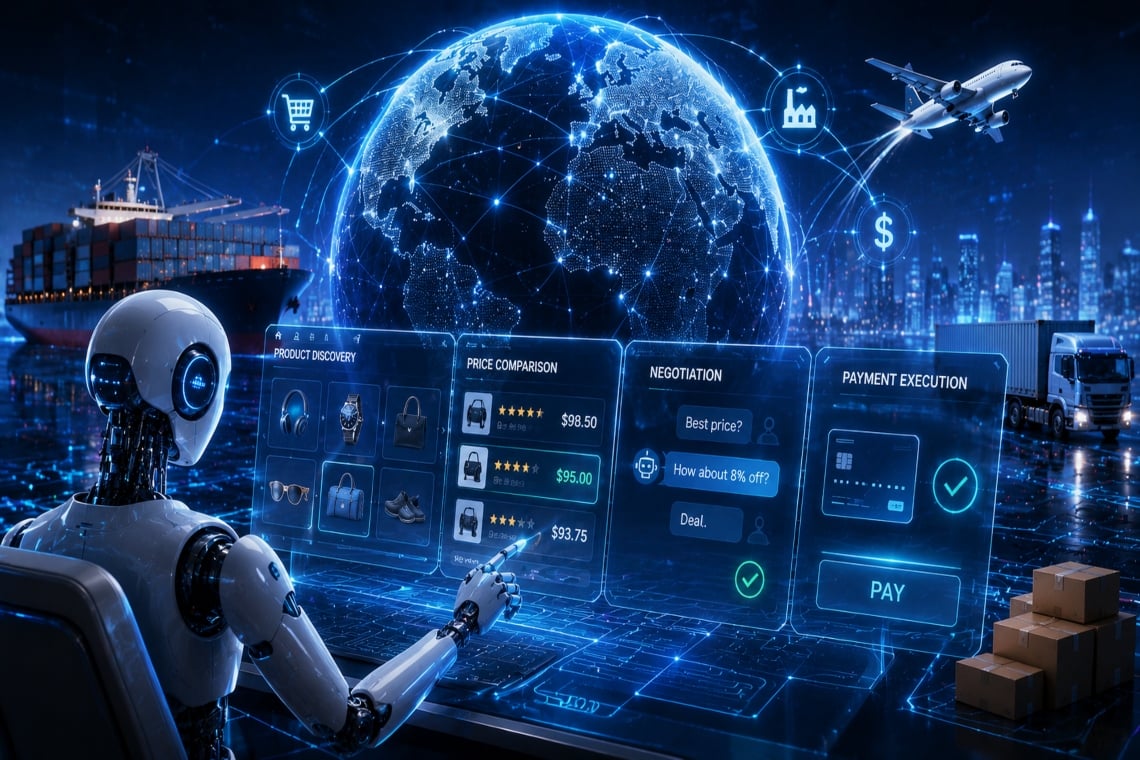
According to the new Morph Report, artificial intelligence is undergoing a monumental transformation. AI agents are no longer just digital assistants or chatbots, but are rapidly becoming autonomous economic actors. These intelligent systems are now able to discover products, compare prices, negotiate terms, and execute payments without direct human intervention.
The report, titled “The Agentic Economy,” analyzes the birth of a new category of economic activity: the so‑called agentic commerce. In this scenario, AI agents act as fully autonomous buyers, capable of making decisions and completing transactions on behalf of users. A shift that promises to radically redefine how commercial exchanges take place on a global scale.
Summary
The numbers behind exponential growth
The figures presented in the Morph Report are impressive. During the 2025 holiday season, spending influenced by AI agents reached 67 billion dollars globally. At the same time, Adobe recorded a 693% increase in retail traffic driven by generative artificial intelligence systems compared to the previous year.
According to McKinsey’s estimates, the long‑term market potential of agentic commerce could exceed one trillion dollars in the U.S. retail sector alone. But the report’s most significant forecast concerns 2028: by that date, the global value of transactions influenced by AI agents could surpass 500 billion dollars in terms of GMV (gross merchandise value).
Tech and payments giants prepare the ground
The report highlights how some of the world’s largest companies are already building the infrastructure needed for this new era. Visa recently confirmed the execution of “hundreds of secure agent‑initiated transactions” within its ecosystem. Google has expanded its Agent Payments Protocol (AP2), involving over 60 partners at launch and introducing native support for payments in stablecoin.
Shopify, Stripe, Mastercard, Coinbase, and OpenAI are also investing in the development of solutions dedicated to machine‑driven commerce. These initiatives show how the sector is rapidly evolving and ready to embrace a future in which machines will be the main players in economic transactions.
Consumer trust: a cultural shift underway
Despite rapid growth, trust in AI agents is not yet absolute. As Renna Ba, Head of Ecosystem at Morph, points out, “most people today do not fully trust AI agents. However, historically consumers have proven to be willing to trade control for convenience surprisingly quickly.”
According to Ba, the process of delegating to machines often happens gradually: “Consumers don’t wake up one morning suddenly deciding to blindly trust AI agents. Rather, they start by delegating small decisions, until delegation itself becomes the norm.”
The report predicts that by 2028 one in ten households in the United States will regularly allow AI agents to make purchases autonomously.
Stablecoins: the key to programmable, global payments
Another central aspect highlighted by the Morph Report concerns the role of stablecoins in the agents’ economy. In a context where machines must be able to make payments in a programmable, always‑online, low‑cost, and globally interoperable way, stablecoins are emerging as the ideal payment instrument.
The forecast is that, by 2028, AI agents will surpass humans in the use of stablecoins for commercial payments. This trend could further accelerate the adoption of stable cryptocurrencies, making them a fundamental pillar of the automated digital economy.
Developer tools: the Morph Skills toolkit
To support the growth of the ecosystem, Morph has open‑sourced Morph Skills, a toolkit designed to enable AI agents to perform actions on blockchain through natural language instructions. This tool allows developers to integrate features such as wallet management, token swapping, and stablecoin payments directly into AI applications.
The goal is to make it easier to create increasingly autonomous agents capable of interacting with decentralized financial infrastructure, opening up new possibilities for transaction automation.
A look to the future: opportunities and challenges of agentic commerce
The rise of AI agents represents one of the most significant transformations in the contemporary digital economy. If the Morph Report’s forecasts materialize, within a few years we will witness a radical change in how commercial exchanges take place: intelligent machines that buy, negotiate, and pay on behalf of users, moving hundreds of billions of dollars every year.
The challenges are substantial, especially in terms of trust, security, and regulation. However, the speed at which consumers are embracing delegation to machines and the commitment of major tech players suggest that agentic commerce is destined to become a mass reality.
To explore all the details and analyses in the report, you can consult the full document on Morph’s official website: [https://morph.network/agentic_economy_report](https://morph.network/agentic_economy_report)
