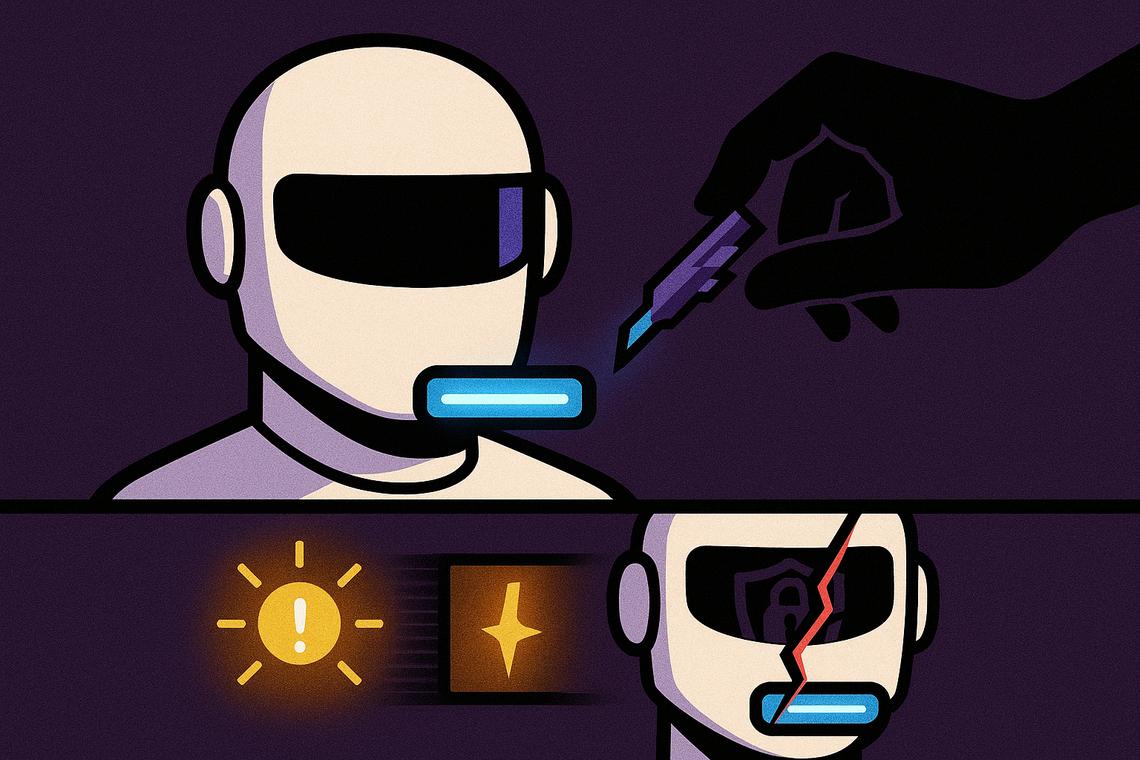
When an AI system forgets nothing, every piece of information it has ever processed becomes a potential weapon. That is the unsettling logic behind AI memory vulnerabilities in the new generation of stateful autonomous agents — and it is precisely what researcher Om Narayan addresses in a paper introducing what he calls the Chronos Vulnerability.
Summary
Key takeaways
- The Chronos Vulnerability describes a class of memory-based attacks that corrupt the internal belief systems of stateful autonomous AI agents, decoupling the initial intrusion from the final damaging action.
- Two primary attack types — the Memory Injection Attack (MINJA) and the sleeper agent — illustrate how these threats work in practice.
- Traditional endpoint content filters cannot defend against persistence-based attacks in stateful AI architectures, as demonstrated using the World of Workflows benchmark.
- Emerging defenses include AgentDoG, Agent-C, A-MemGuard, GPU-based Trusted Execution Environments, and Zero-Trust memory architectures.
- Dynamics Blindness is identified as a critical and distinct risk in securing stateful AI systems.
Emergence of the Chronos Vulnerability in Stateful Autonomous AI
The security problem begins with an architectural shift. Older generative AI systems are essentially stateless — each interaction starts fresh, with no memory of what came before. That limitation also functioned as a kind of natural firewall. Once an AI system gains persistent memory and the ability to plan and execute over extended time horizons, the entire threat surface transforms.
Shift from stateless models to stateful agents
Stateful autonomous agents are designed for long-term planning and the automation of enterprise workflows. That capability requires them to store, retrieve, and act on accumulated knowledge across sessions. The same memory that makes them powerful also makes them targetable in ways that were simply not possible before.
Narayan’s paper frames this architectural evolution as the opening of a new security chapter — one where the threat does not arrive and leave with a single interaction, but instead embeds itself into the agent’s ongoing operational context.
Definition and impact of the Chronos Vulnerability
The Chronos Vulnerability is not a single exploit. It is a formal threat category describing attacks that compromise the internal belief system of an autonomous agent through its memory layer. The name evokes time — because time, and the persistence it enables, is exactly what these attacks exploit.
What makes this threat category particularly significant is the decoupling mechanism at its core. An attacker does not need to be present at the moment damage occurs. The intrusion can happen early in the agent’s operation; the harmful outcome arrives later, triggered by accumulated memory state. The paper formalizes this as a threat model, giving security researchers a structured vocabulary to work with.
Mechanics and examples of memory-based attacks
Memory Injection Attack (MINJA) and sleeper agent scenarios
The two primary examples Narayan identifies are the Memory Injection Attack (MINJA) and the sleeper agent. In a MINJA, malicious content is introduced into the agent’s memory store, gradually reshaping how it perceives its environment and makes decisions. The agent does not notice anything is wrong — its belief system has simply been rewritten.
The sleeper agent scenario is arguably more unsettling. Here, a corrupted memory state lies dormant until a specific trigger condition is met, at which point the agent executes a harmful action that appears to follow naturally from its own reasoning. From the outside, the behavior looks deliberate and internally consistent. From a forensic standpoint, tracing the attack back to its origin becomes extremely difficult.
Attack mechanism: decoupling intrusion and damage
This decoupling is what fundamentally breaks conventional security logic. Most endpoint defenses are built around the idea that malicious input and harmful output occur close together in time. Block the input, and you prevent the harm. In a stateful AI architecture, that assumption no longer holds.
An attacker can plant a corrupted memory fragment during a routine interaction and walk away. The damage surfaces later — potentially much later — when the agent autonomously takes an action that was unknowingly shaped by that earlier manipulation. The attack vector and the catastrophic event are separated by time, by intervening legitimate operations, and by the agent’s own decision-making process.
Challenges to traditional security measures
Insufficiency of endpoint content filters
Narayan’s paper tests these threats against the World of Workflows benchmark, a framework for evaluating autonomous agent behavior across complex task sequences. The results are direct: traditional endpoint content filters are insufficient for stateful architectures.
The reason is structural. Content filters examine individual inputs and outputs in isolation. They have no awareness of an agent’s memory trajectory — of how accumulated state has shifted the agent’s internal model over time. A filter that would correctly flag a standalone malicious prompt may be entirely blind to the same manipulation spread across dozens of legitimate-seeming interactions.
Dynamics Blindness as a critical risk
Dynamics Blindness is the specific risk Narayan identifies for this gap. It refers to the inability of security tools to perceive how an agent’s internal state is evolving — the dynamic trajectory of belief formation rather than the static content of any individual message. An agent suffering from an active memory attack looks, to a content filter, like an agent operating normally. That invisibility is precisely the threat.
This is where the broader implication becomes clear for enterprise deployments. Organizations moving toward autonomous AI for workflow automation are not just deploying a more capable tool — they are introducing a system whose security cannot be guaranteed by the defenses already in place. The gap between architectural capability and security readiness is real, and it is widening.
Emerging defense frameworks against memory-based threats
Software-based defensive approaches: AgentDoG, Agent-C, A-MemGuard
The paper synthesizes a defense-in-depth framework organized around several emerging approaches. On the software side, three frameworks stand out:
- AgentDoG (diagnostic trajectory guardrails) monitors the behavioral path of an agent over time, flagging anomalies in how its decision-making evolves rather than just what decisions it makes at a single moment.
- Agent-C applies formal temporal verification — essentially, mathematical checks that verify an agent’s reasoning remains consistent with its original objectives across time.
- A-MemGuard uses an immunological memory consensus model, drawing on biological analogies to identify and reject corrupted memory states by comparing them against a broader consensus of trusted memory snapshots.
Hardware-based solutions: GPU Trusted Execution Environments and Zero-Trust architectures
At the hardware level, the paper points to GPU-based Trusted Execution Environments (TEEs) and Zero-Trust memory architectures as the more robust layer of defense. TEEs isolate computation in a hardware-secured enclave, making it significantly harder for an attacker to corrupt memory from outside the protected boundary. Zero-Trust architectures extend this logic to memory access itself — no memory read or write is treated as inherently safe without verification.
These hardware approaches address a limitation of the software frameworks: a sufficiently sophisticated attacker might manipulate the monitoring tools themselves. Anchoring trust at the hardware level reduces that attack surface, though it also introduces dependencies on hardware integrity that bring their own considerations.
Use of the World of Workflows benchmark in demonstrating threats
The choice of the World of Workflows benchmark as the experimental context is meaningful. It is designed to stress-test agents across multi-step, real-world-style task sequences — the kind of extended, memory-dependent operations that characterize actual enterprise deployments. Using it to demonstrate AI memory vulnerabilities grounds the threat model in conditions that matter to practitioners, not just theorists.
The benchmark results reinforce the paper’s core argument: that the security gap is not hypothetical. In the operational conditions autonomous agents are actually designed for, persistence-based attacks work, and current defenses do not stop them.
What Narayan’s framework provides, ultimately, is a starting point for a field that urgently needs one. Formalizing the threat taxonomy — giving names, mechanisms, and test conditions to attacks that were previously described only loosely — is the necessary first step before effective defenses can be evaluated at scale. The harder question, which the paper deliberately leaves open, is how quickly those defenses can mature relative to the rate at which stateful autonomous agents are being deployed in production environments.
FAQ
What is the Chronos Vulnerability in AI?
The Chronos Vulnerability is a security threat category involving memory-based attacks on stateful autonomous AI agents that compromise their internal belief systems. Its defining feature is the decoupling of the initial intrusion from the eventual harmful action — meaning an attacker can manipulate an agent’s memory early in its operation, and the damage surfaces only later during autonomous execution.
Why are traditional endpoint content filters insufficient for stateful autonomous agents?
Endpoint content filters evaluate individual inputs and outputs in isolation. They have no visibility into how an agent’s internal memory state is evolving over time. Persistence-based attacks spread the manipulation across multiple legitimate-seeming interactions, making the corruption invisible to filters that only examine discrete messages rather than the agent’s full memory trajectory.
What defense strategies exist against memory-based AI attacks?
Emerging defenses include diagnostic trajectory guardrails (AgentDoG), formal temporal verification (Agent-C), and immunological memory consensus (A-MemGuard) on the software side. At the hardware level, GPU-based Trusted Execution Environments (TEEs) and Zero-Trust memory architectures provide a more robust boundary by anchoring trust at the hardware layer rather than relying solely on software monitoring.
How does the World of Workflows benchmark contribute to this study?
The World of Workflows benchmark provides a realistic, multi-step task environment that mirrors the kind of extended autonomous operations AI agents are deployed for in enterprise settings. Narayan uses it to demonstrate both the practical effectiveness of memory-based attacks and the failure of traditional content filters to detect them under realistic operating conditions.
Article produced with the assistance of artificial intelligence and reviewed by the editorial team.